School of Pharmaceutical Sciences, Guangzhou University of Chinese Medicine, Guangzhou Higher Education Mega Center, 232# Wai Huan East Road, Guangzhou, 510006, Guangdong, China.
Department of TCM Orthopedics & Traumatology, Orthopedic Hospital of Longgang, Shenzhen, 518116, Guangdong, China.
Naunyn Schmiedebergs Arch Pharmacol. 2023 Oct;396(10):2405-2416. doi: 10.1007/s00210-023-02451-3. Epub 2023 May 17.
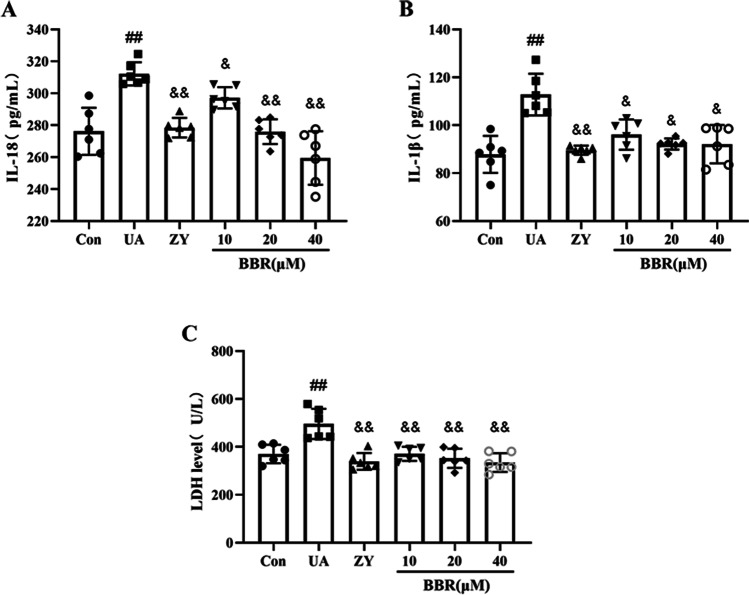
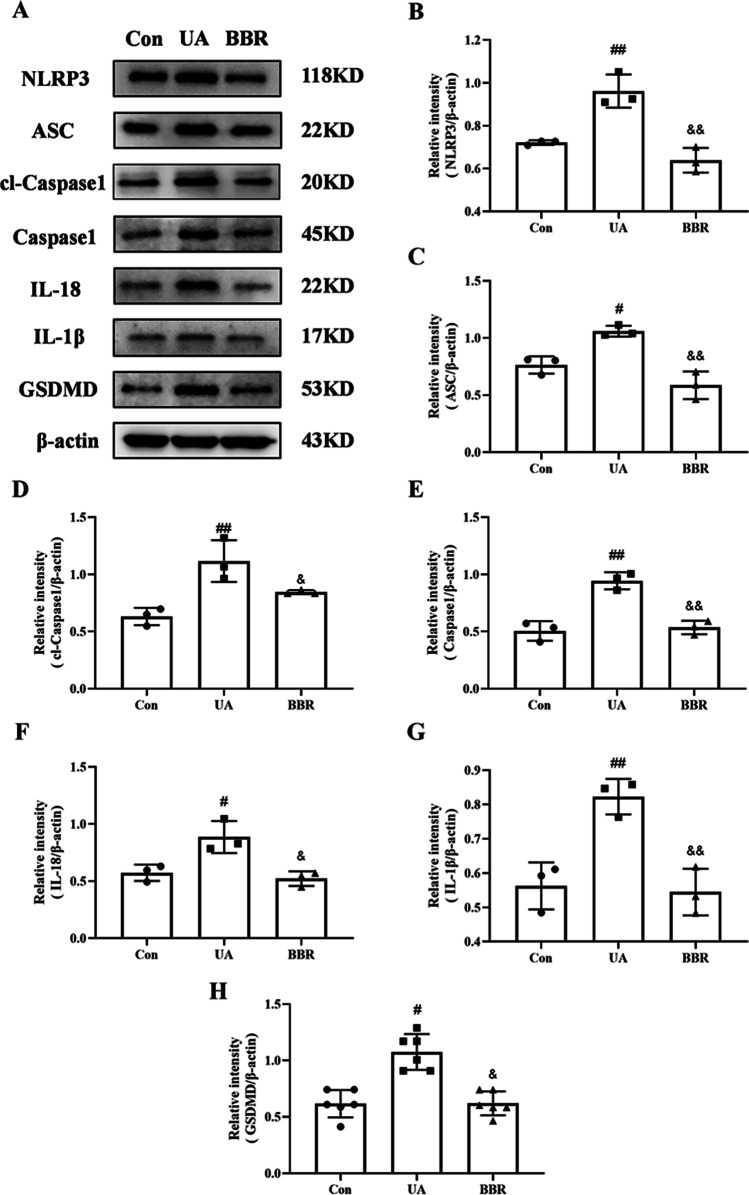
Hyperuricemia (HUA) is a common chronic metabolic disease that can cause renal failure and even death in severe cases. Berberine (BBR) is an isoquinoline alkaloid derived from Phellodendri Cortex with strong antioxidant, anti-inflammatory, and anti-apoptotic properties. The purpose of this study was to investigate the protective effects of berberine (BBR) against uric acid (UA)-induced HK-2 cells and unravel their regulatory potential mechanisms. The CCK8 assay was carried out to detect cell viability. The expression levels of inflammatory factors interleukin-1β (IL-1β) and interleukin-18 (IL-18) and Lactate dehydrogenase (LDH) were measured using Enzyme-linked immunosorbent assays (ELISA). The expression of the apoptosis-related protein (cleaved-Caspase3, cleaved-Caspase9, BAX, BCL-2) was detected by western blot. The effects of BBR on the activities of the NOD-like receptor family pyrin domain containing 3 (NLRP3) and the expression of the downstream genes were determined by RT-PCR and western blot in HK-2 cells. From the data, BBR significantly reversed the up-regulation of inflammatory factors (IL-1β, IL-18) and LDH. Furthermore, BBR down-regulated protein expression of pro-apoptotic proteins BAX, cleaved caspase3 (cl-Caspase3), cleaved caspase9 (cl-Caspase9), and enhanced the expression of antiapoptotic protein BCL-2. Simultaneously, BBR inhibited the activated NLPR3 and reduced the mRNA levels of NLRP3, Caspase1, IL-18, and IL-1β. Also, BBR attenuated the expression of NLRP3 pathway-related proteins (NLRP3, ASC, Caspase1, cleaved-Caspase1, IL-18, IL-1β, and GSDMD). Furthermore, specific NLRP3-siRNA efficiently blocked UA-induced the level of inflammatory factors (IL-1β, IL-18) and LDH and further inhibited activated NLRP3 pathway. Collectively, our results suggested that BBR can alleviate cell injury induced by UA. The underlying unctionary mechanism may be through the NLRP3 signaling pathway.
高尿酸血症(HUA)是一种常见的慢性代谢性疾病,严重时可导致肾衰竭甚至死亡。小檗碱(BBR)是一种从黄柏皮中提取的异喹啉生物碱,具有很强的抗氧化、抗炎和抗凋亡作用。本研究旨在探讨小檗碱(BBR)对尿酸(UA)诱导的 HK-2 细胞的保护作用,并揭示其调节机制。通过 CCK8 法检测细胞活力。采用酶联免疫吸附试验(ELISA)法测定炎症因子白细胞介素-1β(IL-1β)和白细胞介素-18(IL-18)和乳酸脱氢酶(LDH)的表达水平。通过 Western blot 检测凋亡相关蛋白(cleaved-Caspase3、cleaved-Caspase9、BAX、BCL-2)的表达。通过 RT-PCR 和 Western blot 检测 BBR 对 HK-2 细胞 NLRP3 及其下游基因活性和表达的影响。结果表明,BBR 可显著逆转炎症因子(IL-1β、IL-18)和 LDH 的上调。此外,BBR 下调促凋亡蛋白 BAX、cleaved caspase3(cl-Caspase3)、cleaved caspase9(cl-Caspase9)的蛋白表达,增强抗凋亡蛋白 BCL-2 的表达。同时,BBR 抑制激活的 NLPR3,降低 NLRP3、Caspase1、IL-18 和 IL-1β的 mRNA 水平。此外,BBR 还减弱了 NLRP3 通路相关蛋白(NLRP3、ASC、Caspase1、cleaved-Caspase1、IL-18、IL-1β 和 GSDMD)的表达。此外,特异性 NLRP3-siRNA 有效阻断 UA 诱导的炎症因子(IL-1β、IL-18)和 LDH 水平,并进一步抑制激活的 NLRP3 通路。综上所述,BBR 可减轻 UA 诱导的细胞损伤,其作用机制可能与 NLRP3 信号通路有关。