Leiden Institute of Chemistry, Leiden University, PO Box 9502, 2300 RA Leiden, The Netherlands.
Phys Chem Chem Phys. 2023 May 31;25(21):14862-14868. doi: 10.1039/d3cp01215h.
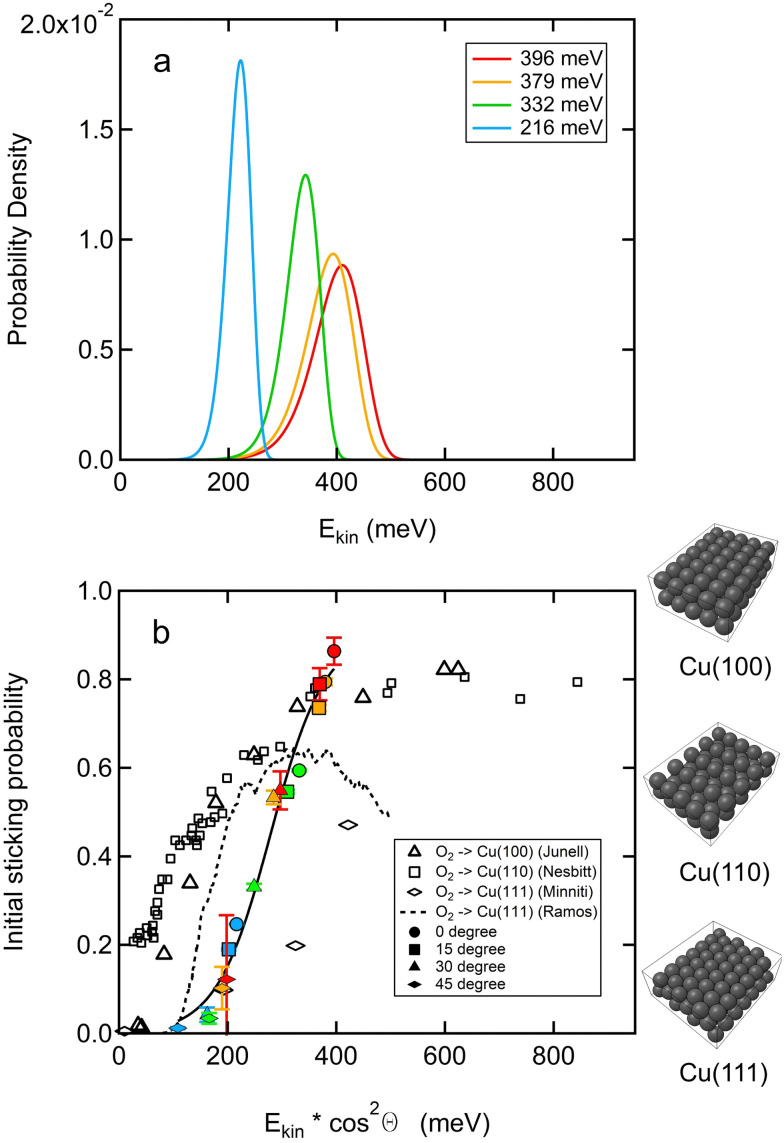
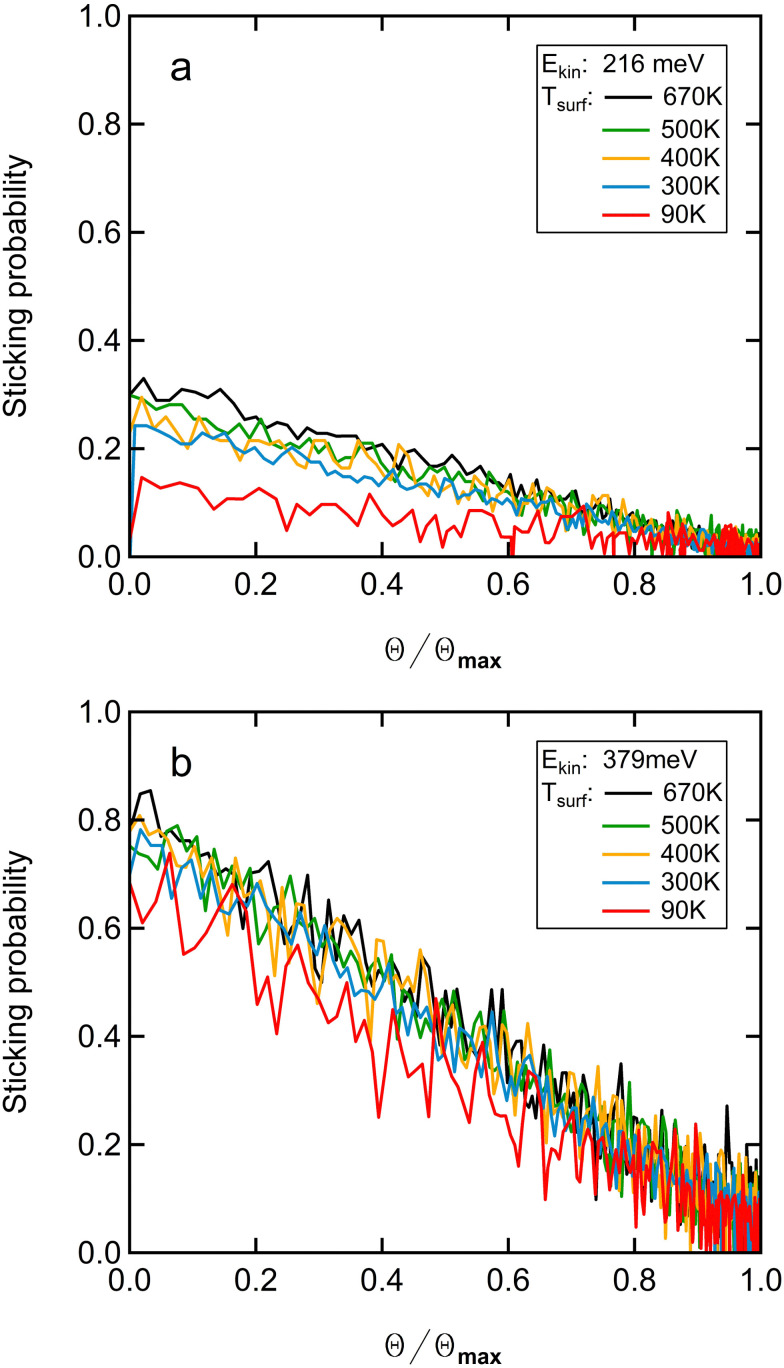
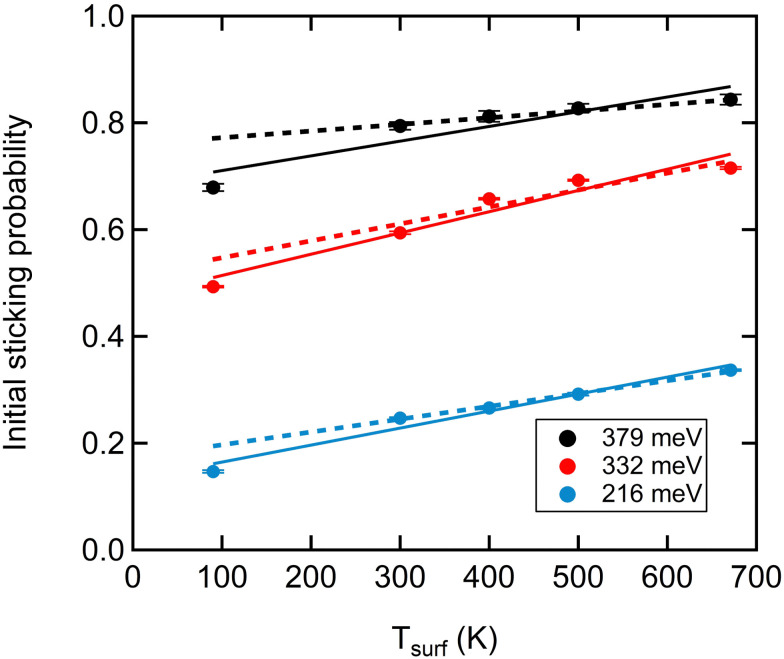
We have studied the adsorption of O on Cu(111) using supersonic molecular beam techniques. For incident energies ranging between 100 and 400 meV, we have determined the sticking probability as a function of angle of incidence, surface temperature, and coverage. Initial sticking probabilities range from near 0 to 0.85 with an onset near 100 meV, making Cu(111) considerably less reactive than Cu(110) and Cu(100). Normal energy scaling applies and reactivity increases appreciably over the entire range of surface temperatures from 90 to 670 K. A strictly linearly decreasing coverage dependence on sticking precludes adsorption and dissociation an extrinsic or long-lived mobile precursor state. We cannot exclude that sticking also occurs molecularly at the lowest surface temperatures. However, all tell tales from our experiments suggest that sticking is predominantly direct and dissociative. Comparison to earlier data shows implications for the relative reactivity of Cu(111) Cu/Ru(0001) overlayers.
我们使用超声分子束技术研究了 O 在 Cu(111) 上的吸附。对于入射能量在 100 到 400 meV 之间的情况,我们确定了作为入射角、表面温度和覆盖率函数的粘附概率。初始粘附概率从接近 0 到 0.85 不等,起始于近 100 meV,这使得 Cu(111)比 Cu(110)和 Cu(100)的反应性差得多。正常的能量标度适用,反应性在从 90 到 670 K 的整个表面温度范围内显著增加。粘附对覆盖率的严格线性依赖性排除了吸附和离解——一种外在的或长寿命的可移动前体状态。我们不能排除在最低的表面温度下也会发生分子粘附。然而,我们所有的实验迹象都表明,粘附主要是直接的和离解的。与早期数据的比较表明了 Cu(111)与 Cu/Ru(0001)覆盖层的相对反应性的含义。