Center for Cardiometabolic Science, Louisville, Kentucky, USA.
Christina Lee Brown Envirome Institute, Louisville, Kentucky, USA.
J Cachexia Sarcopenia Muscle. 2023 Aug;14(4):1802-1814. doi: 10.1002/jcsm.13258. Epub 2023 May 18.
Muscle wasting during cancer cachexia is mediated by protein degradation via autophagy and ubiquitin-linked proteolysis. These processes are sensitive to changes in intracellular pH ([pH] ) and reactive oxygen species, which in skeletal muscle are partly regulated by histidyl dipeptides, such as carnosine. These dipeptides, synthesized by the enzyme carnosine synthase (CARNS), remove lipid peroxidation-derived aldehydes, and buffer [pH] . Nevertheless, their role in muscle wasting has not been studied.
Histidyl dipeptides in the rectus abdominis (RA) muscle and red blood cells (RBCs) of male and female controls (n = 37), weight stable (WS: n = 35), and weight losing (WL; n = 30) upper gastrointestinal cancer (UGIC) patients, were profiled by LC-MS/MS. Expression of enzymes and amino acid transporters, involved in carnosine homeostasis, was measured by Western blotting and RT-PCR. Skeletal muscle myotubes were treated with Lewis lung carcinoma conditioned medium (LLC CM), and β-alanine to study the effects of enhancing carnosine production on muscle wasting.
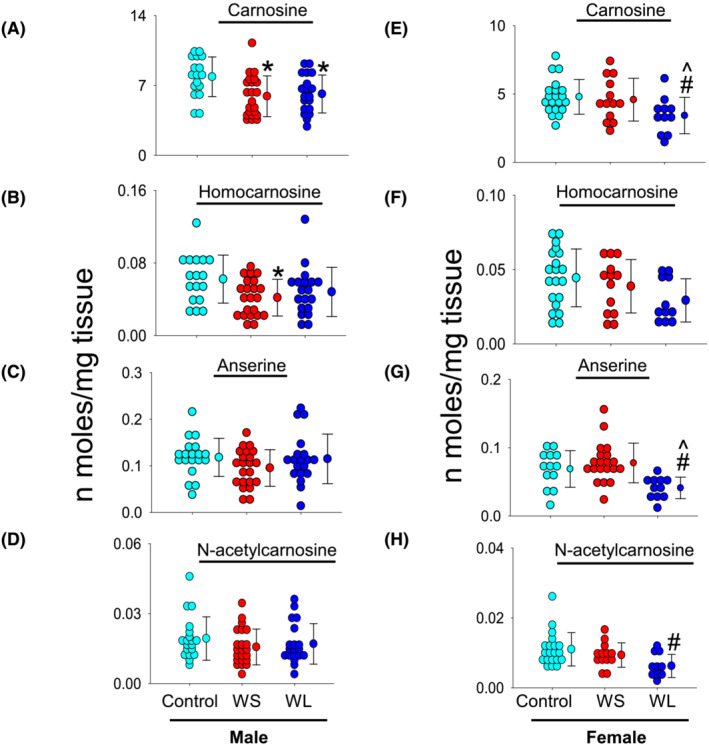
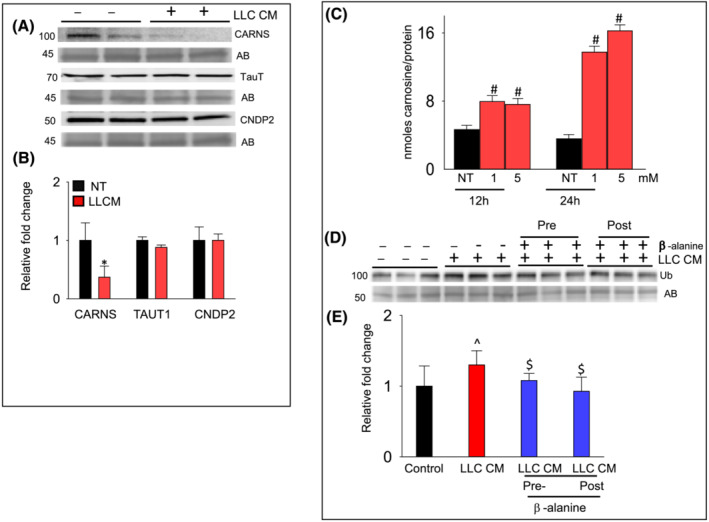
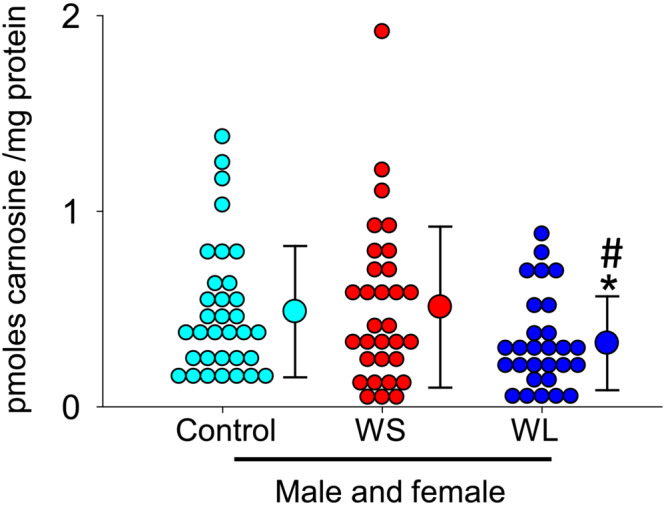
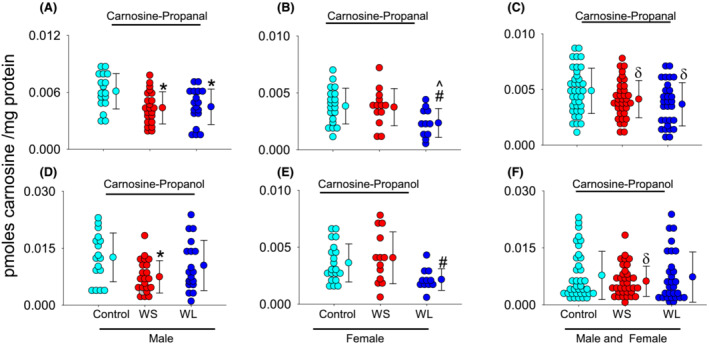
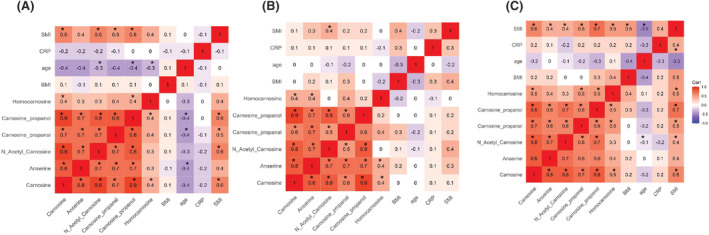
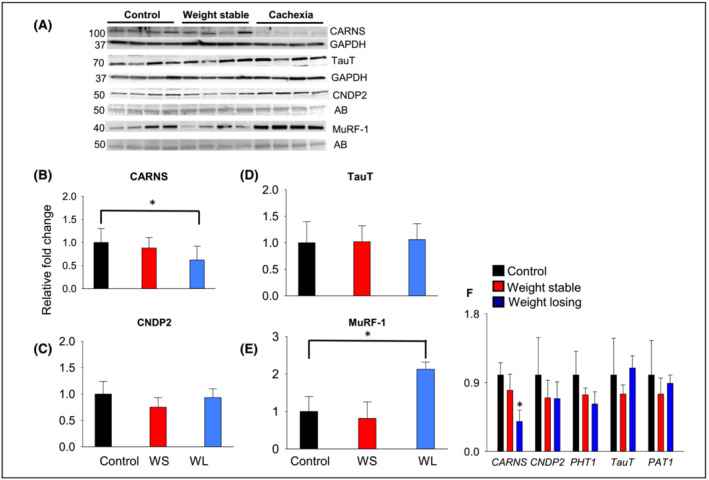
Carnosine was the predominant dipeptide present in the RA muscle. In controls, carnosine levels were higher in men (7.87 ± 1.98 nmol/mg tissue) compared with women (4.73 ± 1.26 nmol/mg tissue; P = 0.002). In men, carnosine was significantly reduced in both the WS (5.92 ± 2.04 nmol/mg tissue, P = 0.009) and WL (6.15 ± 1.90 nmol/mg tissue; P = 0.030) UGIC patients, compared with controls. In women, carnosine was decreased in the WL UGIC (3.42 ± 1.33 nmol/mg tissue; P = 0.050), compared with WS UGIC patients (4.58 ± 1.57 nmol/mg tissue), and controls (P = 0.025). Carnosine was significantly reduced in the combined WL UGIC patients (5.12 ± 2.15 nmol/mg tissue) compared with controls (6.21 ± 2.24 nmol/mg tissue; P = 0.045). Carnosine was also significantly reduced in the RBCs of WL UGIC patients (0.32 ± 0.24 pmol/mg protein), compared with controls (0.49 ± 0.31 pmol/mg protein, P = 0.037) and WS UGIC patients (0.51 ± 0.40 pmol/mg protein, P = 0.042). Depletion of carnosine diminished the aldehyde-removing ability in the muscle of WL UGIC patients. Carnosine levels were positively associated with decreases in skeletal muscle index in the WL UGIC patients. CARNS expression was decreased in the muscle of WL UGIC patients and myotubes treated with LLC-CM. Treatment with β-alanine, a carnosine precursor, enhanced endogenous carnosine production and decreased ubiquitin-linked protein degradation in LLC-CM treated myotubes.
Depletion of carnosine could contribute to muscle wasting in cancer patients by lowering the aldehyde quenching abilities. Synthesis of carnosine by CARNS in myotubes is particularly affected by tumour derived factors and could contribute to carnosine depletion in WL UGIC patients. Increasing carnosine in skeletal muscle may be an effective therapeutic intervention to prevent muscle wasting in cancer patients.
癌症恶病质过程中肌肉的消耗是通过自噬和泛素化蛋白降解介导的蛋白质降解。这些过程对细胞内 pH ([pH]) 和活性氧的变化敏感,而在骨骼肌中,这些变化部分受到组氨酸二肽的调节,如肌肽。这些二肽由肌肽合酶 (CARNS) 合成,可去除脂质过氧化衍生的醛,并缓冲 [pH]。然而,它们在肌肉消耗中的作用尚未得到研究。
通过 LC-MS/MS 对男性和女性对照组(n=37)、体重稳定(WS:n=35)和体重减轻(WL;n=30)上消化道癌症(UGIC)患者的腹直肌(RA)肌肉和红细胞(RBC)中的组氨酸二肽进行分析。通过 Western blot 和 RT-PCR 测量参与肌肽稳态的酶和氨基酸转运体的表达。用 Lewis 肺癌条件培养基(LLC CM)和 β-丙氨酸处理骨骼肌肌管,以研究增强肌肽生成对肌肉消耗的影响。
肌肽是 RA 肌肉中主要的二肽。在对照组中,男性的肌肽水平(7.87±1.98 nmol/mg 组织)高于女性(4.73±1.26 nmol/mg 组织;P=0.002)。在男性中,WS(5.92±2.04 nmol/mg 组织,P=0.009)和 WL(6.15±1.90 nmol/mg 组织;P=0.030)UGIC 患者的肌肽均明显降低,与对照组相比。在女性中,WL UGIC 患者的肌肽(3.42±1.33 nmol/mg 组织;P=0.050)与 WS UGIC 患者(4.58±1.57 nmol/mg 组织)和对照组(P=0.025)相比有所降低。与对照组(6.21±2.24 nmol/mg 组织)相比,WL UGIC 患者的肌肽(5.12±2.15 nmol/mg 组织)明显降低(P=0.045)。WL UGIC 患者的 RBC 中肌肽也明显降低(0.32±0.24 pmol/mg 蛋白),与对照组(0.49±0.31 pmol/mg 蛋白,P=0.037)和 WS UGIC 患者(0.51±0.40 pmol/mg 蛋白,P=0.042)相比。肌肽的耗竭降低了 WL UGIC 患者肌肉中的醛清除能力。肌肽水平与 WL UGIC 患者骨骼肌指数的下降呈正相关。WL UGIC 患者的肌肉和用 LLC-CM 处理的肌管中 CARNS 的表达减少。用肌肽前体 β-丙氨酸处理可增强内源性肌肽的产生,并减少 LLC-CM 处理的肌管中泛素化蛋白的降解。
肌肽的耗竭可能通过降低醛的淬灭能力导致癌症患者的肌肉消耗。肌管中 CARNS 合成的肌肽特别受到肿瘤衍生因素的影响,可能导致 WL UGIC 患者的肌肽耗竭。增加骨骼肌中的肌肽可能是预防癌症患者肌肉消耗的有效治疗干预措施。