College of Medicine, University of Central Florida Orlando, Orlando, FL, USA.
Hull York Medical School, University of York, York, UK.
Childs Nerv Syst. 2023 Jul;39(7):1821-1829. doi: 10.1007/s00381-023-05988-z. Epub 2023 May 18.
Globally, spina bifida (SB) occurs more often in low- and middle-income countries, where the healthcare demands are often quite challenging. Several social/societal issues and/or lack of government support makes for incomplete SB management in many areas. Clearly, neurosurgeons should be knowledgeable about initial closure techniques and the basics of SB management, but must also advocate for the patients outside our immediate scope of care.
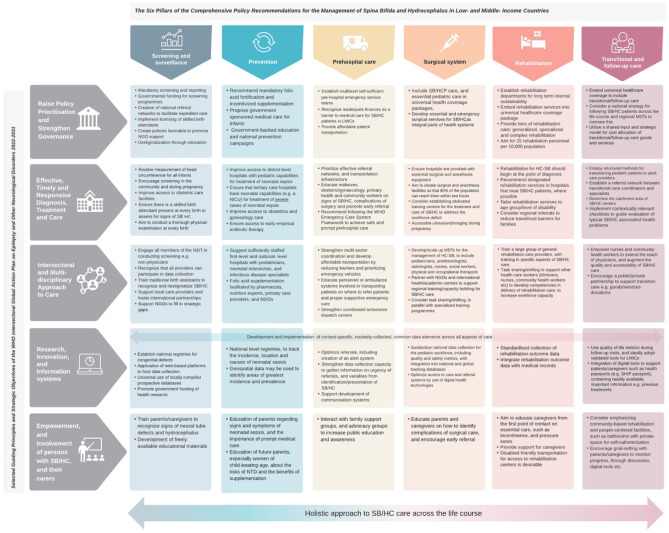
Recently, the Comprehensive Policy Recommendations for the Management of Spina Bifida and Hydrocephalus in Low- and Middle-Income Countries (CHYSPR) and the Intersectoral Global Action Plan on Epilepsy and other Neurological Disorders (IGAP) publications emphasized the need for a more unified approach to SB care. Although both documents discuss other neurological conditions, they support SB as a congenital malformation needing attention.
We identified several similarities for comprehensive SB care in these approaches - including education, governance, advocacy, and the need for continuum of care. Prevention was recognized as the most important aspect for SB going forward. A significant return of investment was noted, and both documents recommend more active neurosurgical involvement (i.e., folic acid fortification).
A new call for holistic and comprehensive care for SB management is recognized. Neurosurgeons are called upon to use solid science to educate governments and actively participate to advocate for better care and most importantly, prevention. Folic acid fortification schemes are mandatory and neurosurgeons should advocate for global strategies.
在全球范围内,脊柱裂(SB)在中低收入国家更为常见,这些国家的医疗保健需求往往极具挑战性。由于存在一些社会/社会问题和/或缺乏政府支持,许多地区的 SB 管理都不完整。显然,神经外科医生应该了解初始闭合技术和 SB 管理的基础知识,但也必须为超出我们直接护理范围的患者发声。
最近,《中低收入国家管理脊柱裂和脑积水综合政策建议》(CHYSPR)和《癫痫和其他神经系统疾病部门间全球行动计划》(IGAP)出版物强调了需要更统一的 SB 护理方法。尽管这两个文件都讨论了其他神经系统疾病,但它们都支持将 SB 作为一种需要关注的先天性畸形。
我们在这些方法中发现了全面 SB 护理的几个相似之处,包括教育、治理、宣传以及连续性护理的需求。预防被认为是 SB 未来最重要的方面。人们注意到了显著的投资回报,这两个文件都建议更积极地让神经外科参与(即叶酸强化)。
人们认识到需要对 SB 管理进行全面综合护理。神经外科医生被要求利用扎实的科学知识来教育政府,并积极参与倡导更好的护理,更重要的是倡导预防。叶酸强化计划是强制性的,神经外科医生应该倡导全球战略。