Department of Nutritional Sciences, Temerty Faculty of Medicine, University of Toronto, Toronto, Ontario, Canada.
Joannah & Brian Lawson Centre for Child Nutrition, University of Toronto, Toronto, Ontario, Canada.
PLoS One. 2023 May 18;18(5):e0285095. doi: 10.1371/journal.pone.0285095. eCollection 2023.
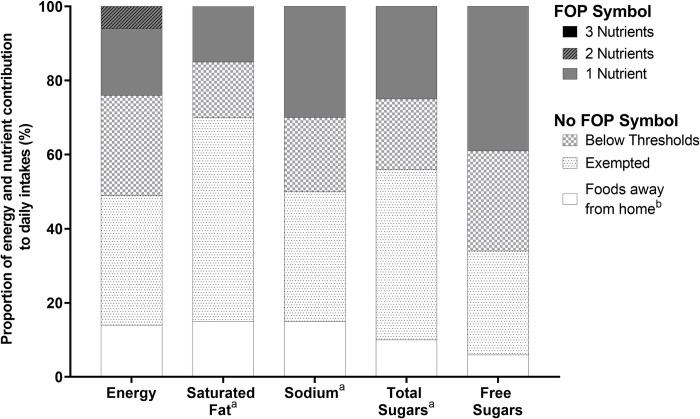
Canada recently mandated front-of-pack (FOP) labelling regulations, where foods meeting and/or exceeding recommended thresholds for nutrients-of-concern (i.e., saturated fat, sodium, and sugars) must display a 'high-in' FOP nutrition symbol. However, there is limited research on the amounts and sources of foods consumed by Canadians that would require a FOP symbol. The objective was to examine the intakes of nutrients-of-concern from foods that would display a FOP symbol and to identify the top food categories contributing to intakes for each nutrient-of-concern. Using the first day 24-hour dietary recall from the nationally representative 2015 Canadian Community Health Survey-Nutrition (CCHS), Canadian adults' intakes of nutrients-of-concern from foods that would display a FOP symbol was examined. Foods were assigned to 1 of 62 categories to identify the top food categories contributing to intakes of energy and nutrient-of-concern that would display a FOP symbol for each nutrient-of-concern. Canadian adults (n = 13,495) consumed approximately 24% of total calories from foods that would display a FOP symbol. Foods that would display a FOP symbol for exceeding thresholds for nutrients-of-concern accounted for 16% of saturated fat, 30% of sodium, 25% of total sugar, and 39% of free sugar intakes among Canadian adults. The top food category contributing intakes of each nutrient-of-concern that would display a FOP symbol were nutrient-specific: Processed meat and meat substitutes for saturated fat; Breads for sodium; and Fruit juices & drinks for total and free sugars. Our findings show that Canadian FOP labelling regulations have the potential to influence the intakes of nutrients-of-concern for Canadian adults. Using the findings as baseline data, future studies are warranted to evaluate the impact of FOP labelling regulations.
加拿大最近颁布了一项强制性的食品标签法规,要求对那些营养成分含量(即饱和脂肪、钠和糖)超过推荐标准的食品,必须贴上一个“高”营养标签符号。然而,对于需要贴此类标签的加拿大食品的摄入量和来源,目前研究还很有限。本研究旨在评估那些需要贴上营养标签符号的食品中营养成分的摄入量,并确定每种营养成分的主要食物来源。研究采用 2015 年加拿大全国代表性社区健康调查-营养调查(CCHS)中第一天的 24 小时膳食回顾,对加拿大成年人从需贴营养标签符号的食品中摄入的营养成分进行了评估。为了确定对每种营养成分的摄入量有贡献的主要食物类别,将食品归入 62 个类别中的 1 个类别。加拿大成年人(n=13495)从需要贴营养标签符号的食品中摄入了大约 24%的总卡路里。对于那些营养成分含量超过推荐标准的食品,需要贴上营养标签符号,其饱和脂肪占 16%,钠占 30%,总糖占 25%,游离糖占 39%。对每种需要贴上营养标签符号的营养成分摄入量贡献最大的食物类别因营养成分而异:加工肉类和肉类替代品与饱和脂肪有关;面包与钠有关;水果汁和饮料与总糖和游离糖有关。研究结果表明,加拿大的营养标签法规有可能影响加拿大成年人对营养成分的摄入量。作为基线数据,未来的研究有必要评估营养标签法规的影响。