Green Sophie M C, Lloyd Kelly E, Smith Samuel G
Leeds Institute of Health Sciences, University of Leeds, LS2 9LU, UK.
Prev Med Rep. 2023 Apr 25;34:102220. doi: 10.1016/j.pmedr.2023.102220. eCollection 2023 Aug.
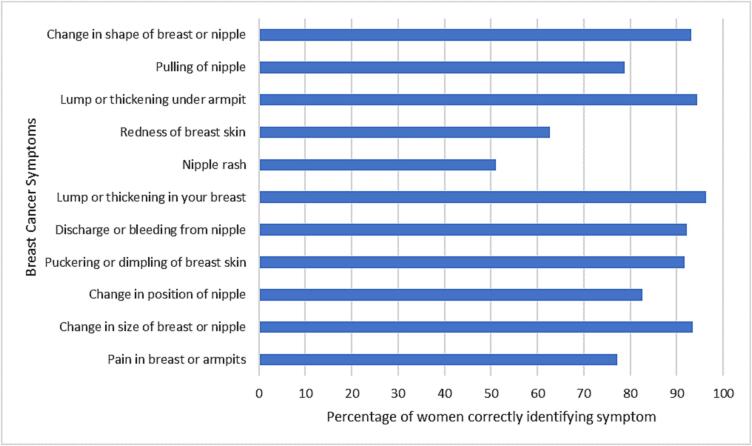
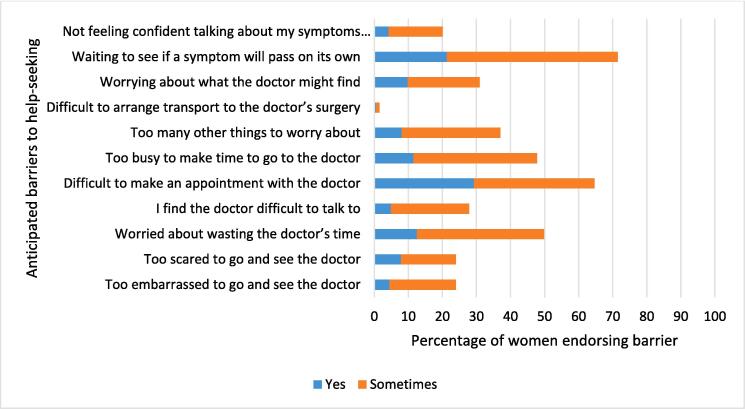
Women with a family history of breast cancer have an increased lifetime risk of the disease. Delay in symptom presentation can lead to poorer outcomes. Low awareness of breast cancer symptoms and help-seeking barriers have been associated with delay in presentation in the general population. Symptom awareness and help-seeking barriers among women at increased risk of breast cancer are unknown. We conducted analysis of survey data which included women with moderate and high risk of breast cancer from 20 secondary and tertiary care clinics in England (n = 408). Women completed a validated survey assessing breast cancer symptom awareness, barriers to help-seeking and anticipated delay in help-seeking. Women recognised an average of 9.1/11 breast cancer symptoms (SD = 2.1). Nipple rash was the least recognised symptom (51.0%). Women educated to at least degree level had higher awareness than those with lower education (β = 0.14, 95% CI 0.13, 0.99, = 0.011). Women at lower socioeconomic status (SES) had lower awareness than those at higher SES (β = -0.13, 95% CI -1.09, -0.07, = 0.027). Women reported several anticipated help-seeking barriers (mean = 4.0/11, SD = 2.8). Waiting to see if a symptom will pass was the most commonly reported barrier to help-seeking (71.5%). Most women (376/408; 92.2%) reported that they would seek medical help within 2 weeks of discovering a breast cancer symptom. Interventions to increase awareness of non-lump breast cancer symptoms and reduce help-seeking barriers are needed, with considerations of appropriate reading levels and modalities for women with lower education and SES.
有乳腺癌家族史的女性一生中患该病的风险会增加。症状出现的延迟会导致更差的预后。在普通人群中,对乳腺癌症状的认知不足和寻求帮助的障碍与症状出现的延迟有关。乳腺癌风险增加的女性对症状的认知和寻求帮助的障碍尚不清楚。我们对调查数据进行了分析,这些数据来自英格兰20家二级和三级护理诊所中患乳腺癌风险为中度和高度的女性(n = 408)。女性完成了一项经过验证的调查,评估乳腺癌症状认知、寻求帮助的障碍以及寻求帮助时预期的延迟。女性平均能识别出11种乳腺癌症状中的9.1种(标准差 = 2.1)。乳头皮疹是最不易被识别的症状(51.0%)。受过至少大学教育的女性比受教育程度较低的女性认知度更高(β = 0.14,95%置信区间0.13,0.99,P = 0.011)。社会经济地位较低(SES)的女性比社会经济地位较高的女性认知度更低(β = -0.13,95%置信区间-1.09,-0.07,P = 0.027)。女性报告了几种预期的寻求帮助的障碍(平均 = 11种中的4.0种,标准差 = 2.8)。等待观察症状是否会自行消失是最常报告的寻求帮助的障碍(71.5%)。大多数女性(376/408;92.2%)报告说,她们会在发现乳腺癌症状后的2周内寻求医疗帮助。需要采取干预措施来提高对非肿块性乳腺癌症状的认知并减少寻求帮助的障碍,同时要考虑到教育程度和社会经济地位较低女性的适当阅读水平和方式。