El Boujnouni Najoua, van der Bent M Leontien, Willemse Marieke, 't Hoen Peter A C, Brock Roland, Wansink Derick G
Department of Medical BioSciences, Research Institute for Medical Innovation, Radboud University Medical Center, 6525 GA Nijmegen, the Netherlands.
Department of Medical Biochemistry, College of Medicine and Medical Sciences, Arabian Gulf University, Manama 293, Bahrain.
Mol Ther Nucleic Acids. 2023 Apr 20;32:622-636. doi: 10.1016/j.omtn.2023.04.010. eCollection 2023 Jun 13.
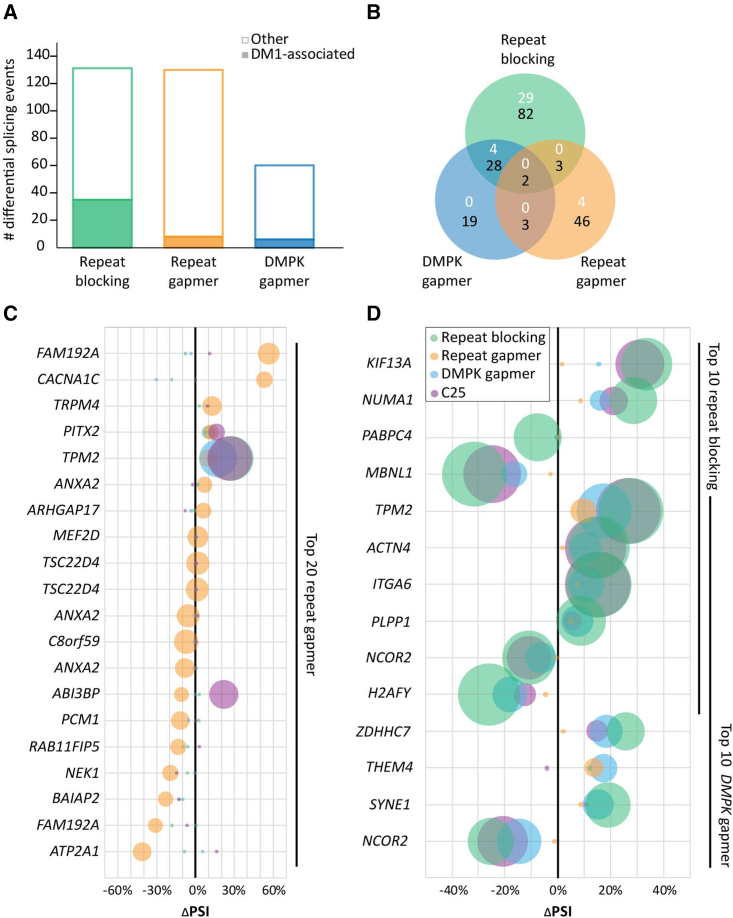
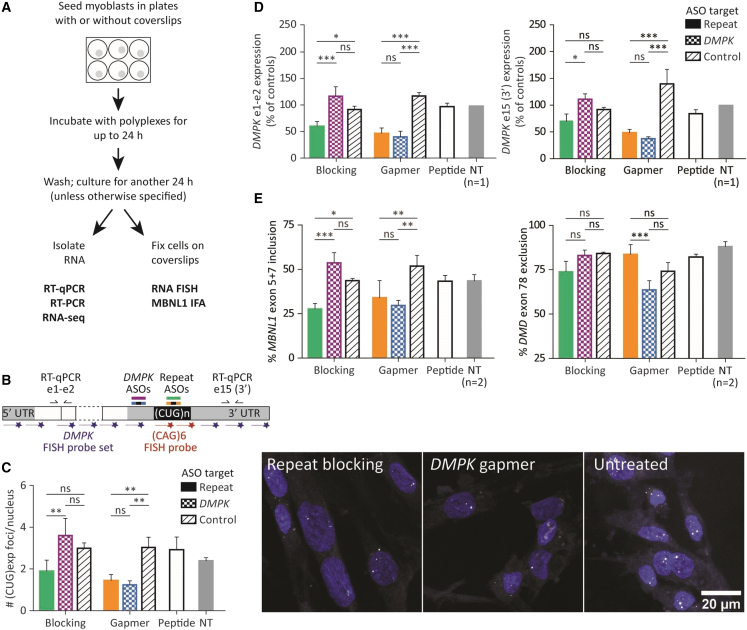
Antisense oligonucleotide (ASO) therapies for myotonic dystrophy type 1 (DM1) are based on elimination of transcripts containing an expanded repeat or inhibition of sequestration of RNA-binding proteins. This activity is achievable by both degradation of expanded transcripts and steric hindrance, although it is unknown which approach is superior. We compared blocking ASOs with RNase H-recruiting gapmers of equivalent chemistries. Two target sequences were selected: the triplet repeat and a unique sequence upstream thereof. We assessed ASO effects on transcript levels, ribonucleoprotein foci and disease-associated missplicing, and performed RNA sequencing to investigate on- and off-target effects. Both gapmers and the repeat blocker led to significant knockdown and a reduction in (CUG) foci. However, the repeat blocker was more effective in MBNL1 protein displacement and had superior efficiency in splicing correction at the tested dose of 100 nM. By comparison, on a transcriptome level, the blocking ASO had the fewest off-target effects. In particular, the off-target profile of the repeat gapmer asks for cautious consideration in further therapeutic development. Altogether, our study demonstrates the importance of evaluating both on-target and downstream effects of ASOs in a DM1 context, and provides guiding principles for safe and effective targeting of toxic transcripts.
用于1型强直性肌营养不良症(DM1)的反义寡核苷酸(ASO)疗法基于消除含有扩增重复序列的转录本或抑制RNA结合蛋白的隔离。尽管尚不清楚哪种方法更具优势,但通过降解扩增转录本和空间位阻都可以实现这种活性。我们比较了具有等效化学性质的阻断ASO与招募RNase H的缺口嵌合体。选择了两个靶序列:三联体重复序列及其上游的一个独特序列。我们评估了ASO对转录本水平、核糖核蛋白病灶和疾病相关剪接错误的影响,并进行了RNA测序以研究靶向和脱靶效应。缺口嵌合体和重复序列阻断剂均导致显著的敲低和(CUG)病灶减少。然而,在100 nM的测试剂量下,重复序列阻断剂在MBNL1蛋白置换方面更有效,并且在剪接校正方面具有更高的效率。相比之下,在转录组水平上,阻断ASO的脱靶效应最少。特别是,重复缺口嵌合体的脱靶情况在进一步的治疗开发中需要谨慎考虑。总之,我们的研究证明了在DM1背景下评估ASO的靶向和下游效应的重要性,并为安全有效地靶向毒性转录本提供了指导原则。