Division of Rheumatology, Department of Medicine, Icahn School of Medicine at Mount Sinai, New York, NY, 10029, United States.
Department of Molecular Physiology and Biophysics, Baylor College of Medicine, Houston, TX, 77030, United States.
EBioMedicine. 2023 Jun;92:104603. doi: 10.1016/j.ebiom.2023.104603. Epub 2023 May 16.
Rheumatoid arthritis (RA) is a common autoimmune disease with emerging environmental and microbiome risk factors. The western diet is typically deficient in magnesium (Mg), and there is some evidence suggesting that Mg may have anti-inflammatory properties. But the actual role of Mg supplementation in arthritis or in T cell subsets has not been explored.
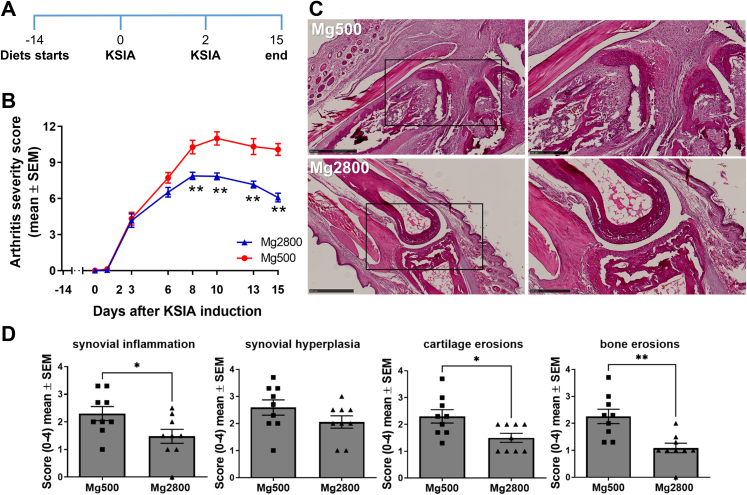
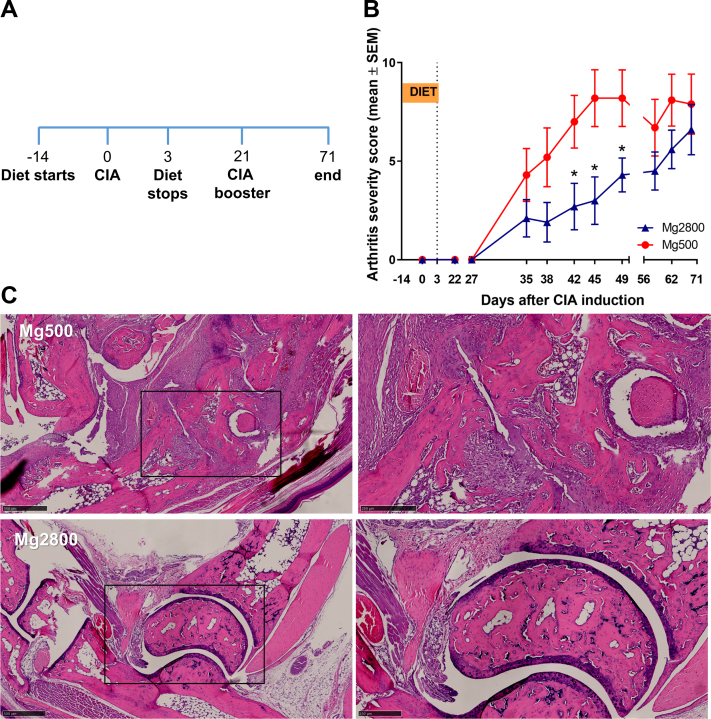
We investigated the role of a high Mg diet in two different mouse models of RA induced with the KRN serum, and collagen-induced arthritis. We also characterized the phenotypes of splenocytes, gene expression, and an extensive intestinal microbiome analyses including fecal material transplantation (FMT).
The high Mg diet group was significantly protected with reduced arthritis severity and joint damage, and reduced expression of IL-1β, IL-6, and TNFα. The high Mg group also had increased numbers of Foxp3+ Treg cells and IL-10-producing T cells. The high Mg protective effect disappeared in IL-10 knockout mice. FMT from the high Mg diet mice recreated the phenotypes seen in the diet-treated mice, with reduced arthritis severity, increased Foxp3+ Treg, and increased IL-10-producing T cells. Intestinal microbiome analyses using 16S rDNA sequencing revealed diet-specific changes, including reduced levels of RA-associated Prevotella in the high Mg group, while increasing levels of Bacteroides and other bacteria associated with increased production of short-chain fatty acids. Metagenomic analyses implicated additional pathways including L-tryptophan biosynthesis and arginine deiminase.
We describe a new role for Mg in suppressing arthritis, in expanding Foxp3+ T reg cells and in the production of IL-10, and show that these effects are mediated by the intestinal microbiome. Our discoveries suggest a novel strategy for modifying the intestinal microbiome to treat RA and other autoimmune and inflammatory diseases.
None.
类风湿性关节炎(RA)是一种常见的自身免疫性疾病,其发病风险与环境和微生物组因素有关。西方饮食通常缺乏镁(Mg),有证据表明 Mg 可能具有抗炎作用。但是,Mg 补充剂在关节炎或 T 细胞亚群中的实际作用尚未得到探索。
我们研究了高 Mg 饮食在两种不同的 RA 小鼠模型(用 KRN 血清和胶原蛋白诱导)中的作用。我们还对脾细胞表型、基因表达以及广泛的肠道微生物组分析(包括粪便移植)进行了特征描述。
高 Mg 饮食组关节炎严重程度和关节损伤明显减轻,IL-1β、IL-6 和 TNFα的表达减少。高 Mg 组 Foxp3+Treg 细胞和 IL-10 产生 T 细胞的数量也增加。IL-10 基因敲除小鼠的高 Mg 保护作用消失。来自高 Mg 饮食小鼠的粪便移植重建了饮食治疗小鼠的表型,关节炎严重程度减轻,Foxp3+Treg 增加,IL-10 产生 T 细胞增加。使用 16S rDNA 测序的肠道微生物组分析显示饮食特异性变化,包括高 Mg 组 RA 相关普雷沃氏菌水平降低,而 Bacteroides 等与短链脂肪酸产量增加相关的细菌水平增加。宏基因组分析表明,还存在其他途径,包括 L-色氨酸生物合成和精氨酸脱氨酶。
我们描述了 Mg 在抑制关节炎、扩增 Foxp3+Treg 细胞和产生 IL-10 方面的新作用,并表明这些作用是由肠道微生物组介导的。我们的发现为通过改变肠道微生物组来治疗 RA 和其他自身免疫性和炎症性疾病提供了一种新策略。
无。