Centre for Applied Health Economics, School of Medicine and Dentistry, Griffith University, 170 Kessels Road, Nathan, QLD, 4111, Australia.
Menzies Health Institute Queensland, Griffith University, Southport, QLD, Australia.
Pharmacoeconomics. 2023 Aug;41(8):913-943. doi: 10.1007/s40273-023-01276-5. Epub 2023 May 19.
Atrial fibrillation (AF) remains the most common form of cardiac arrhythmia. Management of AF aims to reduce the risk of stroke, heart failure and premature mortality via rate or rhythm control. This study aimed to review the literature on the cost effectiveness of treatment strategies to manage AF among adults living in low-, middle- and high-income countries.
We searched MEDLINE (OvidSp), Embase, Web of Science, Cochrane Library, EconLit and Google Scholar for relevant studies between September 2022 and November 2022. The search strategy involved medical subject headings or related text words. Data management and selection was performed using EndNote library. The titles and abstracts were screened followed by eligibility assessment of full texts. Selection, assessment of the risk of bias within the studies, and data extraction were conducted by two independent reviewers. The cost-effectiveness results were synthesised narratively. The analysis was performed using Microsoft Excel 365. The incremental cost effectiveness ratio for each study was adjusted to 2021 USD values.
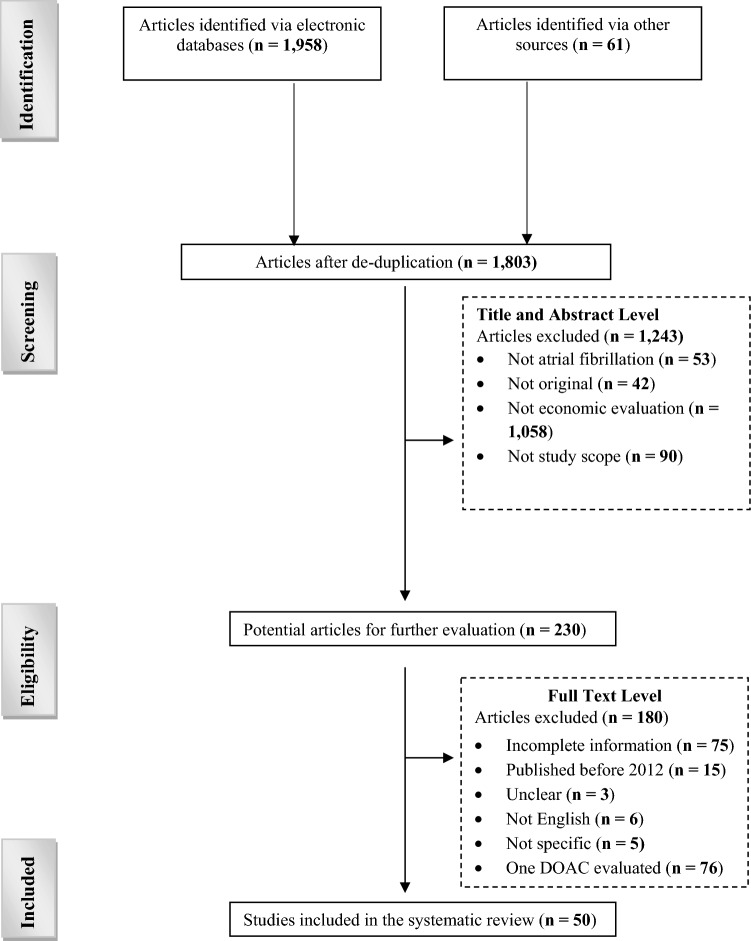
Fifty studies were included in the analysis after selection and risk of bias assessment. In high-income countries, apixaban was predominantly cost effective for stroke prevention in patients at low and moderate risk of stroke, while left atrial appendage closure (LAAC) was cost effective in patients at high risk of stroke. Propranolol was the cost-effective choice for rate control, while catheter ablation and the convergent procedure were cost-effective strategies in patients with paroxysmal and persistent AF, respectively. Among the anti-arrhythmic drugs, sotalol was the cost-effective strategy for rhythm control. In middle-income countries, apixaban was the cost-effective choice for stroke prevention in patients at low and moderate risk of stroke while high-dose edoxaban was cost effective in patients at high risk of stroke. Radiofrequency catheter ablation was the cost-effective option in rhythm control. No data were available for low-income countries.
This systematic review has shown that there are several cost-effective strategies to manage AF in different resource settings. However, the decision to use any strategy should be guided by objective clinical and economic evidence supported by sound clinical judgement.
CRD42022360590.
心房颤动(AF)仍然是最常见的心律失常形式。通过控制心率或节律,AF 的管理旨在降低中风、心力衰竭和过早死亡的风险。本研究旨在回顾管理生活在低收入、中等收入和高收入国家的成年人的 AF 的治疗策略的成本效益的文献。
我们在 2022 年 9 月至 11 月期间在 MEDLINE(OvidSp)、Embase、Web of Science、Cochrane 图书馆、EconLit 和 Google Scholar 上搜索了相关研究。搜索策略涉及医学主题词或相关文本词。使用 EndNote 库进行数据管理和选择。筛选标题和摘要,然后对全文进行资格评估。两名独立评审员进行了选择、评估研究中的偏倚风险以及数据提取。通过 Microsoft Excel 365 对成本效益结果进行综合叙述。将每项研究的增量成本效益比调整为 2021 年美元值。
经过选择和风险偏倚评估,共有 50 项研究纳入分析。在高收入国家,阿哌沙班主要对中风风险低和中度的患者预防中风具有成本效益,而左心耳封堵术(LAAC)对中风风险高的患者具有成本效益。普萘洛尔是控制心率的经济选择,而导管消融和汇聚术分别是阵发性和持续性 AF 患者的经济有效的策略。在抗心律失常药物中,索他洛尔是节律控制的经济选择。在中等收入国家,阿哌沙班是中风风险低和中度的患者预防中风的经济选择,而高剂量依度沙班对中风风险高的患者具有成本效益。射频导管消融是节律控制的经济选择。没有关于低收入国家的数据。
本系统评价表明,在不同资源环境下,有几种管理 AF 的具有成本效益的策略。然而,任何策略的使用决定都应基于客观的临床和经济证据,并辅以合理的临床判断。
CRD42022360590。