Department of Biomedical Informatics, Ajou University School of Medicine, Suwon, Gyeonggi-do, Republic of Korea.
BUD.on Inc, Jeonju, Jeollabuk-do, Republic of Korea.
Sci Rep. 2023 May 19;13(1):8108. doi: 10.1038/s41598-023-35146-z.
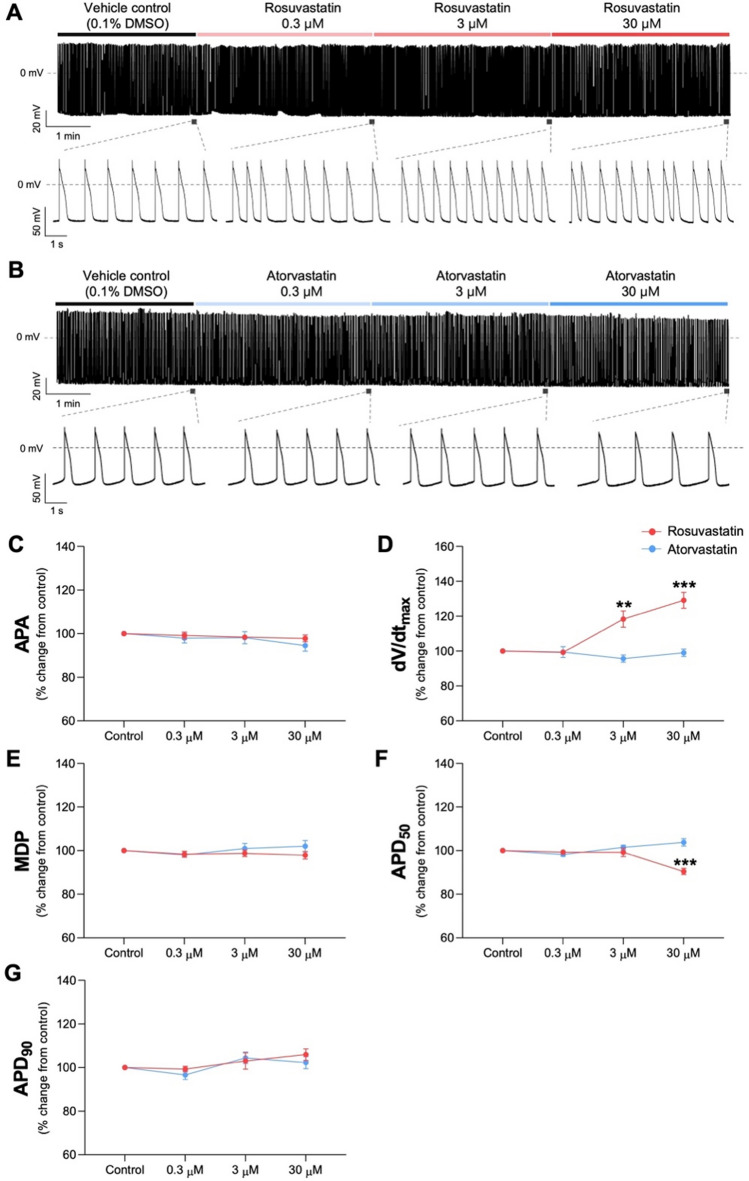
Drug-induced QT prolongation is attributed to several mechanisms, including hERG channel blockage. However, the risks, mechanisms, and the effects of rosuvastatin-induced QT prolongation remain unclear. Therefore, this study assessed the risk of rosuvastatin-induced QT prolongation using (1) real-world data with two different settings, namely case-control and retrospective cohort study designs; (2) laboratory experiments using human-induced pluripotent stem cell-derived cardiomyocytes (hiPSC-CM); (3) nationwide claim data for mortality risk evaluation. Real-world data showed an association between QT prolongation and the use of rosuvastatin (OR [95% CI], 1.30 [1.21-1.39]) but not for atorvastatin (OR [95% CI], 0.98 [0.89-1.07]). Rosuvastatin also affected the sodium and calcium channel activities of cardiomyocytes in vitro. However, rosuvastatin exposure was not associated with a high risk of all-cause mortality (HR [95% CI], 0.95 [0.89-1.01]). Overall, these results suggest that rosuvastatin use increased the risk of QT prolongation in real-world settings, significantly affecting the action potential of hiPSC-CMs in laboratory settings. Long-term rosuvastatin treatment was not associated with mortality. In conclusion, while our study links rosuvastatin use to potential QT prolongation and possible influence on the action potential of hiPSC-CMs, long-term use does not show increased mortality, necessitating further research for conclusive real-world applications.
药物引起的 QT 间期延长归因于多种机制,包括 hERG 通道阻滞。然而,瑞舒伐他汀引起的 QT 间期延长的风险、机制和影响仍不清楚。因此,本研究使用(1)具有两种不同设置的真实世界数据,即病例对照和回顾性队列研究设计;(2)使用人诱导多能干细胞衍生的心肌细胞(hiPSC-CM)的实验室实验;(3)评估死亡率风险的全国性索赔数据,评估了瑞舒伐他汀引起的 QT 间期延长的风险。真实世界的数据显示 QT 间期延长与瑞舒伐他汀的使用之间存在关联(OR [95% CI],1.30 [1.21-1.39]),但与阿托伐他汀无关(OR [95% CI],0.98 [0.89-1.07])。瑞舒伐他汀还影响体外心肌细胞的钠和钙通道活性。然而,瑞舒伐他汀暴露与全因死亡率的高风险无关(HR [95% CI],0.95 [0.89-1.01])。总体而言,这些结果表明,瑞舒伐他汀的使用增加了真实环境中 QT 间期延长的风险,这显著影响了 hiPSC-CM 中动作电位的实验室环境。长期瑞舒伐他汀治疗与死亡率无关。总之,虽然我们的研究将瑞舒伐他汀的使用与潜在的 QT 间期延长和对 hiPSC-CM 动作电位的可能影响联系起来,但长期使用并未显示出死亡率增加,需要进一步的研究以得出真实世界应用的结论。