Department of Pathology, University of Pittsburgh Medical Center, Pittsburgh, PA.
Department of Medicine, University of Pittsburgh Medical Center, Pittsburgh, PA.
Ann Surg. 2023 Oct 1;278(4):e789-e797. doi: 10.1097/SLA.0000000000005904. Epub 2023 May 22.
We report the development and validation of a combined DNA/RNA next-generation sequencing (NGS) platform to improve the evaluation of pancreatic cysts.
Despite a multidisciplinary approach, pancreatic cyst classification, such as a cystic precursor neoplasm, and the detection of high-grade dysplasia and early adenocarcinoma (advanced neoplasia) can be challenging. NGS of preoperative pancreatic cyst fluid improves the clinical evaluation of pancreatic cysts, but the recent identification of novel genomic alterations necessitates the creation of a comprehensive panel and the development of a genomic classifier to integrate the complex molecular results.
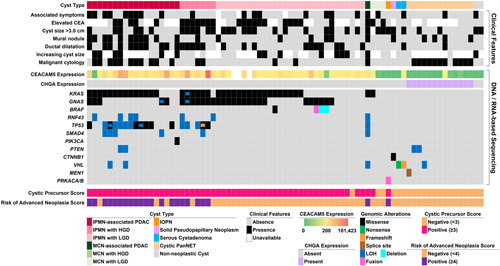
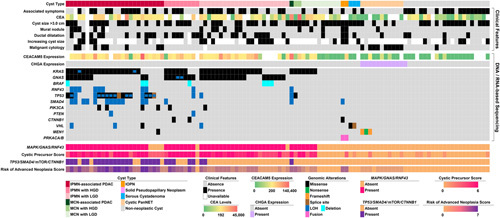
An updated and unique 74-gene DNA/RNA-targeted NGS panel (PancreaSeq Genomic Classifier) was created to evaluate 5 classes of genomic alterations to include gene mutations (e.g., KRAS, GNAS, etc.), gene fusions and gene expression. Further, CEA mRNA ( CEACAM5 ) was integrated into the assay using RT-qPCR. Separate multi-institutional cohorts for training (n=108) and validation (n=77) were tested, and diagnostic performance was compared to clinical, imaging, cytopathologic, and guideline data.
Upon creation of a genomic classifier system, PancreaSeq GC yielded a 95% sensitivity and 100% specificity for a cystic precursor neoplasm, and the sensitivity and specificity for advanced neoplasia were 82% and 100%, respectively. Associated symptoms, cyst size, duct dilatation, a mural nodule, increasing cyst size, and malignant cytopathology had lower sensitivities (41-59%) and lower specificities (56-96%) for advanced neoplasia. This test also increased the sensitivity of current pancreatic cyst guidelines (IAP/Fukuoka and AGA) by >10% and maintained their inherent specificity.
PancreaSeq GC was not only accurate in predicting pancreatic cyst type and advanced neoplasia but also improved the sensitivity of current pancreatic cyst guidelines.
我们报告了一种联合 DNA/RNA 下一代测序(NGS)平台的开发和验证,以提高对胰腺囊肿的评估。
尽管采用了多学科方法,但胰腺囊肿的分类,如囊性前体肿瘤,以及高级别发育不良和早期腺癌(高级别肿瘤)的检测仍然具有挑战性。术前胰腺囊液的 NGS 可改善胰腺囊肿的临床评估,但最近发现的新型基因组改变需要创建一个全面的面板,并开发一个基因组分类器来整合复杂的分子结果。
创建了一个更新和独特的 74 个基因 DNA/RNA 靶向 NGS 面板(PancreaSeq 基因组分类器),以评估包括基因突变(如 KRAS、GNAS 等)、基因融合和基因表达在内的 5 类基因组改变。此外,还使用 RT-qPCR 将 CEA mRNA(CEACAM5)整合到检测中。分别在培训(n=108)和验证(n=77)的多机构队列中进行了测试,并将诊断性能与临床、影像学、细胞学和指南数据进行了比较。
创建基因组分类器系统后,PancreaSeq GC 对囊性前体肿瘤的敏感性为 95%,特异性为 100%,对高级别肿瘤的敏感性和特异性分别为 82%和 100%。相关症状、囊肿大小、胆管扩张、壁结节、囊肿大小增加和恶性细胞学对高级别肿瘤的敏感性(41-59%)和特异性(56-96%)较低。该检测还提高了当前胰腺囊肿指南(IAP/Fukuoka 和 AGA)的敏感性>10%,并保持了其固有的特异性。
PancreaSeq GC 不仅能准确预测胰腺囊肿类型和高级别肿瘤,还能提高当前胰腺囊肿指南的敏感性。