Department of General Surgery, Key Laboratory of Research in Pancreatic Tumor, State Key Laboratory of Complex Severe and Rare Disease, National Science and Technology Key Infrastructure on Translational Medicine in Peking Union Medical College Hospital, Peking Union Medical College Hospital, Chinese Academy of Medical Sciences & Peking Union Medical College, Beijing, 100730, China.
Department of Medical Research Center, State Key Laboratory of Complex Severe and Rare Disease, National Science and Technology Key Infrastructure on Translational Medicine in Peking Union Medical College Hospital, Peking Union Medical College Hospital, Chinese Academy of Medical Sciences & Peking Union Medical College, Beijing, 100730, China.
Signal Transduct Target Ther. 2023 Oct 18;8(1):406. doi: 10.1038/s41392-023-01645-8.
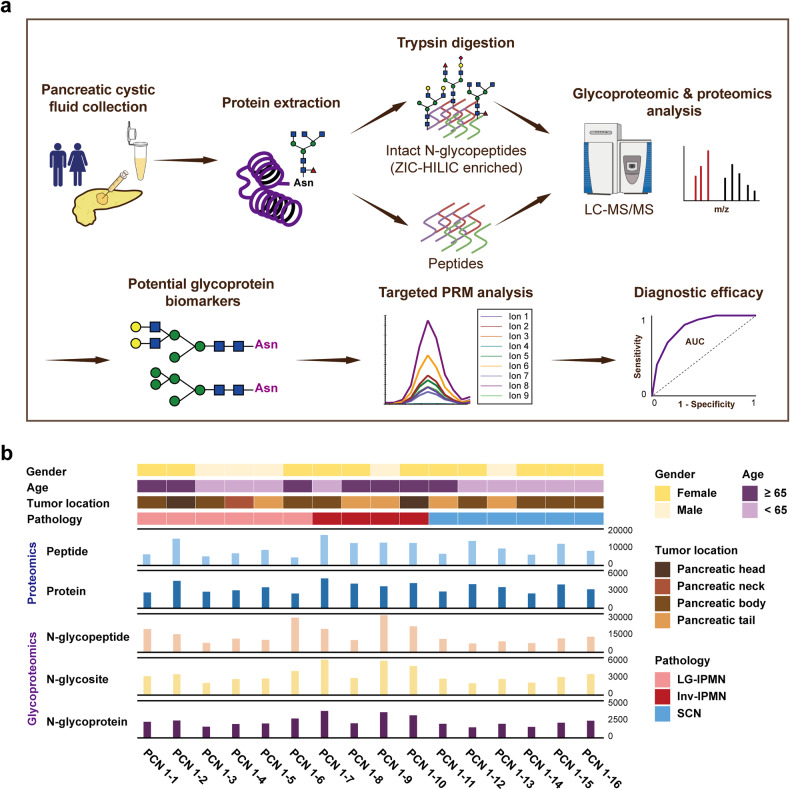
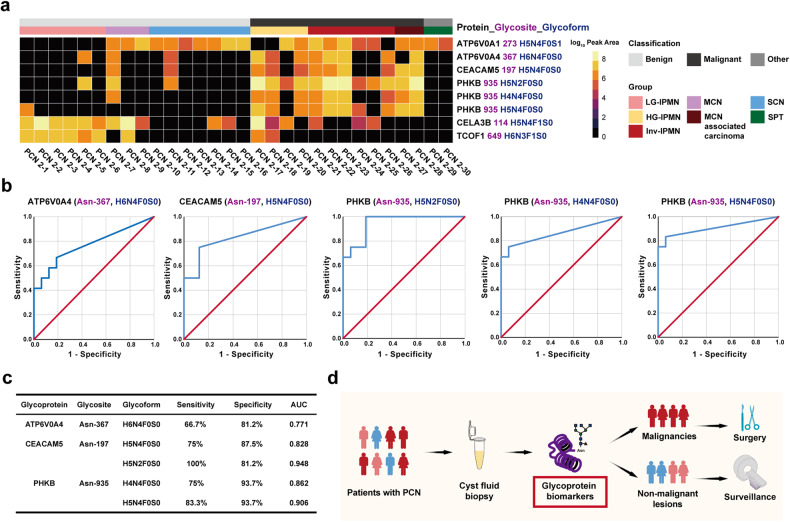
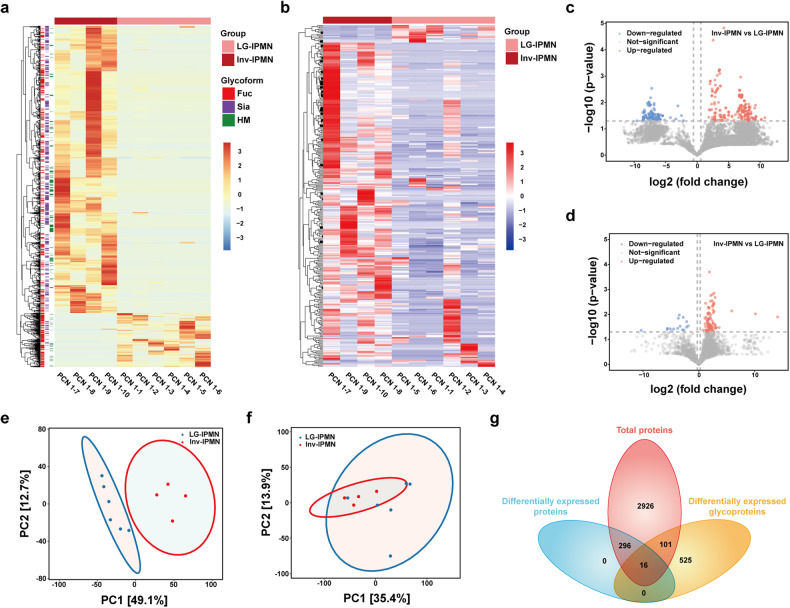
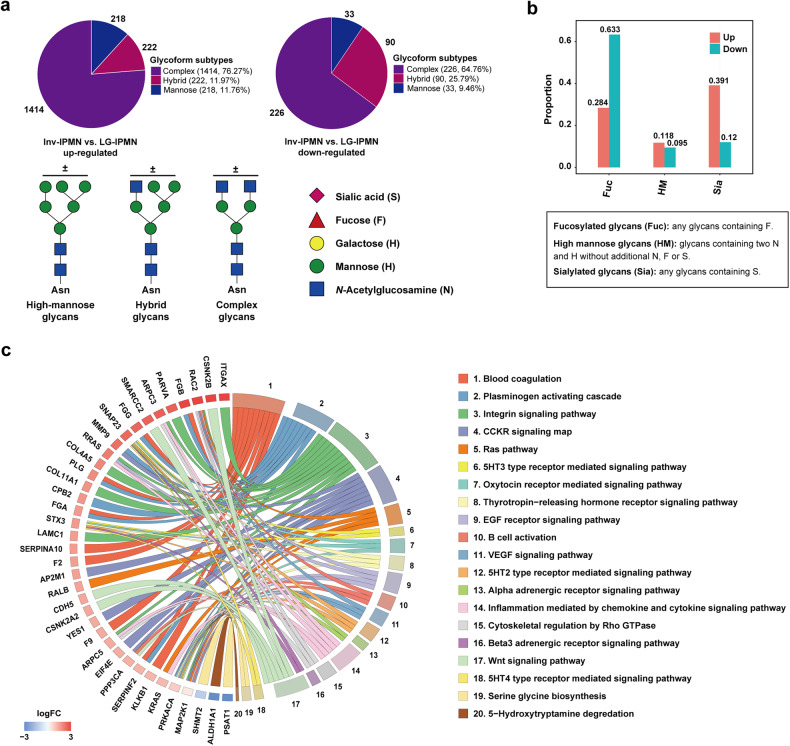
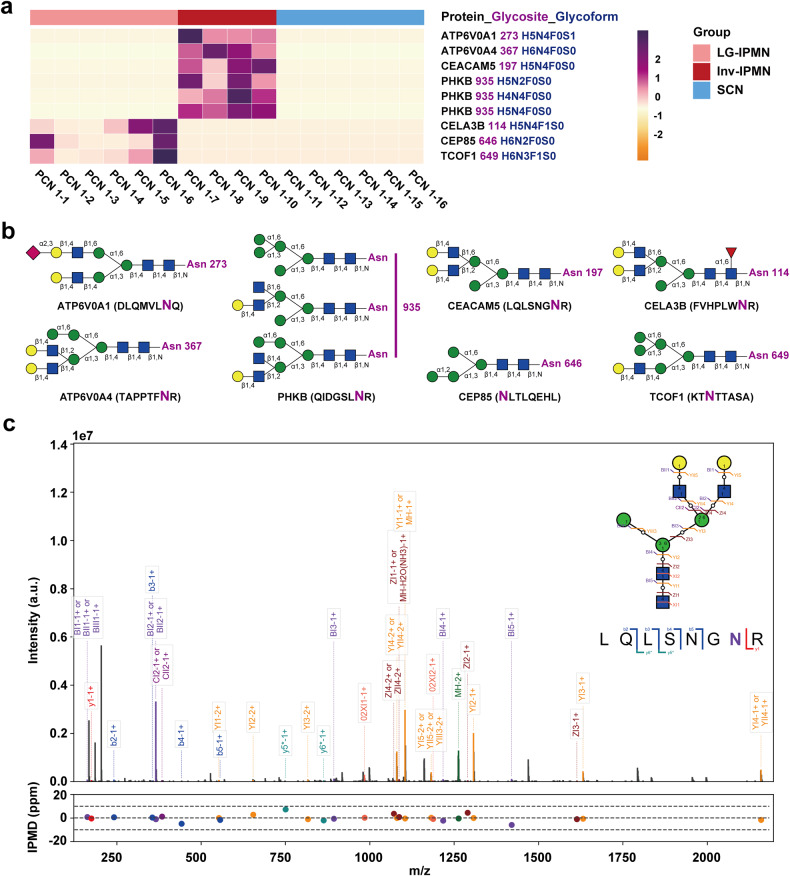
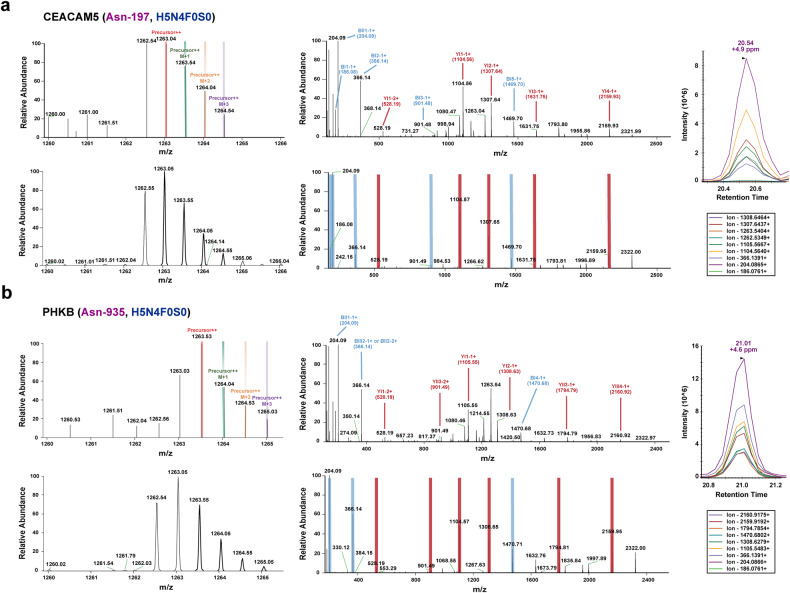
Pancreatic cystic neoplasms (PCNs) are recognized as precursor lesions of pancreatic cancer, with a marked increase in prevalence. Early detection of malignant PCNs is crucial for improving prognosis; however, current diagnostic methods are insufficient for accurately identifying malignant PCNs. Here, we utilized mass spectrometry (MS)-based glycosite- and glycoform-specific glycoproteomics, combined with proteomics, to explore potential cyst fluid diagnostic biomarkers for PCN. The glycoproteomic and proteomic landscape of pancreatic cyst fluid samples from PCN patients was comprehensively investigated, and its characteristics during the malignant transformation of PCN were analyzed. Under the criteria of screening specific cyst fluid biomarkers for the diagnosis of PCN, a group of cyst fluid glycoprotein biomarkers was identified. Through parallel reaction monitoring (PRM)-based targeted glycoproteomic analysis, we validated these chosen glycoprotein biomarkers in a second cohort, ultimately confirming N-glycosylated PHKB (Asn-935, H5N2F0S0; Asn-935, H4N4F0S0; Asn-935, H5N4F0S0), CEACAM5 (Asn-197, H5N4F0S0) and ATP6V0A4 (Asn-367, H6N4F0S0) as promising diagnostic biomarkers for distinguishing malignant PCNs. These glycoprotein biomarkers exhibited robust performance, with an area under the curve ranging from 0.771 to 0.948. In conclusion, we successfully established and conducted MS-based glycoproteomic analysis to identify novel cyst fluid glycoprotein biomarkers for PCN. These findings hold significant clinical implications, providing valuable insights for PCN decision-making, and potentially offering therapeutic targets for PCN treatment.
胰腺囊性肿瘤(PCN)被认为是胰腺癌的前体病变,其患病率显著增加。早期发现恶性 PCN 对于改善预后至关重要;然而,目前的诊断方法不足以准确识别恶性 PCN。在这里,我们利用基于质谱(MS)的糖基和糖型特异性糖蛋白质组学,结合蛋白质组学,探索 PCN 的潜在囊液诊断生物标志物。全面研究了 PCN 患者的胰腺囊液样本的糖蛋白质组学和蛋白质组学图谱,并分析了其在 PCN 恶性转化过程中的特征。在筛选用于诊断 PCN 的特定囊液生物标志物的标准下,确定了一组囊液糖蛋白生物标志物。通过基于平行反应监测(PRM)的靶向糖蛋白质组学分析,我们在第二个队列中验证了这些选定的糖蛋白生物标志物,最终证实 N-糖基化 PHKB(Asn-935,H5N2F0S0;Asn-935,H4N4F0S0;Asn-935,H5N4F0S0)、CEACAM5(Asn-197,H5N4F0S0)和 ATP6V0A4(Asn-367,H6N4F0S0)是区分恶性 PCN 的有前途的诊断生物标志物。这些糖蛋白生物标志物表现出稳健的性能,曲线下面积范围为 0.771 至 0.948。总之,我们成功建立并进行了基于 MS 的糖蛋白质组学分析,以鉴定用于 PCN 的新型囊液糖蛋白生物标志物。这些发现具有重要的临床意义,为 PCN 决策提供了有价值的见解,并为 PCN 治疗提供了潜在的治疗靶点。