Department of Emergency, Nanjing First Hospital, Nanjing Medical University, Nanjing, Jiangsu Province, China.
PeerJ. 2023 May 16;11:e15335. doi: 10.7717/peerj.15335. eCollection 2023.
The role of thyroid hormones is crucial in the response to stress and critical illness, which has been reported to be closely associated with a poor prognosis in patients admitted to the intensive care unit (ICU). This study aimed to explore the relationship between thyroid hormone and prognosis in septic shock patients.
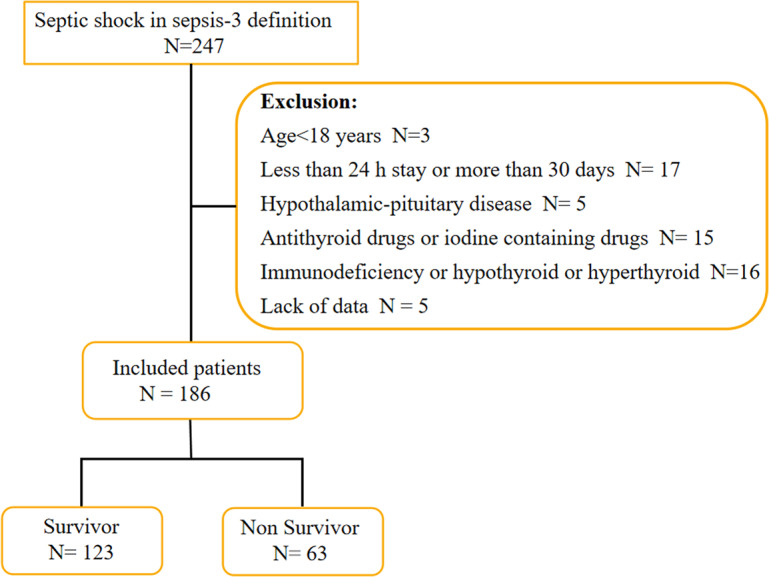
A total of 186 patients with septic shock were enrolled in the analytical study between December 2014 and September 2022. The baseline variables and thyroid hormone were collected. The patients were divided into survivor group and non-survivor group according to whether they died during the ICU hospitalization. Among 186 patients with septic shock, 123 (66.13%) were in the survivor group and 63 (33.87%) were in the non-survivor group.
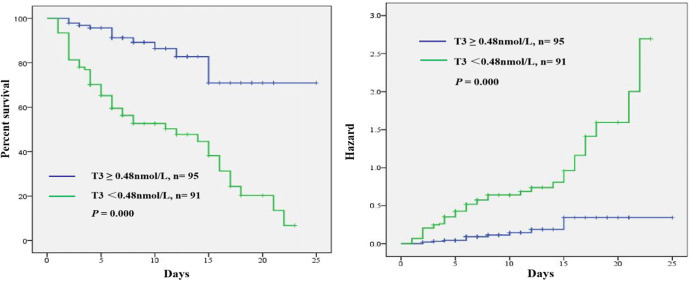
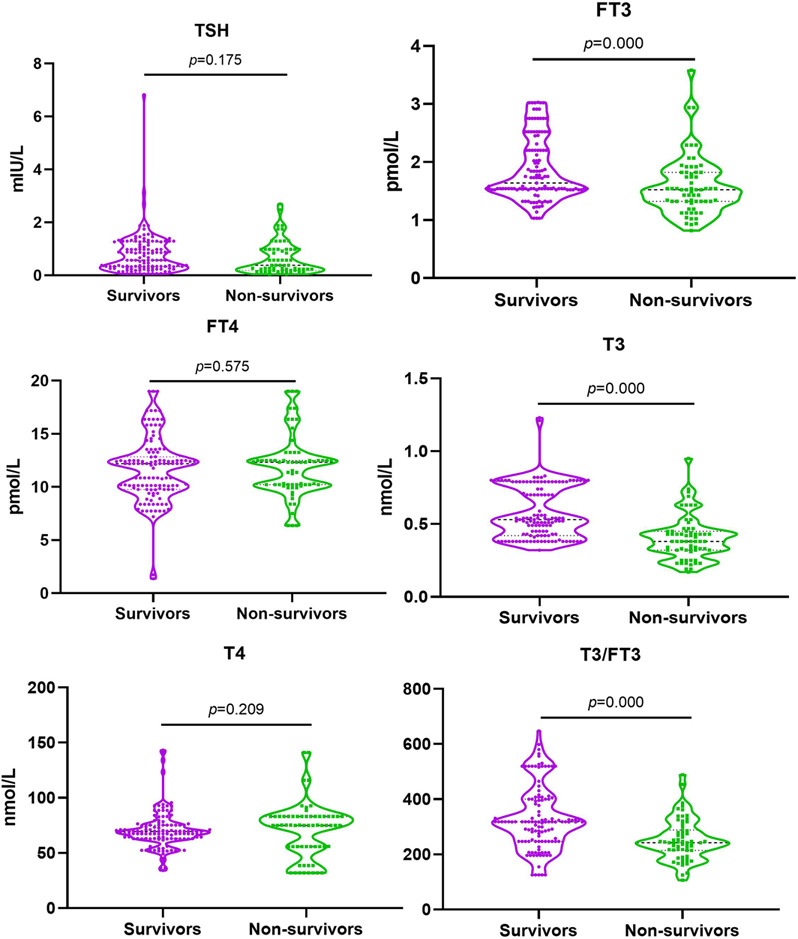
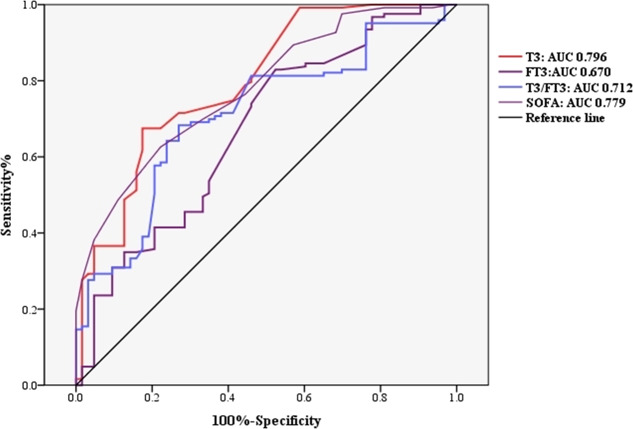
There were significant differences in the indictors of free triiodothyronine (FT3) ( = 0.000), triiodothyronine (T3) ( = 0.000), T3/FT3 ( = 0.000), acute physiology and chronic health evaluation II score (APACHE II) ( = 0.000), sequential organ failure assessment score (SOFA) ( = 0.000), pulse rate ( = 0.020), creatinine ( = 0.008), PaO2/FiO2 ( = 0.000), length of stay ( = 0.000) and hospitalization expenses ( = 0.000) in ICU between the two groups. FT3 [odds ratio (OR): 1.062, 95% confidence interval(CI): (0.021, 0.447), = 0.003], T3 (OR: 0.291, 95% CI: 0.172-0.975, = 0.037) and T3/FT3 (OR: 0.985, 95% CI:0.974-0.996, = 0.006) were independent risk factors of the short-term prognosis of septic shock patients after adjustment. The areas under the receiver operating characteristic curves for T3 was associated with ICU mortality (AUC = 0.796, < 0.05) and was higher than that for FT3 (AUC = 0.670, < 0.05) and T3/FT3 (AUC = 0.712, < 0.05). A Kaplan-Meier curve showed that patients with T3 greater than 0.48 nmol/L had a significantly higher survival rate than the patients with T3 less than 0.48 nmol/L.
The decrease in serum level of T3 in patients with septic shock is associated with ICU mortality. Early detection of serum T3 level could help clinicians to identify septic shock patients at high risk of clinical deterioration.
甲状腺激素在应激和危重病患者的反应中起着至关重要的作用,有报道称其与入住重症监护病房(ICU)患者的预后密切相关。本研究旨在探讨甲状腺激素与脓毒症性休克患者预后的关系。
本分析性研究共纳入了 2014 年 12 月至 2022 年 9 月期间 186 例脓毒症性休克患者,收集了患者的基线变量和甲状腺激素水平。根据患者 ICU 住院期间是否死亡,将患者分为存活组和死亡组。在 186 例脓毒症性休克患者中,123 例(66.13%)为存活组,63 例(33.87%)为死亡组。
两组间游离三碘甲状腺原氨酸(FT3)(=0.000)、三碘甲状腺原氨酸(T3)(=0.000)、T3/FT3(=0.000)、急性生理学和慢性健康评估 II 评分(APACHE II)(=0.000)、序贯器官衰竭评估评分(SOFA)(=0.000)、脉搏率(=0.020)、肌酐(=0.008)、动脉血氧分压与吸入氧浓度比值(PaO2/FiO2)(=0.000)、ICU 住院时间(=0.000)和住院费用(=0.000)等指标存在显著差异。多因素分析结果显示,FT3(OR:1.062,95%CI:0.021-0.447,=0.003)、T3(OR:0.291,95%CI:0.172-0.975,=0.037)和 T3/FT3(OR:0.985,95%CI:0.974-0.996,=0.006)是脓毒症性休克患者短期预后的独立危险因素。T3 与 ICU 死亡率相关的受试者工作特征曲线下面积(AUC)为 0.796(<0.05),高于 FT3(AUC=0.670,<0.05)和 T3/FT3(AUC=0.712,<0.05)。Kaplan-Meier 曲线显示,T3 水平大于 0.48 nmol/L 的患者的生存率明显高于 T3 水平小于 0.48 nmol/L 的患者。
脓毒症性休克患者血清 T3 水平降低与 ICU 死亡率相关。早期检测血清 T3 水平有助于临床医生识别临床恶化风险较高的脓毒症性休克患者。