Allwohn Luisa, Wolfgang Josy, Onken Julia, Wasilewski David, Roohani Siyer, Zips Daniel, Ehret Felix, Kaul David
Charité - Universitätsmedizin Berlin, Corporate Member of Freie Universität Berlin and Humboldt-Universität zu Berlin, Department of Radiation Oncology, Berlin, Germany.
Charité - Universitätsmedizin Berlin, Corporate Member of Freie Universität Berlin and Humboldt-Universität zu Berlin, Department of Neurosurgery, Berlin, Germany.
Clin Transl Radiat Oncol. 2023 Apr 5;41:100626. doi: 10.1016/j.ctro.2023.100626. eCollection 2023 Jul.
Oligodendrogliomas (ODG) are rare, diffusely infiltrating brain tumors, defined by their 1p/19q-codeletion and isocitrate dehydrogenase (IDH) mutation. Herein, we analyze the influence of various tumor and patient characteristics on progression-free survival (PFS) and overall survival (OS) in a homogeneous patient cohort.
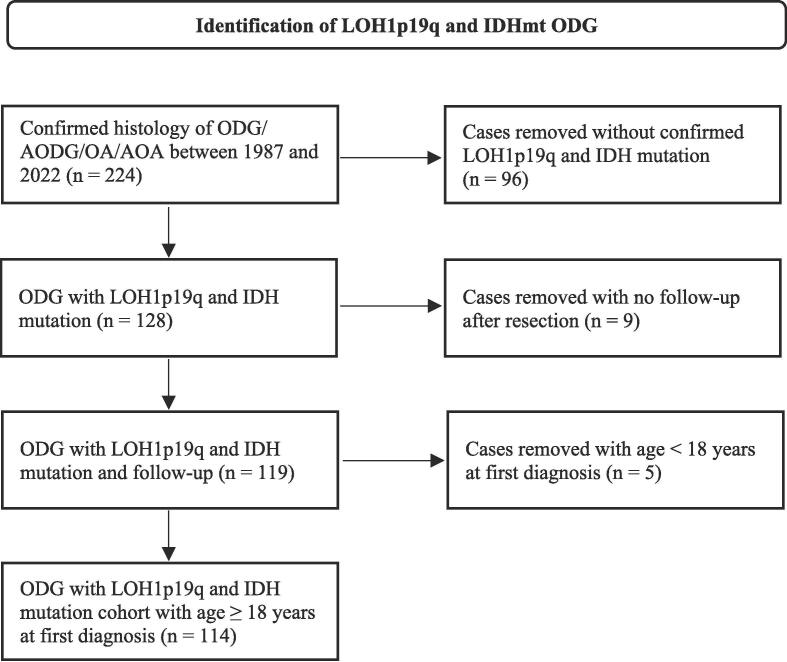
Patients treated for a 1p/19q-codeleted and IDH-mutant ODG were evaluated. The patient and tumor characteristics were analyzed for their influence on PFS and OS.
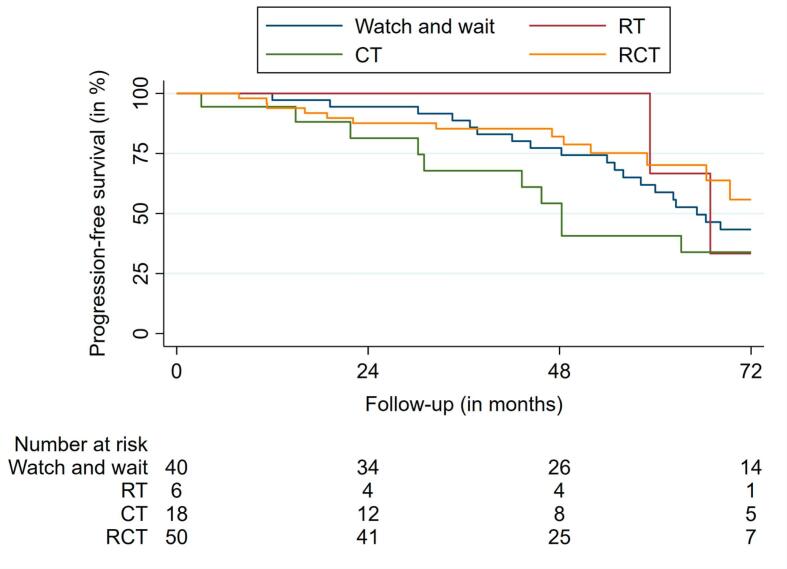
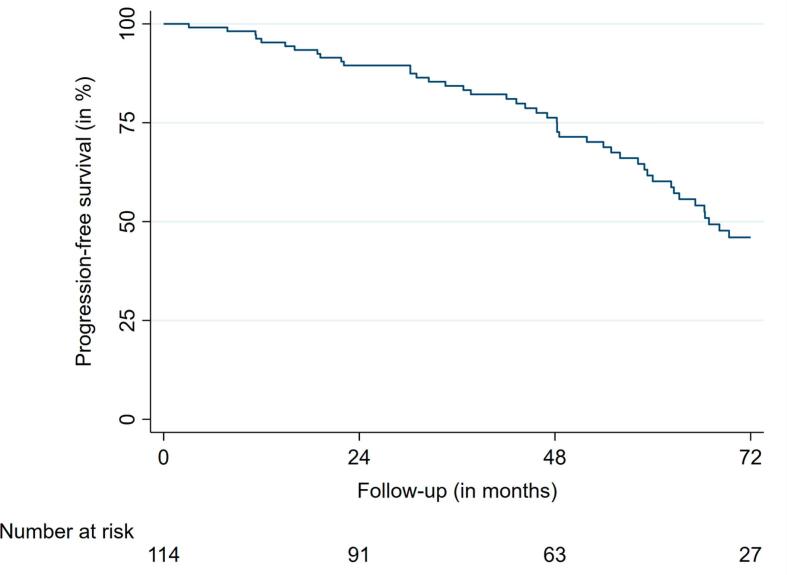
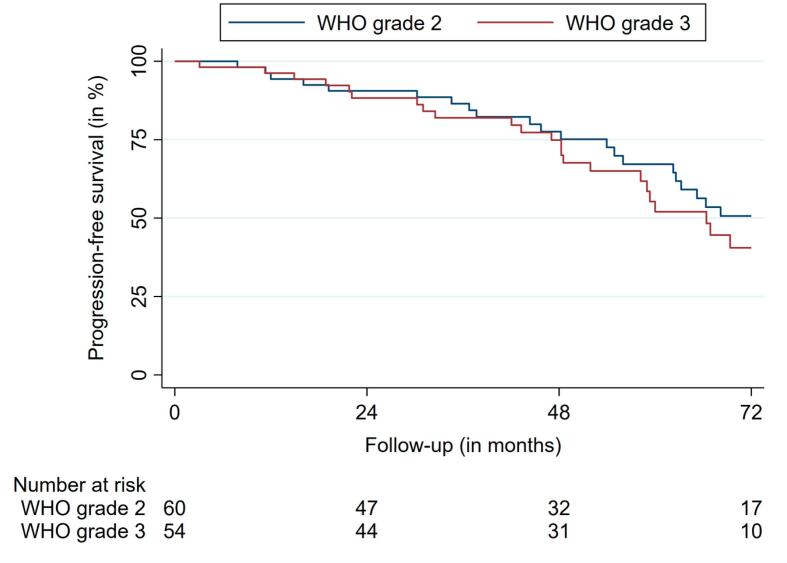
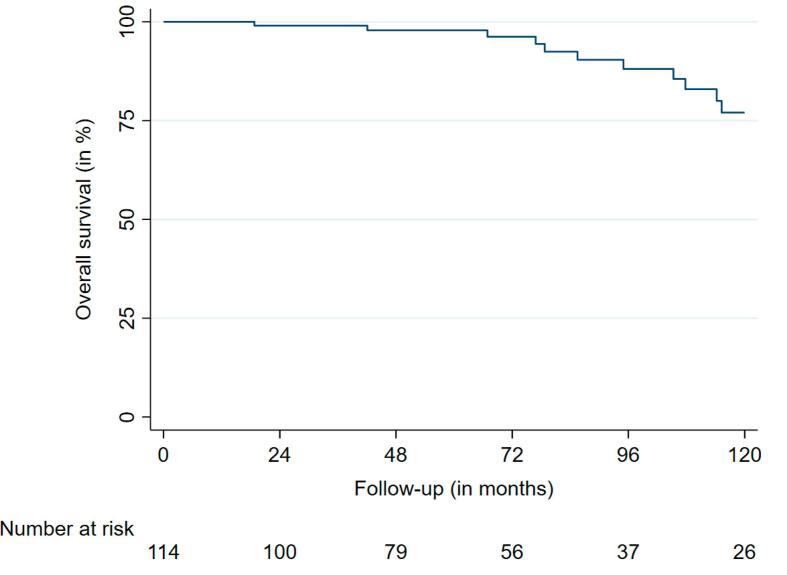
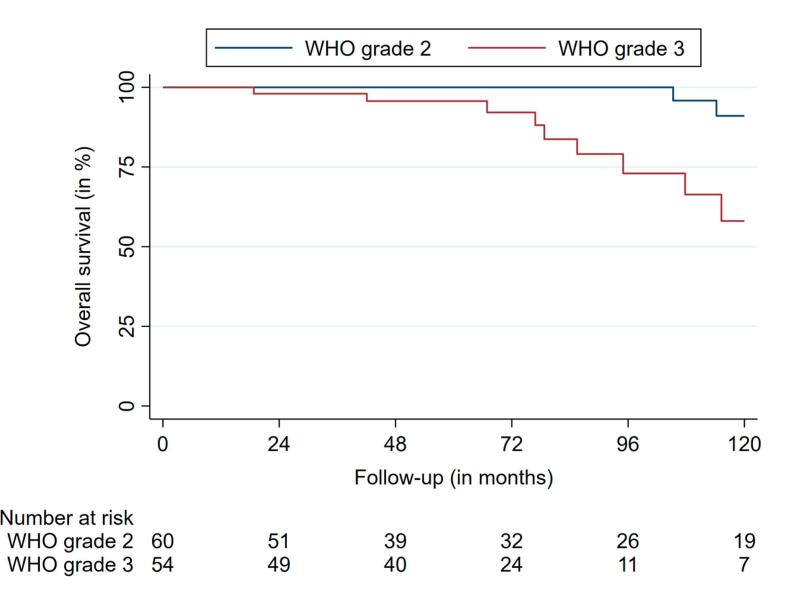
One-hundred-fourteen patients met the inclusion criteria. The median clinical and radiographic follow-up periods were 68.6 and 69.8 months. The median PFS and OS were 66.9 and 236.0 months, respectively. The 2-, 4- and 6-year PFS rates were 89.5%, 76.3%, and 46.0%. The 2-, 4- and 6-year OS rates were 99.0%, 97.9%, and 96.2%. For WHO grade 2 ODG, extent of resection ( 0.01, 0.01; 0.02, 0.02), radiotherapy ( 0.01, < 0.01) and chemotherapy ( 0.01, 0.01) were associated with a prolonged PFS. For WHO grade 3 ODG, only a combined radiochemotherapy (RCT) lowered the risk of progression in the multivariable analysis ( = 0.02, 0.09). Most RCT patients received temozolomide (TMZ) instead of procarbazine, lomustine, and vincristine.
Whereas previous studies often comprise tumors with IDH wild type status and without 1p/19q-codeletion, this homogeneous ODG cohort, as defined by the current WHO classification, demonstrated PFS benefits for various therapies, especially concerning RCT. While this is generally in accordance with comparable studies, more prospective work on homogeneous patient cohorts is required to refine treatment guidelines and to determine the role of TMZ in ODG.
少突胶质细胞瘤(ODG)是一种罕见的弥漫性浸润性脑肿瘤,其定义为存在1p/19q共缺失和异柠檬酸脱氢酶(IDH)突变。在此,我们分析了在一个同质化患者队列中,各种肿瘤和患者特征对无进展生存期(PFS)和总生存期(OS)的影响。
对接受治疗的1p/19q共缺失且IDH突变的ODG患者进行评估。分析患者和肿瘤特征对PFS和OS的影响。
114例患者符合纳入标准。临床和影像学中位随访期分别为68.6个月和69.8个月。中位PFS和OS分别为66.9个月和236.0个月。2年、4年和6年PFS率分别为89.5%、76.3%和46.0%。2年、4年和6年OS率分别为99.0%、97.9%和96.2%。对于世界卫生组织(WHO)2级ODG,切除范围(P = 0.01,P = 0.01;P = 0.02,P = 0.02)、放疗(P = 0.01,P < 0.01)和化疗(P = 0.01,P = 0.01)与延长的PFS相关。对于WHO 3级ODG,在多变量分析中,只有联合放化疗(RCT)降低了进展风险(P = 0.02,P = 0.09)。大多数RCT患者接受替莫唑胺(TMZ)而非丙卡巴肼、洛莫司汀和长春新碱。
以往研究通常纳入IDH野生型状态且无1p/19q共缺失的肿瘤,而这个按照当前WHO分类定义的同质化ODG队列显示出各种治疗方法对PFS有益,尤其是关于RCT。虽然这总体上与类似研究一致,但仍需要对同质化患者队列开展更多前瞻性研究,以完善治疗指南并确定TMZ在ODG中的作用。