School of Clinical Medicine, Xuzhou Medical University, Xuzhou, 221000, China.
Department of Neurology, Affiliated Hospital of Xuzhou Medical University, Xuzhou, 221000, China.
BMC Neurol. 2023 May 23;23(1):203. doi: 10.1186/s12883-023-03222-6.
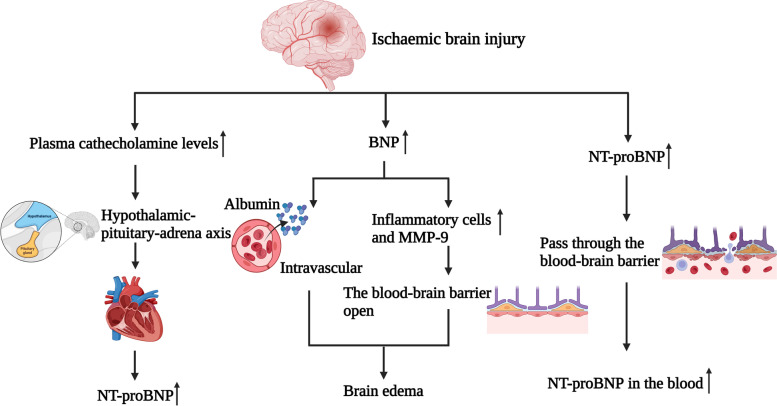
Few studies correlated n-terminal pro-brain natriuretic peptide (NT-proBNP) with early neurological deterioration (END) and prognosis of acute ischaemic stroke (AIS) patients with rt-PA intravenous thrombolysis. Therefore this study aimed to investigate the relationship between NT-proBNP and END, and prognosis after intravenous thrombolysis in patients with AIS.
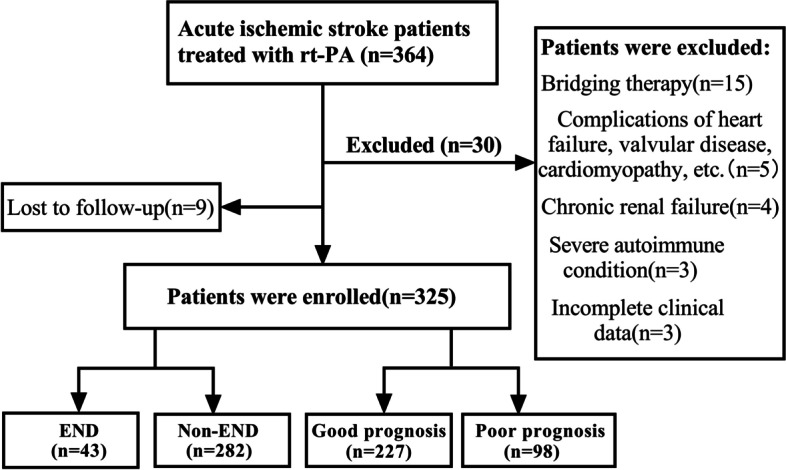
A total of 325 patients with AIS were enrolled. We performed the natural logarithm transformation on the NT-proBNP [ln(NT-proBNP)]. Univariate and multivariate logistic regression analyses were performed to assess the relationship between ln(NT-proBNP) and END, and prognosis and receiver operating characteristic (ROC) curves were used to show the sensitivity and specificity of NT-proBNP.
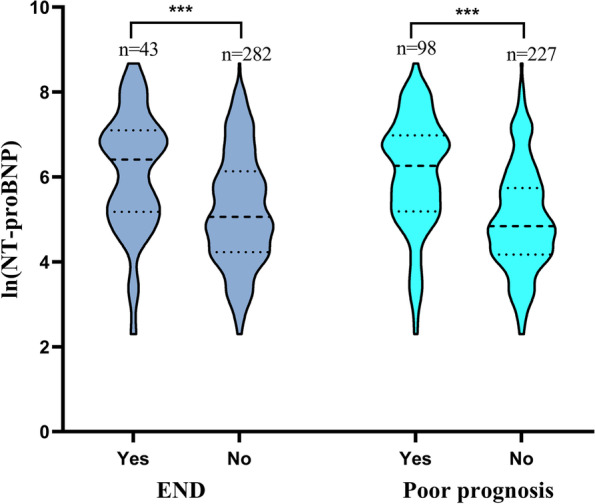
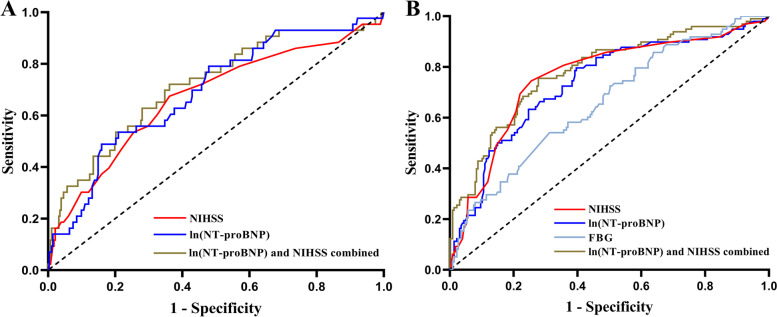
After thrombolysis, among 325 patients with AIS, 43 patients (13.2%) developed END. In addition, three months follow-up showed a poor prognosis in 98 cases (30.2%) and a good prognosis in 227 cases (69.8%). Multivariate logistic regression analysis showed that ln(NT-proBNP) was an independent risk factor for END (OR = 1.450,95%CI:1.072 ~ 1.963, P = 0.016) and poor prognosis at three months follow-up (OR = 1.767, 95%CI: 1.347 ~ 2.317, P < 0.001) respectively. According to ROC curve analysis, ln(NT-proBNP) (AUC 0.735, 95%CI: 0.674 ~0.796, P < 0.001) had a good predictive value for poor prognosis, with a predictive value of 5.12 and sensitivity and specificity of 79.59% and 60.35% respectively. When combined with NIHSS to predict END(AUC 0.718, 95%CI: 0.631 ~ 0.805, P < 0.001) and poor prognosis(AUC 0.780, 95%CI: 0.724 ~ 0.836, P < 0.001), the predictive value of the model is further improved.
NT-proBNP is independently associated with END and poor prognosis in patients with AIS following intravenous thrombolysis and has a particular predictive value for END and poor prognosis.
很少有研究将 N 端脑利钠肽前体(NT-proBNP)与急性缺血性脑卒中(AIS)患者 rt-PA 静脉溶栓后的早期神经功能恶化(END)和预后相关联。因此,本研究旨在探讨 NT-proBNP 与 END 之间的关系,以及 AIS 患者静脉溶栓后的预后。
共纳入 325 例 AIS 患者。我们对 NT-proBNP [ln(NT-proBNP)]进行自然对数转换。采用单因素和多因素逻辑回归分析评估 ln(NT-proBNP)与 END 及预后的关系,并采用受试者工作特征(ROC)曲线显示 NT-proBNP 的敏感性和特异性。
溶栓后,325 例 AIS 患者中 43 例(13.2%)发生 END。此外,3 个月随访时 98 例(30.2%)预后不良,227 例(69.8%)预后良好。多因素逻辑回归分析显示,ln(NT-proBNP)是 END(OR=1.450,95%CI:1.0721.963,P=0.016)和 3 个月随访时预后不良(OR=1.767,95%CI:1.3472.317,P<0.001)的独立危险因素。根据 ROC 曲线分析,ln(NT-proBNP)(AUC 0.735,95%CI:0.6740.796,P<0.001)对预后不良有较好的预测价值,预测值为 5.12,敏感性和特异性分别为 79.59%和 60.35%。当与 NIHSS 联合预测 END(AUC 0.718,95%CI:0.6310.805,P<0.001)和预后不良(AUC 0.780,95%CI:0.724~0.836,P<0.001)时,该模型的预测价值进一步提高。
NT-proBNP 与 AIS 患者静脉溶栓后 END 和预后不良独立相关,对 END 和预后不良有特殊的预测价值。