Kaiser Permanente Northern California, Department of Adult and Family Medicine, Oakland, CA, USA.
Kaiser Permanente Northern California, Department of Head and Neck Surgery, Oakland, CA, USA.
Perm J. 2023 Jun 15;27(2):31-36. doi: 10.7812/TPP/22.094. Epub 2023 May 24.
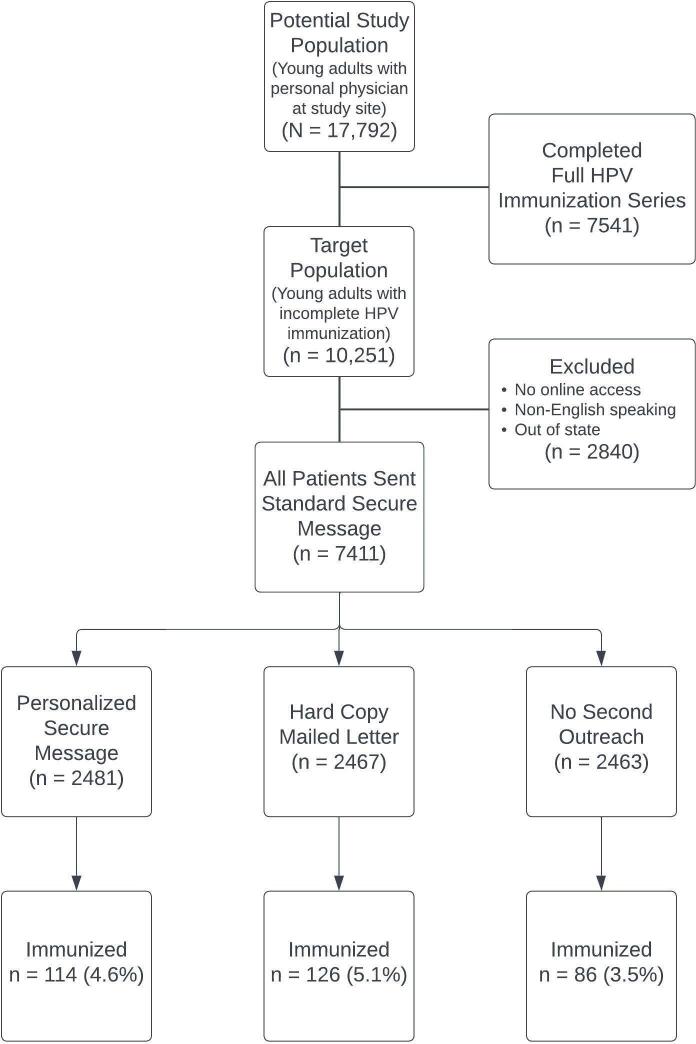
INTRODUCTION Immunization rates against the human papillomavirus (HPV) remain suboptimal in the young adult population. Little is known about the most effective means for encouraging vaccination in this population. METHODS The authors conducted a clinical trial of 3 methods to encourage HPV vaccination in a large Northern California integrated Health Plan. Young adults aged 18-26 with evidence of insufficient HPV vaccination were sent a bulk secure message from the Health Plan (standard outreach); those who did not respond were randomized to no further outreach, a second, personalized secure message from a specific practitioner, or a letter mailed to their home. The primary outcome was receipt of at least 1 HPV vaccine within 3 months following the initial bulk secure message. RESULTS In total, 7718 young adults were randomized. After 3 months, 86 patients (3.5%) who received no additional outreach obtained an immunization, compared with 114 (4.6%) who received the second secure message (p = 0.05) and 126 (5.1%) who received the mailed letter (p = 0.006). DISCUSSION Supplemental mailed or personalized electronic messages increased vaccination beyond no additional intervention, although gains were not clinically meaningful. These findings highlight the need for more successful alternatives to encourage uptake of such preventive health interventions among young adults. The successful conduct of this rapid-cycle, randomized trial showed that such evaluations are feasible, providing actionable data to inform implementation strategies. CONCLUSIONS Further study is needed to identify effective strategies for improving preventive health uptake in this important and underserved population. Rapid-cycle randomized evaluation strategies can provide critical information to focus efforts for achieving this goal.
简介 人乳头瘤病毒(HPV)疫苗的接种率在年轻成年人中仍然不理想。对于在这一人群中鼓励接种疫苗的最有效方法知之甚少。
方法 作者在加利福尼亚州北部的一家综合医疗计划中进行了一项临床试验,以研究 3 种方法来鼓励 HPV 疫苗接种。向年龄在 18-26 岁之间、HPV 疫苗接种不足的年轻人发送来自医疗计划的群发安全信息(标准外展);对于未回复的人,随机分配不进行进一步外展、由特定医生发送第二次个性化安全信息或邮寄到家中的信件。主要结果是在初始群发安全信息后 3 个月内至少接种 1 剂 HPV 疫苗。
结果 共有 7718 名年轻人被随机分配。3 个月后,未接受其他额外服务的 86 名患者(3.5%)接受了免疫接种,而接受第二次安全信息的 114 名患者(4.6%)(p = 0.05)和接受邮寄信件的 126 名患者(5.1%)(p = 0.006)。
讨论 补充邮寄或个性化电子信息增加了疫苗接种率,超过了没有额外干预的情况,尽管收益没有临床意义。这些发现强调了需要更成功的替代方案来鼓励年轻成年人接受此类预防保健干预。这种快速循环、随机试验的成功开展表明,这种评估是可行的,可以提供可操作的数据来为实施策略提供信息。
结论 需要进一步研究以确定在这一重要且服务不足的人群中提高预防保健普及率的有效策略。快速循环随机评估策略可以为集中精力实现这一目标提供关键信息。