Department of Internal Medicine, Seoul National University Hospital, Seoul, Republic of Korea.
Department of Internal Medicine, Seoul National University Hospital, Seoul, Republic of Korea.
J Adv Res. 2024 Apr;58:139-147. doi: 10.1016/j.jare.2023.05.003. Epub 2023 May 22.
Low-density lipoprotein (LDL) cholesterol-lowering treatment is beneficial for the secondary or primary prevention of high-risk atherosclerotic cardiovascular disease (ASCVD). However, the prognostic implications of low LDL cholesterol levels in patients without previous ASCVD and without statin use remain elusive.
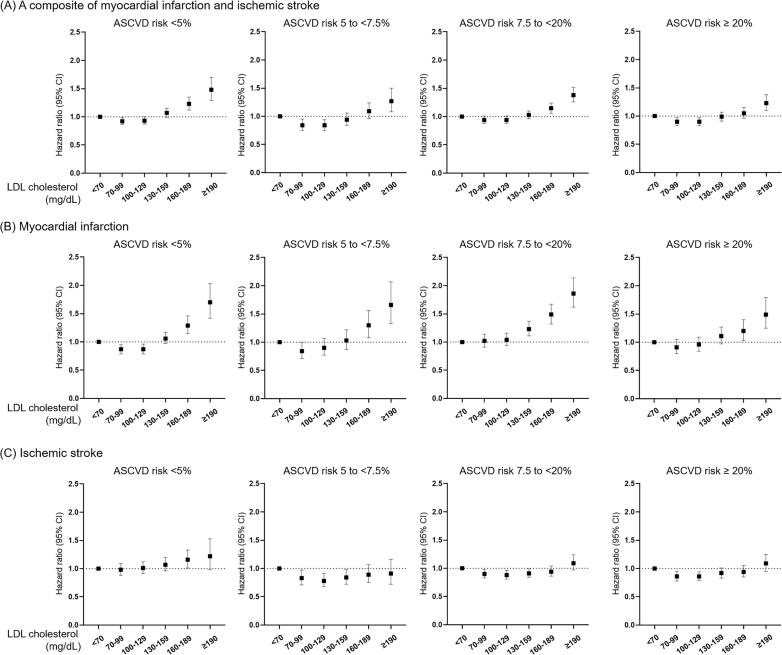
From a nationwide cohort, 2,432,471 participants without previous ASCVD or statin use were included. For myocardial infarction (MI) and ischemic stroke (IS), participants were followed-up from 2009 to 2018. They were stratified according to 10-year ASCVD risk (<5 %, 5 %-<7.5 %, 7.5 %-<20 %, and ≥20 %) and LDL cholesterol level (<70, 70-99, 100-129, 130-159, 160-189, and ≥190 mg/dL).
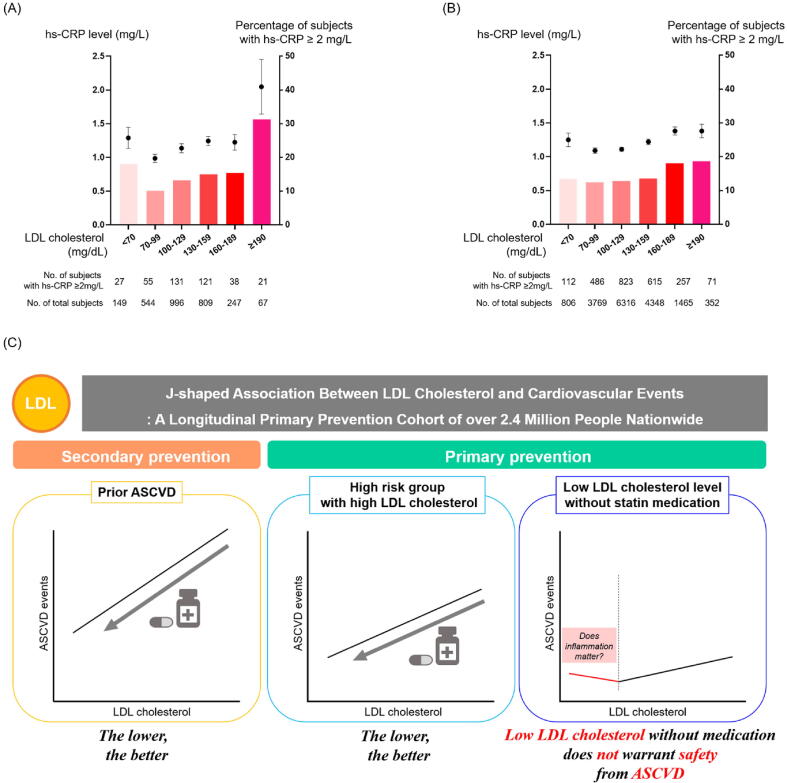
The relationship between LDL cholesterol levels and ASCVD events exhibited a J-shaped curve for both MI and IS. After classification according to the ASCVD risk, this J-shaped relationship was consistently observed for the composite of MI and IS. Participants with an LDL cholesterol level <70 mg/dL showed a higher MI risk than those with a level of 70-99 mg/dL or 100-129 mg/dL in the low-ASCVD risk group. The J-shaped curve between LDL cholesterol levels and MI risk was attenuated across ASCVD risk groups. For IS, participants with an LDL cholesterol level <70 mg/dL demonstrated increased risks compared with those with a level of 70-99 mg/dL, 100-129 mg/dL, or 130-159 mg/dL in the borderline, intermediate, and high ASCVD risk groups, respectively. In contrast, a linear association was observed in participants taking statins. Interestingly, a J-shaped association was observed between LDL cholesterol and high-sensitivity C-reactive protein (hs-CRP) levels; the mean hs-CRP level and the proportion of individuals with increased hs-CRP levels were relatively high among individuals with an LDL cholesterol level <70 mg/dL.
Although high LDL cholesterol levels increase the risk of ASCVD, low LDL cholesterol levels do not warrant safety from ASCVD. Therefore, individuals with low LDL cholesterol levels should be carefully monitored.
降低 LDL 胆固醇的治疗方法有益于高危动脉粥样硬化性心血管疾病(ASCVD)的二级或一级预防。然而,在没有先前 ASCVD 且未使用他汀类药物的患者中,LDL 胆固醇水平较低的预后意义仍不清楚。
本研究纳入了一个全国性队列中的 2432471 名无先前 ASCVD 或他汀类药物使用史的参与者。对于心肌梗死(MI)和缺血性卒中(IS),参与者从 2009 年随访至 2018 年。根据 10 年 ASCVD 风险(<5%、5%-<7.5%、7.5%-<20%和≥20%)和 LDL 胆固醇水平(<70、70-99、100-129、130-159、160-189 和≥190 mg/dL)对参与者进行分层。
LDL 胆固醇水平与 MI 和 IS 之间的 ASCVD 事件之间存在 J 形关系。根据 ASCVD 风险进行分类后,MI 和 IS 的复合终点也观察到了这种 J 形关系。在低 ASCVD 风险组中,LDL 胆固醇水平<70 mg/dL 的参与者的 MI 风险高于 LDL 胆固醇水平为 70-99 mg/dL 或 100-129 mg/dL 的参与者。LDL 胆固醇水平与 MI 风险之间的 J 形曲线在 ASCVD 风险组中逐渐减弱。对于 IS,LDL 胆固醇水平<70 mg/dL 的参与者与 LDL 胆固醇水平为 70-99 mg/dL、100-129 mg/dL 或 130-159 mg/dL 的参与者相比,发生 IS 的风险增加,分别在边缘、中间和高 ASCVD 风险组中。相比之下,在服用他汀类药物的参与者中观察到线性关联。有趣的是,LDL 胆固醇与高敏 C 反应蛋白(hs-CRP)水平之间存在 J 形关联;在 LDL 胆固醇水平<70 mg/dL 的个体中,hs-CRP 水平较高,hs-CRP 水平升高的个体比例相对较高。
虽然高 LDL 胆固醇水平会增加 ASCVD 的风险,但 LDL 胆固醇水平较低并不能保证免于 ASCVD。因此,应密切监测 LDL 胆固醇水平较低的个体。