Director of the Center for Clinical Research, Texas Heart Institute, Houston, Texas, USA.
Podiatric Surgery, Reno Foot and Ankle, Reno, Nevada, USA.
Int Wound J. 2023 Nov;20(9):3531-3539. doi: 10.1111/iwj.14226. Epub 2023 May 25.
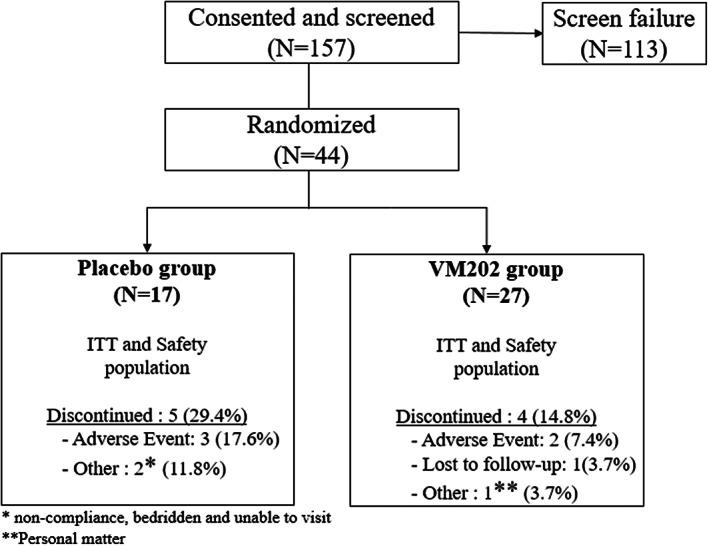
To evaluate the status of a 7-month phase 3 study conducted to test the effect of intramuscular injections of VM202 (ENGENSIS), a plasmid DNA encoding human hepatocyte growth factor, into the calf muscles of chronic nonhealing diabetic foot ulcers with concomitant peripheral artery disease. The phase 3 study, originally aimed to recruit 300 subjects, was discontinued because of slow patient recruitment. An unprespecified interim analysis was performed for the 44 subjects enrolled to assess the status and determine the future direction. Statistical analyses were carried out for the Intent-to-Treat (ITT) population and separately for subjects with neuroischemic ulcers, using a t-test and Fisher's exact test. A logistic regression analysis was also conducted. VM202 was safe and potentially should have benefits. In the ITT population (N = 44), there was a positive trend toward closure in the VM202 group from 3 to 6 months but with no statistical significance. Levels of ulcer volume or area were found to be highly skewed between the placebo and VM202 groups. Forty subjects, excluding four outliers in both arms, showed significant wound-closing effects at month 6 (P = .0457). In 23 patients with neuroischemic ulcers, the percentage of subjects reaching complete ulcer closure was significantly higher in the VM202 group at months 3, 4, and 5 (P = .0391, .0391, and .0361). When two outliers were excluded, a significant difference was evident in months 3, 4, 5, and 6 (P = .03 for all points). A potentially clinically meaningful 0.15 increase in Ankle-Brachial Index was observed in the VM202 group at day 210 in the ITT population (P = .0776). Intramuscular injections of VM202 plasmid DNA to calf muscle may have promise in the treatment of chronic neuroischemic diabetic foot ulcers (DFUs). Given the safety profile and potential healing effects, continuing a larger DFU study is warranted with modifications of the current protocol and expansion of enrolling sites.
评估一项 7 个月的 3 期研究的结果,该研究旨在测试肌内注射 VM202(ENGENSIS)对伴有外周动脉疾病的慢性难愈性糖尿病足溃疡患者小腿肌肉的影响。该 3 期研究最初计划招募 300 名受试者,但由于患者招募缓慢而被终止。进行了一次未预设的中期分析,对纳入的 44 名受试者进行评估以了解现状并确定未来的方向。对意向治疗(ITT)人群和神经缺血性溃疡患者分别进行了统计分析,使用 t 检验和 Fisher 确切检验。还进行了逻辑回归分析。VM202 是安全的,并且可能具有益处。在 ITT 人群(N=44)中,VM202 组在 3 至 6 个月时的愈合趋势呈阳性,但无统计学意义。在安慰剂和 VM202 组之间,溃疡体积或面积的水平存在高度偏斜。排除两个臂的四个离群值后,40 名患者在第 6 个月时显示出显著的伤口闭合效果(P=0.0457)。在 23 名神经缺血性溃疡患者中,VM202 组在第 3、4 和 5 个月时达到完全溃疡闭合的患者比例明显更高(P=0.0391,0.0391 和 0.0361)。排除两个离群值后,在第 3、4、5 和 6 个月时差异显著(所有点 P=0.03)。在 ITT 人群中,VM202 组在第 210 天时踝肱指数(ABI)有 0.15 的潜在临床意义的升高(P=0.0776)。在小腿肌肉中肌内注射 VM202 质粒 DNA 可能有望治疗慢性神经缺血性糖尿病足溃疡(DFU)。鉴于其安全性和潜在的愈合效果,需要对当前方案进行修改并扩大入组地点,以继续进行更大的 DFU 研究。