Department of Surgery, Dartmouth-Hitchcock Medical Center, The Geisel School of Medicine at Dartmouth, Lebanon, NH 03756, USA.
DartLab, Dartmouth Cancer Center, Lebanon, NH 03756, USA.
Curr Oncol. 2023 May 17;30(5):5116-5134. doi: 10.3390/curroncol30050387.
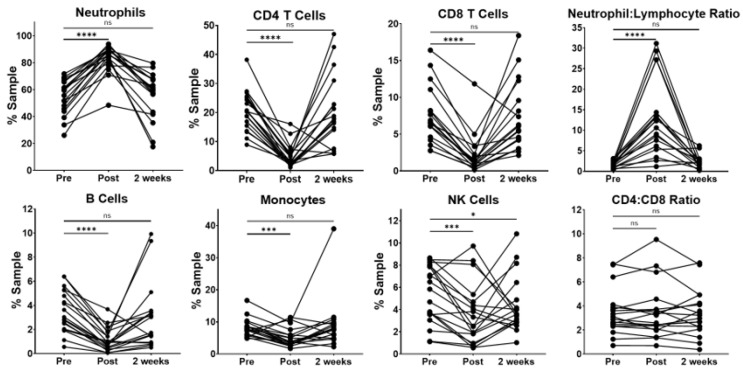
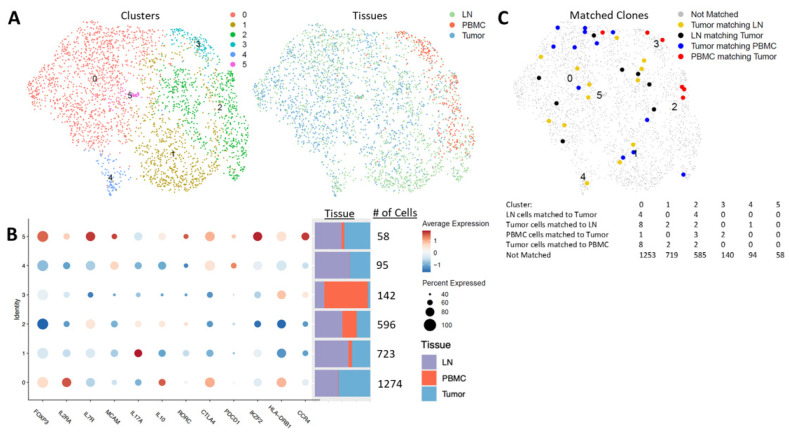
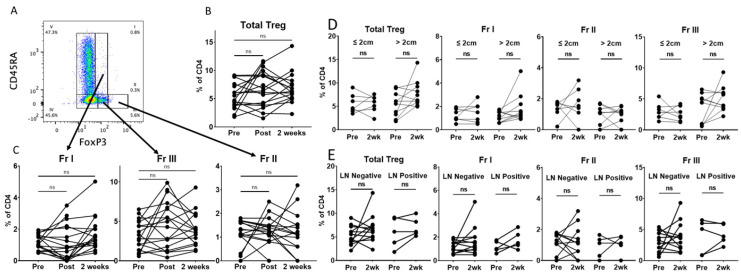
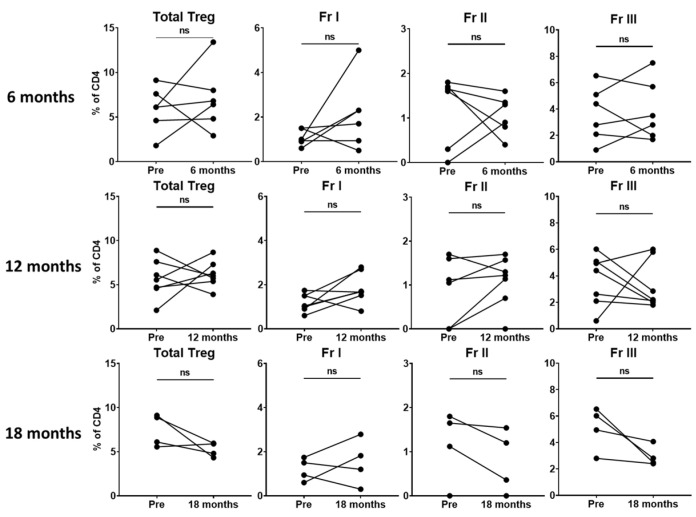
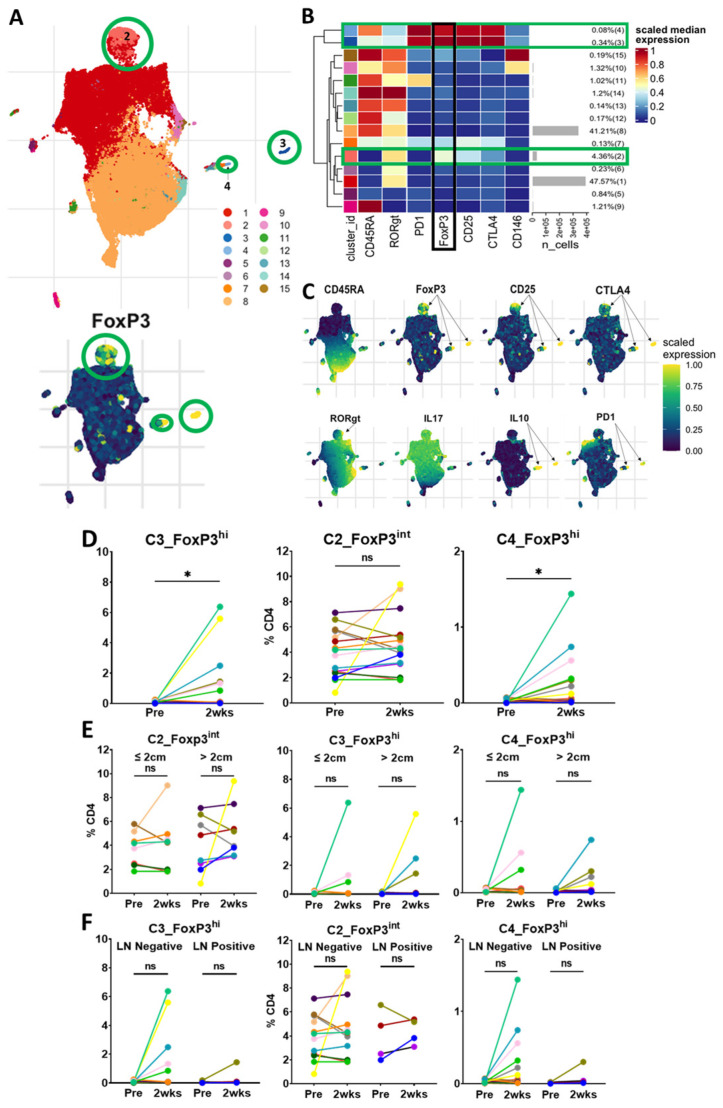
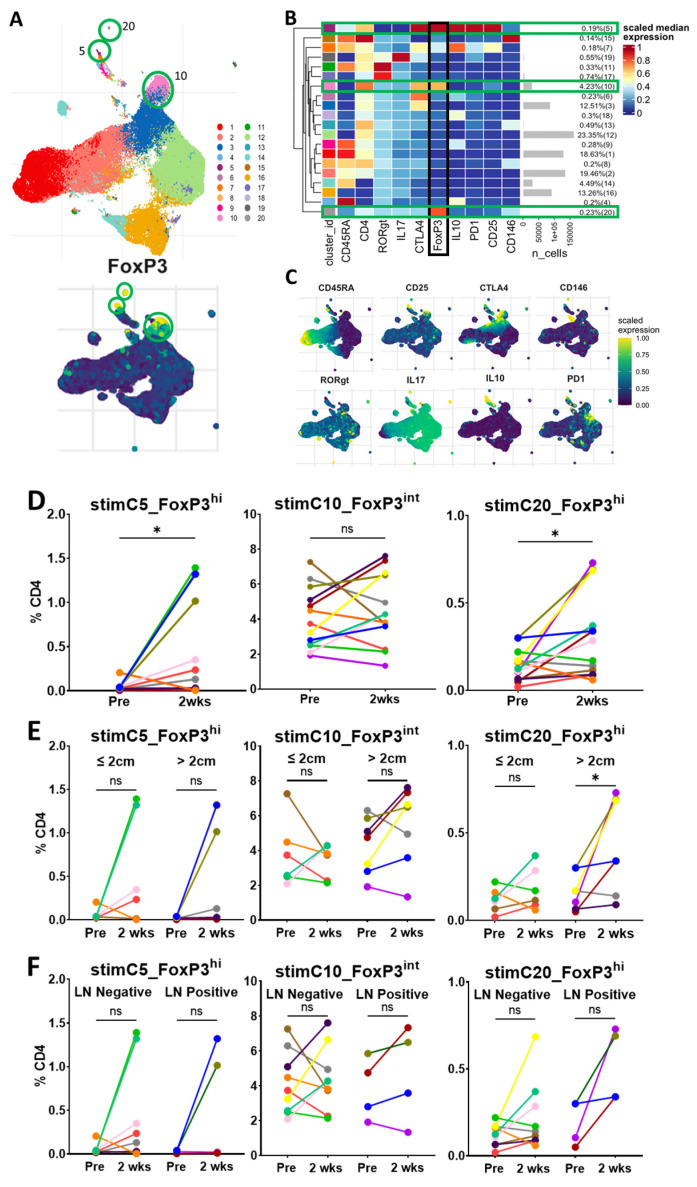
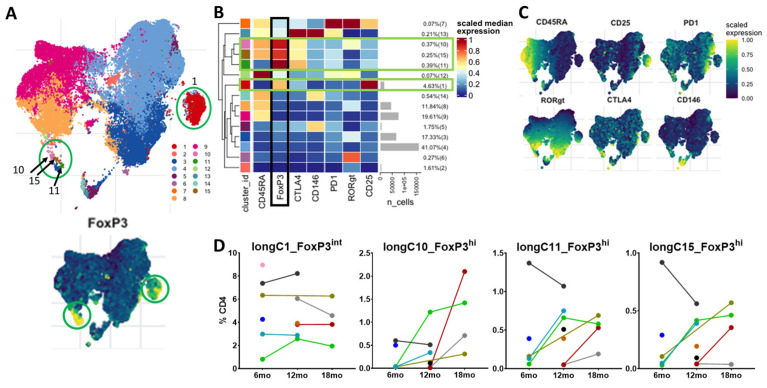
This pilot study sought to evaluate the circulating levels of immune cells, particularly regulatory T-cell (Treg) subsets, before and after lung resection for non-small cell lung cancer. Twenty-five patients consented and had specimens collected. Initially, peripheral blood of 21 patients was collected for circulating immune cell studies. Two of these patients were excluded due to technical issues, leaving 19 patients for the analyses of circulating immune cells. Standard gating and high-dimensional unsupervised clustering flow cytometry analyses were performed. The blood, tumors and lymph nodes were analyzed via single-cell RNA and TCR sequencing for Treg analyses in a total of five patients (including four additional patients from the initial 21 patients). Standard gating flow cytometry revealed a transient increase in neutrophils immediately following surgery, with a variable neutrophil-lymphocyte ratio and a stable CD4-CD8 ratio. Unexpectedly, the total Treg and Treg subsets did not change with surgery with standard gating in short- or long-term follow-up. Similarly, unsupervised clustering of Tregs revealed a dominant cluster that was stable perioperatively and long-term. Two small FoxP3 clusters slightly increased following surgery. In the longer-term follow-up, these small FoxP3 Treg clusters were not identified, indicating that they were likely a response to surgery. Single-cell sequencing demonstrated six CD4+FoxP3+ clusters among the blood, tumors and lymph nodes. These clusters had a variable expression of FoxP3, and several were mainly, or only, present in tumor and lymph node tissue. As such, serial monitoring of circulating Tregs may be informative, but not completely reflective of the Tregs present in the tumor microenvironment.
本初步研究旨在评估非小细胞肺癌肺切除术前和术后循环免疫细胞,尤其是调节性 T 细胞 (Treg) 亚群的水平。25 名患者同意并采集了标本。最初,采集了 21 名患者的外周血进行循环免疫细胞研究。由于技术问题,其中 2 名患者被排除在外,剩下 19 名患者进行循环免疫细胞分析。进行了标准门控和高维无监督聚类流式细胞术分析。对 5 名患者(包括最初的 21 名患者中的 4 名额外患者)的血液、肿瘤和淋巴结进行单细胞 RNA 和 TCR 测序,以分析 Treg。标准门控流式细胞术显示手术后中性粒细胞立即短暂增加,中性粒细胞与淋巴细胞比值和 CD4-CD8 比值稳定。出乎意料的是,标准门控短期或长期随访中,总 Treg 和 Treg 亚群并未随手术而改变。同样,Treg 的无监督聚类显示了一个术前和长期稳定的优势簇。两个小的 FoxP3 簇在手术后略有增加。在更长的随访中,这些小的 FoxP3 Treg 簇没有被识别,表明它们可能是对手术的反应。单细胞测序显示血液、肿瘤和淋巴结中存在六个 CD4+FoxP3+簇。这些簇的 FoxP3 表达具有可变性,其中几个簇主要或仅存在于肿瘤和淋巴结组织中。因此,循环 Treg 的连续监测可能具有信息性,但不能完全反映肿瘤微环境中存在的 Treg。