Polednikova Karolina, Kozel Martin, Linkova Hana, Novackova Marketa, Trinh Minh Duc, Tousek Petr
Cardiocentre of University Hospital Kralovske Vinohrady, Srobarova 1150/50, Prague 100 34, Czechia.
Third Faculty of Medicine, Charles University, Ruska 2411, Prague 100 00, Czechia.
Eur Heart J Suppl. 2023 May 24;25(Suppl E):E10-E16. doi: 10.1093/eurheartjsupp/suad105. eCollection 2023 Jun.
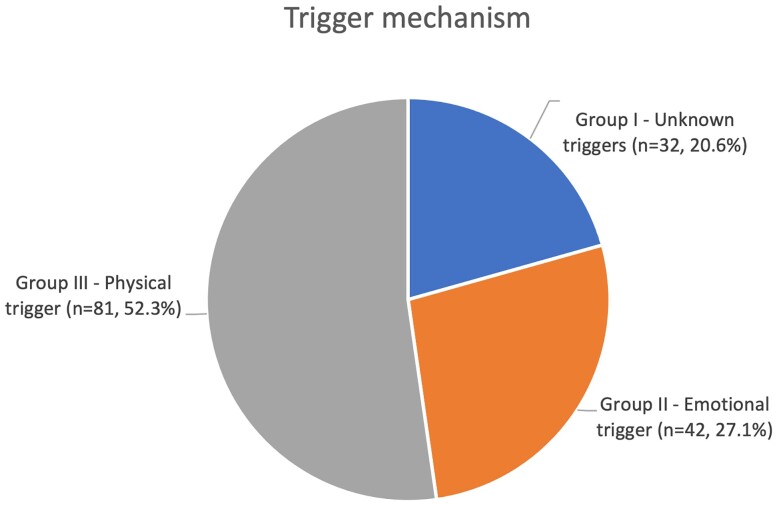
A unique clinical feature of Takotsubo syndrome (TTS) is the stress trigger factor. Different types of triggers exist, generally divided into emotional and physical stressor. The aim was to create long-term registry of all consecutive patients with TTS across all disciplines in our large university hospital. We enrolled patients on the basis of meeting the diagnostic criteria of the international InterTAK Registry. We aimed to determine type of triggers, clinical characteristics, and outcome of TTS patients during 10 years period. In our prospective, academic, single centre registry, we enrolled 155 consecutive patients with diagnoses of TTS between October 2013 and October 2022. The patients were divided into three groups, those having unknown ( = 32; 20.6%), emotional ( = 42; 27.1%), or physical ( = 81; 52.3%) triggers. Clinical characteristics, cardiac enzyme levels, echocardiographic findings, including ejection fraction, and TTS type did not differ among the groups. Chest pain was less common in the group of patients with a physical trigger. On the other hand, arrhythmogenic disorders such as prolonged QT intervals, cardiac arrest requiring defibrillation, and atrial fibrillation were more common among the TTS patients with unknown triggers compared with the other groups. The highest in-hospital mortality was observed between patients having physical trigger (16% vs. 3.1% in TTS with emotional trigger and 4.8% in TTS with unknown trigger; = 0.060). More than half of the patients with TTS diagnosed in a large university hospital had a physical trigger as a stress factor. An essential part of caring for these types of patients is the correct identification of TTS in the context of severe other conditions and the absence of typical cardiac symptoms. Patients with physical trigger have a significantly higher risk of acute heart complications. Interdisciplinary cooperation is essential in the treatment of patients with this diagnosis.
应激性心肌病(TTS)的一个独特临床特征是应激触发因素。存在不同类型的触发因素,一般分为情绪性和生理性应激源。目的是在我们大型大学医院建立一个涵盖所有学科的TTS连续患者的长期登记册。我们根据符合国际InterTAK登记册的诊断标准招募患者。我们旨在确定10年期间TTS患者的触发因素类型、临床特征和结局。在我们的前瞻性、学术性、单中心登记册中,我们招募了2013年10月至2022年10月期间连续诊断为TTS的155例患者。患者分为三组,触发因素未知组(n = 32;20.6%)、情绪性触发因素组(n = 42;27.1%)或生理性触发因素组(n = 81;52.3%)。各组之间的临床特征、心肌酶水平、超声心动图结果(包括射血分数)和TTS类型无差异。生理性触发因素组的患者胸痛较少见。另一方面,与其他组相比,触发因素未知的TTS患者中,诸如QT间期延长、需要除颤的心脏骤停和心房颤动等致心律失常性疾病更为常见。生理性触发因素组患者的院内死亡率最高(分别为16%,而情绪性触发因素的TTS患者为3.1%,触发因素未知的TTS患者为4.8%;P = 0.060)。在一家大型大学医院诊断的TTS患者中,超过一半有生理性触发因素作为应激因素。在严重的其他疾病背景下且无典型心脏症状的情况下正确识别TTS是护理这类患者的重要环节。生理性触发因素的患者发生急性心脏并发症的风险显著更高。跨学科合作在治疗此类诊断的患者中至关重要。