Wang Dandan, Hu Xiaolong, Li Minling, Liu Jie, Tang Ming, Liu Wuhua, Zhan Jianwen, Xu Yongtao, Zhang Weiwei
College of Forestry, Wildlife Conservation Research Center, Jiangxi Agricultural University, Nanchang, Jiangxi, China.
College of Animal Science and Technology, Jiangxi Agricultural University, Nanchang, Jiangxi, China.
Zookeys. 2023 Feb 22;1149:17-36. doi: 10.3897/zookeys.1149.96936. eCollection 2023.
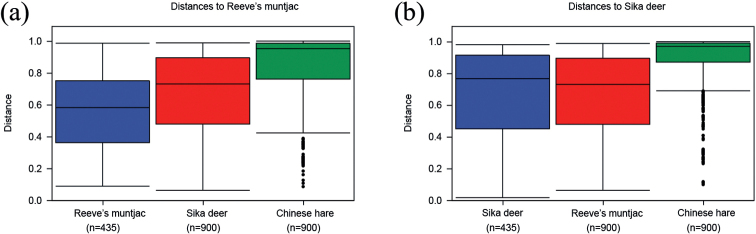
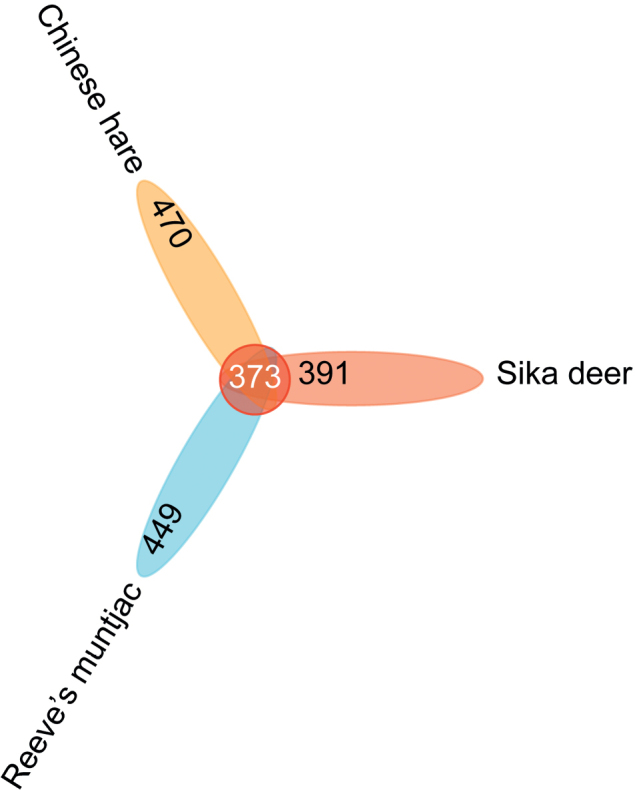
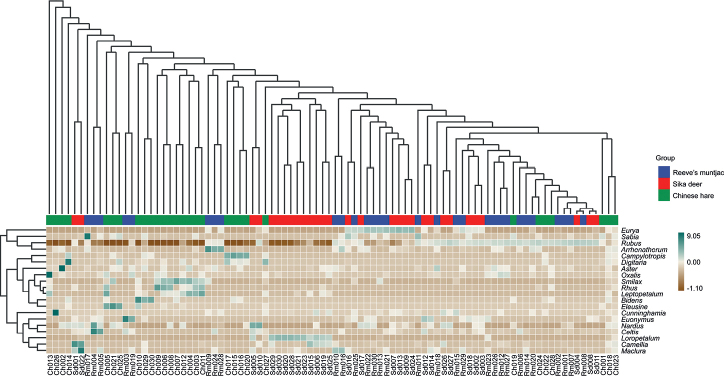
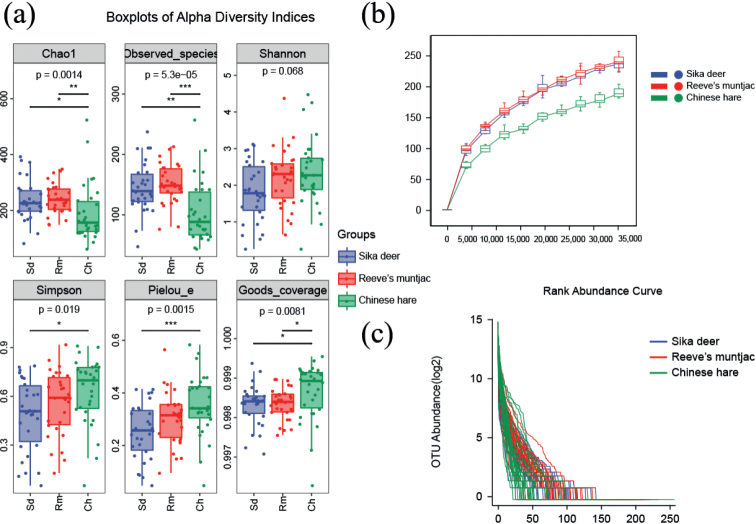
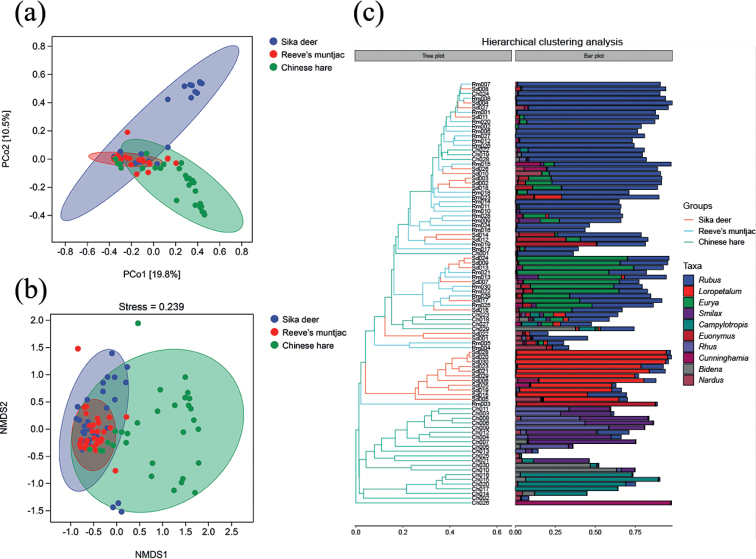
Species co-existence depends on how organisms utilize their environment and resources. Little is known about the winter diet composition and sympatric co-existence of South China sika deer and its companion species in Taohongling. In this study, high-throughput sequencing and metabarcoding trnL were used to study the diet composition and interspecific relationship including sika deer, Reeve's muntjac, and Chinese hare. Our results show that 203 genera in 90 families are contained in the diet of sika deer, 203 genera in 95 families for Reeve's muntjac, and 163 genera in 75 families for Chinese hare. Sika deer fed on , , and in winter, accounting for 75.30%; Reeve's muntjac consumed mainly , , and , accounting for 68.80%, and Chinese hare mainly fed on , , and , accounting for 41.98%. The Shannon index showed no significant difference between groups ( > 0.05). The NMDS analysis found considerable overlap among three species. Sika deer and Reeve's muntjac consumed similar forage plants but varied greatly in Chinese hare, which occupied the widest choice in winter, resulting in higher diet breadth and increased dietary divergence, thereby reducing competition and facilitating coexistence. The diet niche overlap index among them, as represented by Pianka's index, ranging from 0.62 between sika deer and Chinese hare to 0.83 between sika deer and Reeve's muntjac, which indicated a more similar niche and potential competition in closely related species. Our findings provide a new diet perspective of three herbivores, leading to a more comprehensive understanding of resource partitioning and species coexistence.
物种共存取决于生物体如何利用其环境和资源。关于华南梅花鹿及其在桃红岭的伴生物种的冬季饮食组成和同域共存情况,人们了解甚少。在本研究中,利用高通量测序和trnL元条形码技术研究了梅花鹿、黑麂和中华野兔的饮食组成及种间关系。我们的结果表明,梅花鹿的饮食中包含90科203属,黑麂的饮食中有95科203属,中华野兔的饮食中有75科163属。梅花鹿在冬季以[此处原文缺失具体植物名称]、[此处原文缺失具体植物名称]和[此处原文缺失具体植物名称]为食,占比75.30%;黑麂主要食用[此处原文缺失具体植物名称]、[此处原文缺失具体植物名称]和[此处原文缺失具体植物名称],占比68.80%,中华野兔主要以[此处原文缺失具体植物名称]、[此处原文缺失具体植物名称]和[此处原文缺失具体植物名称]为食,占比41.98%。香农指数显示各群体之间无显著差异(>0.05)。非度量多维尺度分析发现三个物种之间有相当大的重叠。梅花鹿和黑麂食用相似的饲用植物,但中华野兔的差异很大,中华野兔在冬季的选择范围最广,导致其饮食广度更高,饮食差异增加,从而减少竞争并促进共存。以Pianka指数表示的它们之间的饮食生态位重叠指数,在梅花鹿和中华野兔之间为0.62,在梅花鹿和黑麂之间为0.83,这表明亲缘关系较近的物种生态位更相似且存在潜在竞争。我们的研究结果为这三种食草动物提供了新的饮食视角,有助于更全面地理解资源分配和物种共存。