Li Ruofei, Wang Dandan, Cao Zhiming, Liu Yuqin, Wu Wenguo, Liu Wuhua, Zhan Jianwen, Xu Yongtao
Jiangxi Provincial Key Laboratory of Conservation Biology, Jiangxi Agricultural University, Nanchang, Jiangxi, China.
Taohongling Sika Deer National Nature Reserve Administration, Pengze, Jiangxi, China.
PeerJ. 2024 Dec 23;12:e18665. doi: 10.7717/peerj.18665. eCollection 2024.
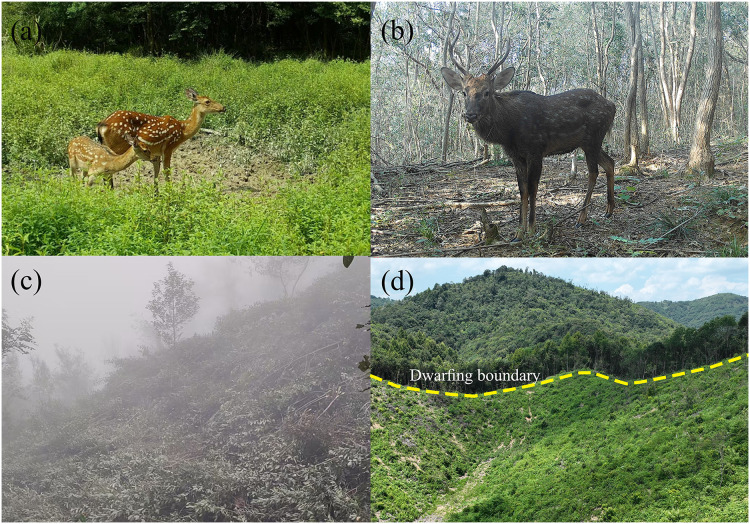
Food provides essential nutrients and energy necessary for animals to sustain life activities. Accordingly, dietary niche analysis facilitates the exploration of foraging strategies and interspecific relationships among wildlife. The vegetation succession has reduced understory forage resources (., shrubs and herbs) available to sika deer (). Little is known about the summer foraging strategies or the interspecific relationship between sika deer and Reeves' muntjac ().
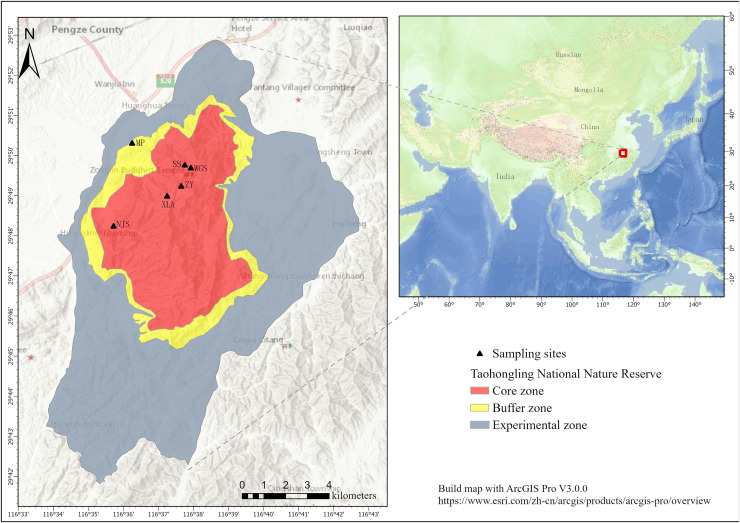
The present study used high-throughput sequencing and DNA metabarcoding techniques to investigate the feeding habits and interspecific relationships between sika deer and Reeves' muntjac in our study.
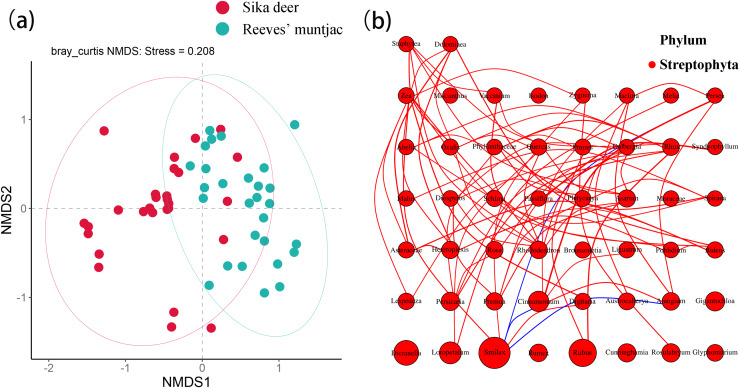
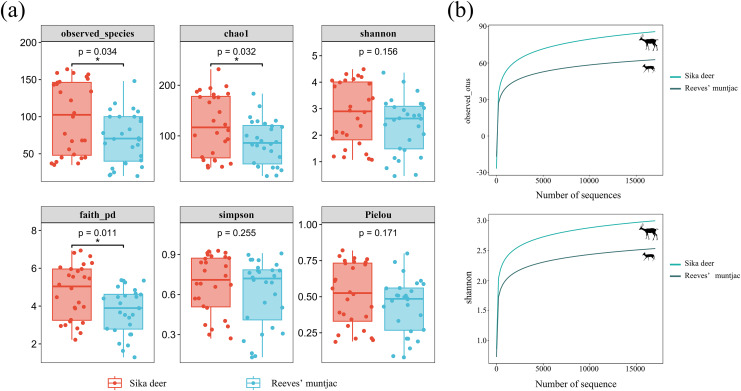
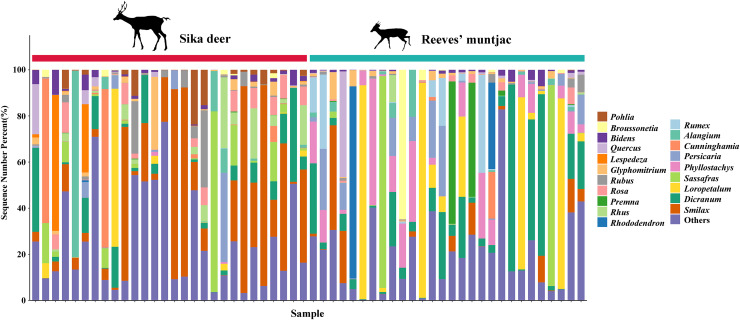
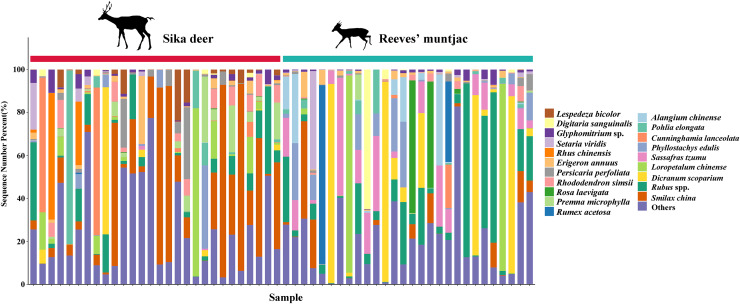
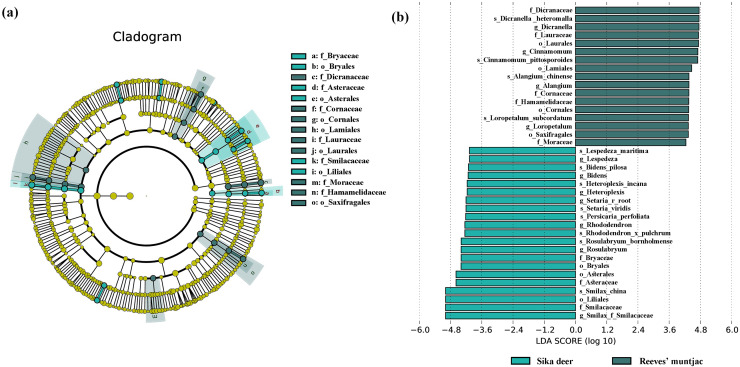
A total of 458 amplicon sequence variants (ASVs) were identified from fecal samples, with 88 ASVs (19.21%) unique to sika deer and 52 ASVs (11.35%) unique to Reeves' muntjac, suggesting the consumption and utilization of specific food items for the two species. The family Rosaceae was the most abundant for both species, especially spp. and . Alpha diversity (local species richness) indicated that the dietary species richness of sika deer was higher than that of Reeves' muntjac, but the difference was not statistically significant. Sika deer also exhibited a higher evenness index ( = 0.514) than Reeves' muntjac ( = 0.442). Linear discriminant effect size analysis revealed significant differences in forage plants between the two herbivores. The niche breadths of sika deer and Reeves' muntjac were 11.36 and 14.06, respectively, and the dietary niche overlap index was 0.44. Our findings indicate the diet partitioning primarily manifested in the differentiation of food items and the proportion, which ultimately reduces the overlap of nutritional niches and helps avoid conflicts resulting from resource utilization. This study provides a deeper insight into the diversity of foraging strategies and the interspecific relationship of herbivores from the food dimension.
食物为动物维持生命活动提供必需的营养物质和能量。因此,食性生态位分析有助于探索野生动物的觅食策略和种间关系。植被演替减少了梅花鹿可利用的林下觅食资源(如灌木和草本植物)。目前对于梅花鹿的夏季觅食策略或梅花鹿与黑麂之间的种间关系了解甚少。
本研究采用高通量测序和DNA宏条形码技术,调查了研究区域内梅花鹿和黑麂的食性及种间关系。
从粪便样本中总共鉴定出458个扩增子序列变体(ASV),其中88个ASV(约19.21%)为梅花鹿所特有,52个ASV(约11.35%)为黑麂所特有,这表明这两个物种对特定食物的消耗和利用情况。蔷薇科对两个物种来说都是最丰富的,尤其是 属植物和 属植物。α多样性(局部物种丰富度)表明,梅花鹿的食性物种丰富度高于黑麂,但差异无统计学意义。梅花鹿的均匀度指数(=0.514)也高于黑麂(=0.442)。线性判别效应大小分析显示,两种食草动物的觅食植物存在显著差异。梅花鹿和黑麂的生态位宽度分别为11.36和14.06,食性生态位重叠指数为0.44。我们的研究结果表明,食性划分主要体现在食物种类和比例的差异上,这最终减少了营养生态位的重叠,有助于避免因资源利用而产生的冲突。本研究从食物维度为食草动物觅食策略的多样性和种间关系提供了更深入的见解。