Department of Mathematics, School of Natural Sciences, Shiv Nadar Institution of Eminence, Dadri, Uttar Pradesh, India.
Global Health Institute, University of Antwerp, Antwerp, Belgium.
PLoS Negl Trop Dis. 2023 May 26;17(5):e0011320. doi: 10.1371/journal.pntd.0011320. eCollection 2023 May.
Onchocerciasis, also known as "river blindness", is caused by the bite of infected female blackflies (genus Simuliidae) that transmit the parasite Onchocerca volvulus. A high onchocerciasis microfarial load increases the risk to develop epilepsy in children between the ages of 3 and 18 years. In resource-limited settings in Africa where onchocerciasis has been poorly controlled, high numbers of onchocerciasis-associated epilepsy (OAE) are reported. We use mathematical modeling to predict the impact of onchocerciasis control strategies on the incidence and prevalence of OAE.
We developed an OAE model within the well-established mathematical modelling framework ONCHOSIM. Using Latin-Hypercube Sampling (LHS), and grid search technique, we quantified transmission and disease parameters using OAE data from Maridi County, an onchocerciasis endemic area, in southern Republic of South Sudan. Using ONCHOSIM, we predicted the impact of ivermectin mass drug administration (MDA) and vector control on the epidemiology of OAE in Maridi.
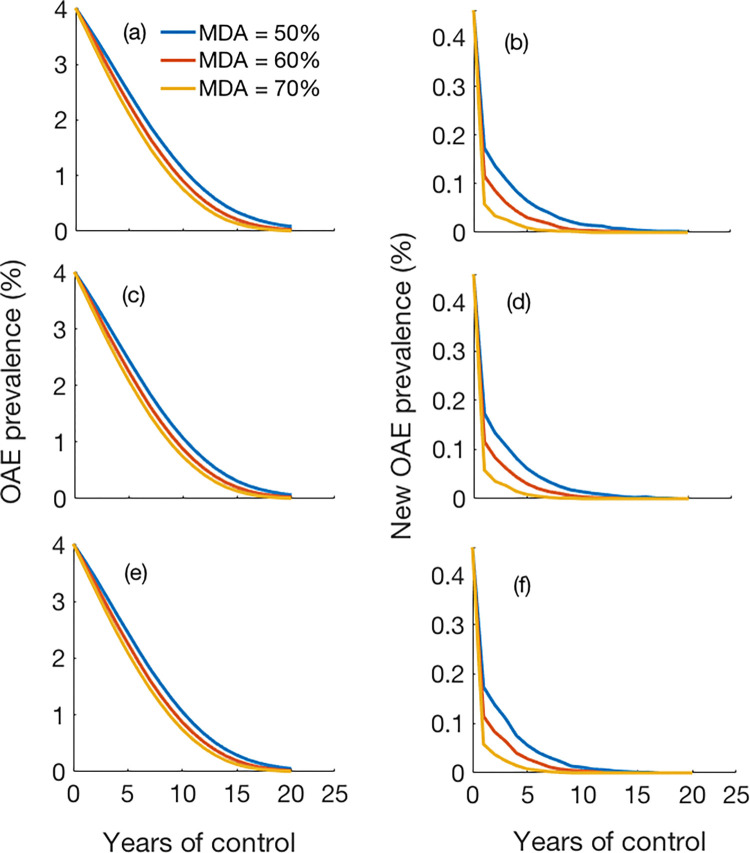
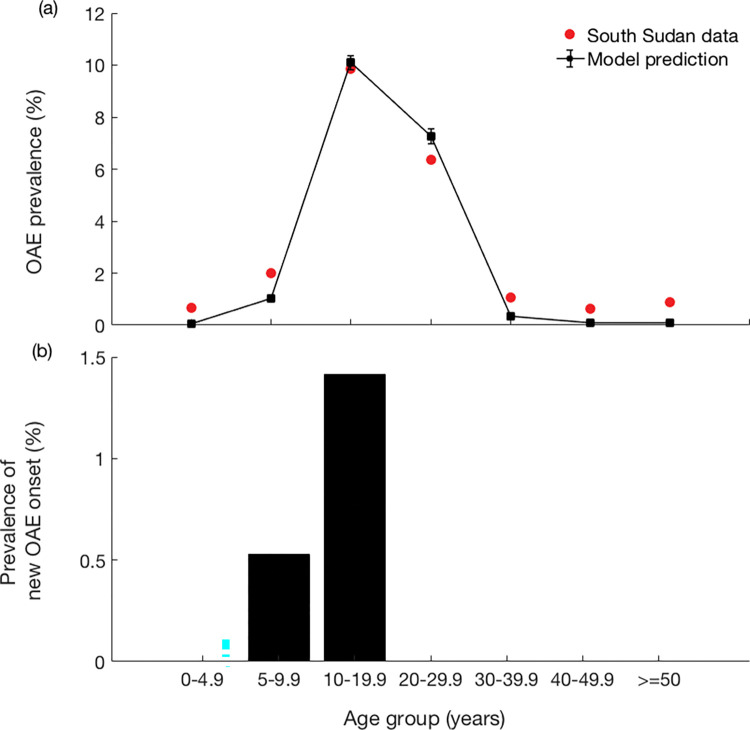
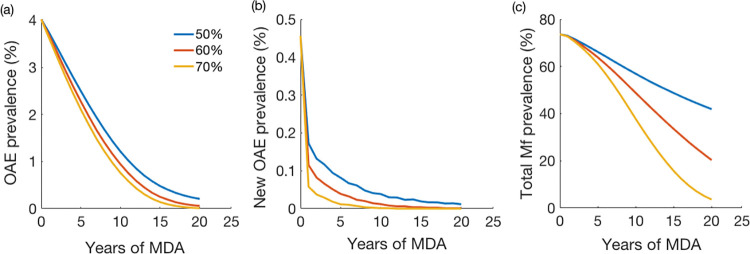
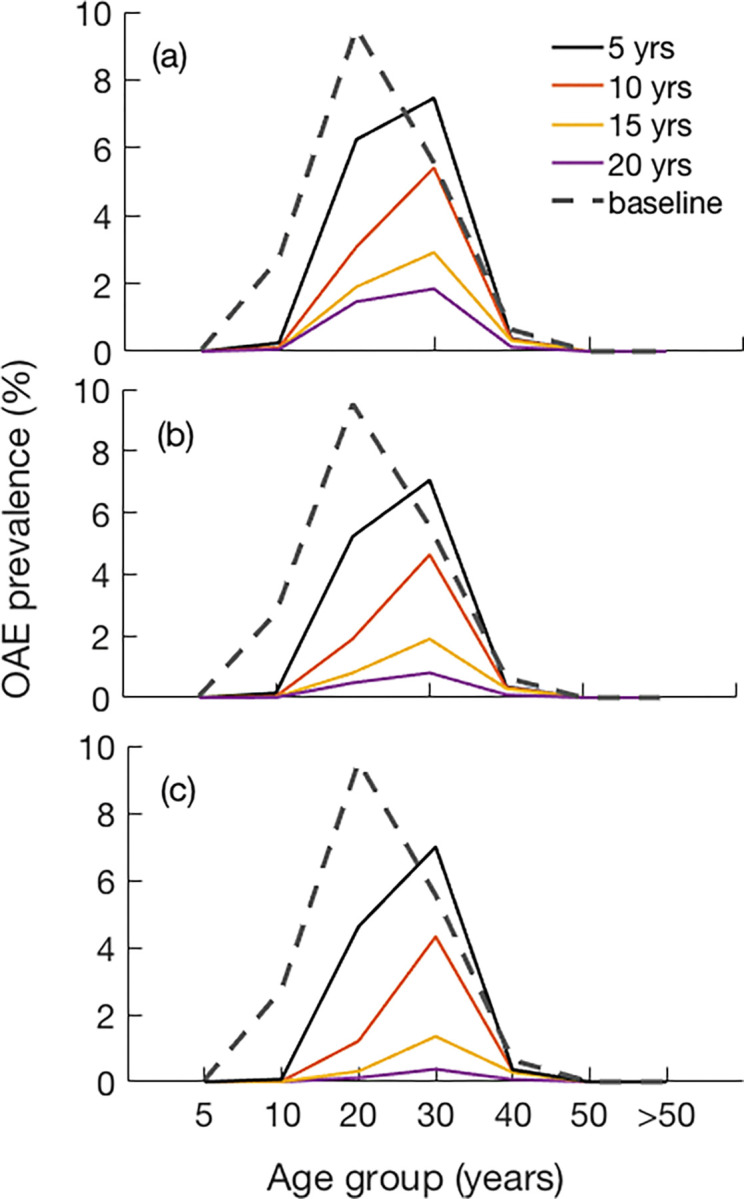
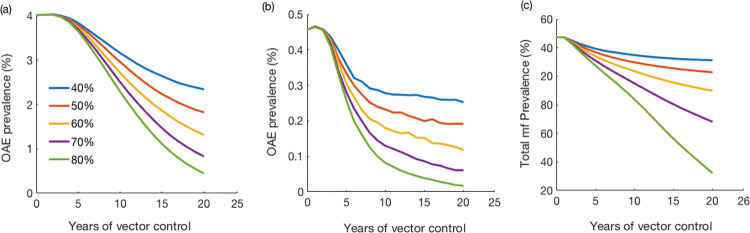
The model estimated an OAE prevalence of 4.1% in Maridi County, close to the 3.7% OAE prevalence reported in field studies. The OAE incidence is expected to rapidly decrease by >50% within the first five years of implementing annual MDA with good coverage (≥70%). With vector control at a high efficacy level (around 80% reduction of blackfly biting rates) as the sole strategy, the reduction is slower, requiring about 10 years to halve the OAE incidence. Increasing the efficacy levels of vector control, and implementing vector control simultaneously with MDA, yielded better results in preventing new cases of OAE.
CONCLUSIONS/SIGNIFICANCES: Our modeling study demonstrates that intensifying onchocerciasis eradication efforts could substantially reduce OAE incidence and prevalence in endemic foci. Our model may be useful for optimizing OAE control strategies.
盘尾丝虫病,又称“河盲症”,是由受感染的雌性蚋(Simuliidae 属)叮咬传播寄生虫盘尾丝虫引起的。高微丝蚴负荷会增加 3 至 18 岁儿童患癫痫的风险。在非洲资源有限的地区,盘尾丝虫病控制不力,据报道有大量与盘尾丝虫病相关的癫痫(OAE)。我们使用数学模型来预测盘尾丝虫病控制策略对 OAE 发病率和患病率的影响。
我们在成熟的数学模型框架 ONCHOSIM 中开发了一个 OAE 模型。使用拉丁超立方抽样(LHS)和网格搜索技术,我们使用来自南苏丹共和国马里迪县的 OAE 数据量化了传播和疾病参数,马里迪县是盘尾丝虫病流行地区。使用 ONCHOSIM,我们预测了在马里迪实施伊维菌素大规模药物治疗(MDA)和病媒控制对 OAE 流行病学的影响。
该模型估计马里迪县的 OAE 患病率为 4.1%,接近实地研究报告的 3.7%的 OAE 患病率。在实施高覆盖率(≥70%)的年度 MDA 的前五年内,OAE 发病率预计将迅速下降超过 50%。如果仅使用高疗效(减少蚋叮咬率约 80%)的病媒控制作为单一策略,则降低速度较慢,需要大约 10 年时间将 OAE 发病率减半。提高病媒控制的疗效水平,并同时与 MDA 实施病媒控制,可以更好地预防新的 OAE 病例。
结论/意义:我们的建模研究表明,加强盘尾丝虫病根除工作可以大大降低流行地区 OAE 的发病率和患病率。我们的模型可能有助于优化 OAE 控制策略。