Di Stefano Vincenzo, Prinzi Francesco, Luigetti Marco, Russo Massimo, Tozza Stefano, Alonge Paolo, Romano Angela, Sciarrone Maria Ausilia, Vitali Francesca, Mazzeo Anna, Gentile Luca, Palumbo Giovanni, Manganelli Fiore, Vitabile Salvatore, Brighina Filippo
Department of Biomedicine, Neuroscience and Advanced Diagnostics (BiND), University of Palermo, 90127 Palermo, Italy.
Fondazione Policlinico Universitario A, Gemelli-IRCCS, UOC Neurologia, 00168 Rome, Italy.
Brain Sci. 2023 May 16;13(5):805. doi: 10.3390/brainsci13050805.
Hereditary transthyretin amyloidosis with polyneuropathy (ATTRv) is an adult-onset multisystemic disease, affecting the peripheral nerves, heart, gastrointestinal tract, eyes, and kidneys. Nowadays, several treatment options are available; thus, avoiding misdiagnosis is crucial to starting therapy in early disease stages. However, clinical diagnosis may be difficult, as the disease may present with unspecific symptoms and signs. We hypothesize that the diagnostic process may benefit from the use of machine learning (ML).
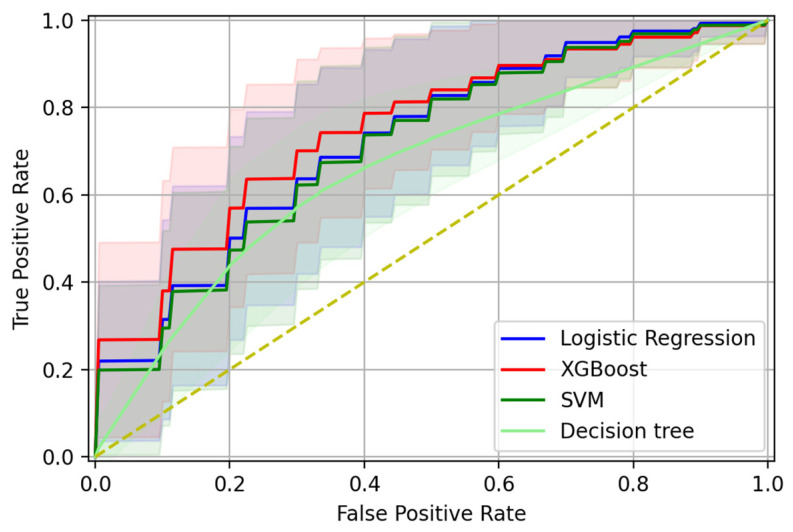
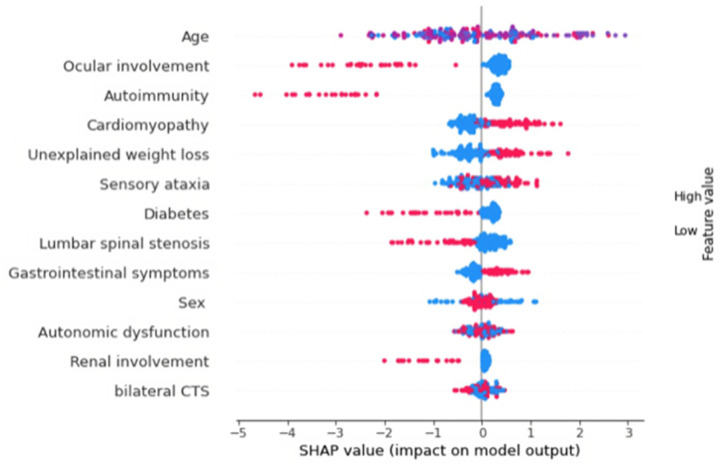
397 patients referring to neuromuscular clinics in 4 centers from the south of Italy with neuropathy and at least 1 more red flag, as well as undergoing genetic testing for ATTRv, were considered. Then, only probands were considered for analysis. Hence, a cohort of 184 patients, 93 with positive and 91 (age- and sex-matched) with negative genetics, was considered for the classification task. The XGBoost (XGB) algorithm was trained to classify positive and negative mutation patients. The SHAP method was used as an explainable artificial intelligence algorithm to interpret the model findings.
diabetes, gender, unexplained weight loss, cardiomyopathy, bilateral carpal tunnel syndrome (CTS), ocular symptoms, autonomic symptoms, ataxia, renal dysfunction, lumbar canal stenosis, and history of autoimmunity were used for the model training. The XGB model showed an accuracy of 0.707 ± 0.101, a sensitivity of 0.712 ± 0.147, a specificity of 0.704 ± 0.150, and an AUC-ROC of 0.752 ± 0.107. Using the SHAP explanation, it was confirmed that unexplained weight loss, gastrointestinal symptoms, and cardiomyopathy showed a significant association with the genetic diagnosis of ATTRv, while bilateral CTS, diabetes, autoimmunity, and ocular and renal involvement were associated with a negative genetic test.
Our data show that ML might potentially be a useful instrument to identify patients with neuropathy that should undergo genetic testing for ATTRv. Unexplained weight loss and cardiomyopathy are relevant red flags in ATTRv in the south of Italy. Further studies are needed to confirm these findings.
遗传性转甲状腺素蛋白淀粉样变多发性神经病(ATTRv)是一种成人起病的多系统疾病,会影响周围神经、心脏、胃肠道、眼睛和肾脏。如今,有多种治疗选择;因此,避免误诊对于在疾病早期阶段开始治疗至关重要。然而,临床诊断可能很困难,因为该疾病可能表现出非特异性症状和体征。我们假设诊断过程可能会受益于机器学习(ML)的应用。
研究纳入了来自意大利南部4个中心神经肌肉诊所的397例患有神经病且至少还有1个警示信号并接受了ATTRv基因检测的患者。然后,仅考虑先证者进行分析。因此,将一组184例患者纳入分类任务,其中93例基因检测为阳性,91例(年龄和性别匹配)基因检测为阴性。使用XGBoost(XGB)算法对阳性和阴性突变患者进行分类。采用SHAP方法作为可解释的人工智能算法来解释模型结果。
糖尿病、性别、不明原因体重减轻、心肌病、双侧腕管综合征(CTS)、眼部症状、自主神经症状、共济失调、肾功能不全、腰椎管狭窄和自身免疫病史用于模型训练。XGB模型的准确率为0.707±0.101,灵敏度为0.712±0.147,特异性为0.704±0.150,曲线下面积(AUC-ROC)为0.752±0.107。通过SHAP解释证实,不明原因体重减轻、胃肠道症状和心肌病与ATTRv的基因诊断显著相关,而双侧CTS、糖尿病、自身免疫以及眼部和肾脏受累与基因检测阴性相关。
我们的数据表明,机器学习可能是识别应接受ATTRv基因检测的神经病患者的有用工具。在意大利南部,不明原因体重减轻和心肌病是ATTRv的重要警示信号。需要进一步研究来证实这些发现。