Department of Oncology, University of Turin, San Luigi Hospital, 10043 Orbassano, TO, Italy.
Int J Mol Sci. 2023 May 17;24(10):8883. doi: 10.3390/ijms24108883.
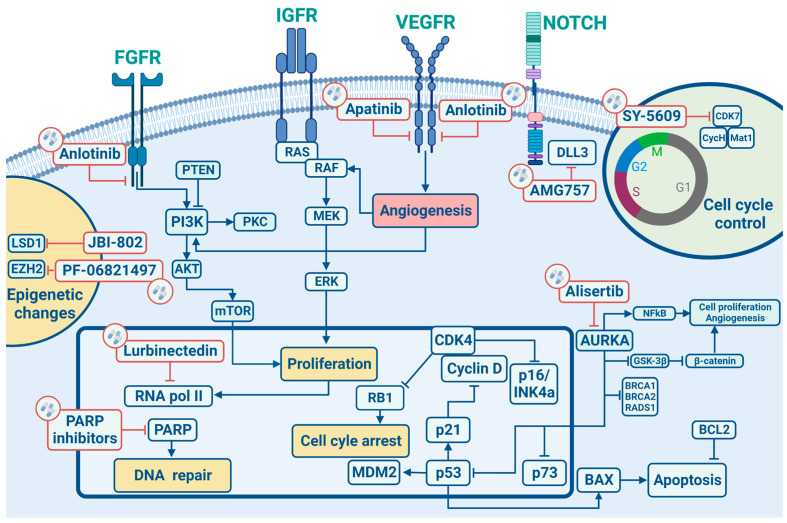
The clinical management of small cell lung cancer (SCLC) treatment remains a major challenge for thoracic oncologists, with very few therapeutic advances significantly impacting patients' survival. The recent introduction of immunotherapy in the clinical setting produced a marginal benefit for a limited subset of metastatic patients, while the therapeutic scenario for relapsing extended-disease small cell lung cancers (ED-SCLCs) remains almost deserted. Recent efforts clarified the molecular features of this disease, leading to the identification of key signalling pathways which may serve as potential targets for clinical use. Despite the large number of molecules tested and the numerous therapeutic failures, some targeted therapies have recently shown interesting preliminary results. In this review, we describe the main molecular pathways involved in SCLC development/progression and provide an updated summary of the targeted therapies currently under investigation in SCLC patients.
小细胞肺癌(SCLC)的临床治疗仍然是胸科肿瘤学家面临的重大挑战,很少有治疗进展能显著改善患者的生存。免疫疗法在临床应用中的最近引入仅对有限的转移性患者亚组产生了微小获益,而复发广泛期小细胞肺癌(ED-SCLC)的治疗情况仍然几乎没有进展。最近的研究阐明了该疾病的分子特征,确定了可能作为临床应用的潜在靶点的关键信号通路。尽管测试了大量的分子并经历了许多治疗失败,但一些靶向治疗最近显示出了有趣的初步结果。在这篇综述中,我们描述了 SCLC 发展/进展中涉及的主要分子途径,并提供了目前正在 SCLC 患者中进行研究的靶向治疗的最新总结。