Kawano Yutaro, Masai Hiroshi, Nakagawa Shintaro, Yoshie Naoko, Terao Jun
Department of Basic Science, Graduate School of Arts and Sciences, The University of Tokyo, 3-8-1, Komaba, Meguro-ku, Tokyo 153-8902, Japan.
PRESTO, Japan Science and Technology Agency, 4-1-8, Honcho, Kawaguchi, Saitama 332-0012, Japan.
Polymers (Basel). 2023 May 20;15(10):2389. doi: 10.3390/polym15102389.
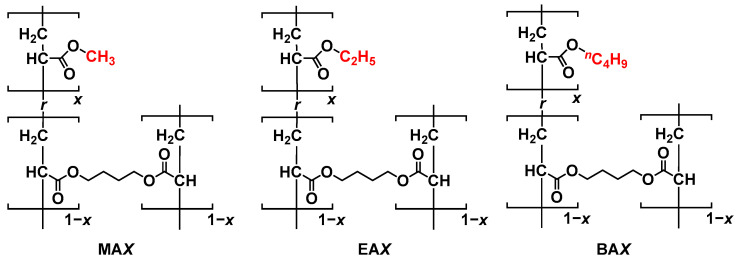
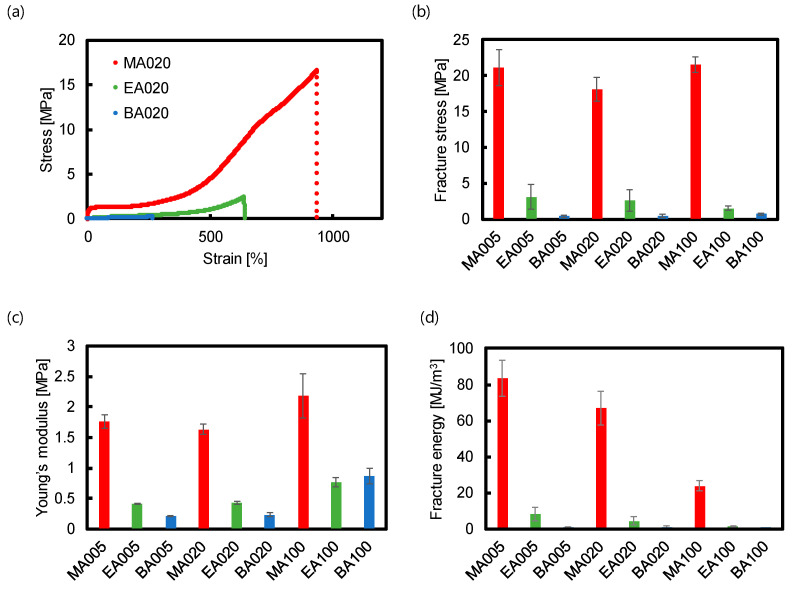
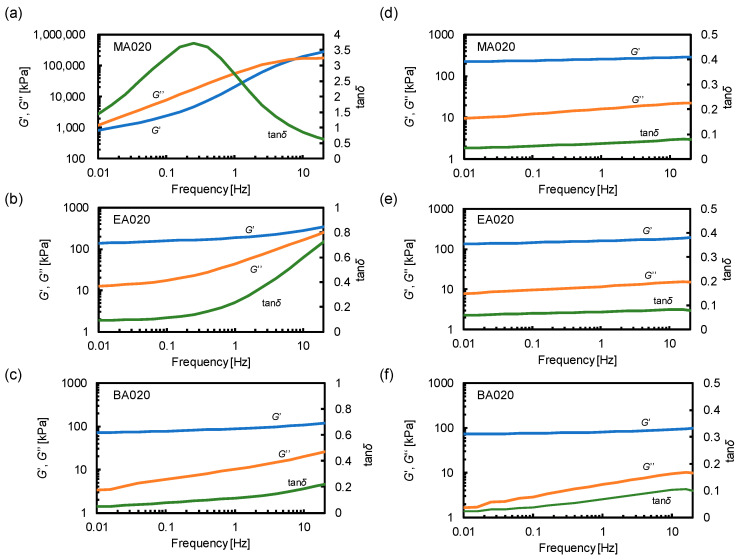
Polyacrylate-based network materials are widely used in various products owing to their facile synthesis via radical polymerization reactions. In this study, the effects of alkyl ester chains on the toughness of polyacrylate-based network materials were investigated. Polymer networks were fabricated via the radical polymerization of methyl acrylate (MA), ethyl acrylate (EA), and butyl acrylate (BA) in the presence of 1,4-butanediol diacrylate as a crosslinker. Differential scanning calorimetry and rheological measurements revealed that the toughness of MA-based networks drastically increased compared with that of EA- and BA-based networks; the fracture energy of the MA-based network was approximately 10 and 100 times greater than that of EA and BA, respectively. The high fracture energy was attributed to the glass transition temperature of the MA-based network (close to room temperature), resulting in large energy dissipation via viscosity. Our results set a new basis for expanding the applications of polyacrylate-based networks as functional materials.
基于聚丙烯酸酯的网络材料因其可通过自由基聚合反应轻松合成而广泛应用于各种产品中。在本研究中,研究了烷基酯链对基于聚丙烯酸酯的网络材料韧性的影响。通过在作为交联剂的1,4 - 丁二醇二丙烯酸酯存在下,使丙烯酸甲酯(MA)、丙烯酸乙酯(EA)和丙烯酸丁酯(BA)进行自由基聚合来制备聚合物网络。差示扫描量热法和流变学测量表明,与基于EA和BA的网络相比,基于MA的网络的韧性急剧增加;基于MA的网络的断裂能分别比基于EA和BA的网络大大约10倍和100倍。高断裂能归因于基于MA的网络的玻璃化转变温度(接近室温),导致通过粘性产生大量能量耗散。我们的结果为扩展基于聚丙烯酸酯的网络作为功能材料的应用奠定了新基础。