Université Paris Cité, Institute of Psychiatry and Neuroscience of Paris (IPNP), INSERM U1266, Paris, Institutde psychiatrie, CNRS GDR 3557, France.
NeuroSpin, Atomic Energy Commission, Gif-sur Yvette, France.
Eur Psychiatry. 2023 May 29;66(1):e41. doi: 10.1192/j.eurpsy.2023.2414.
Electroencephalography (EEG) microstates translate resting-state temporal dynamics of neuronal networks throughout the brain and could constitute possible markers of psychiatric disorders. We tested the hypothesis of an increased imbalance between a predominant self-referential mode (microstate C) and a decreased attentional mode (microstate D) in psychosis, mood, and autism spectrum disorders.
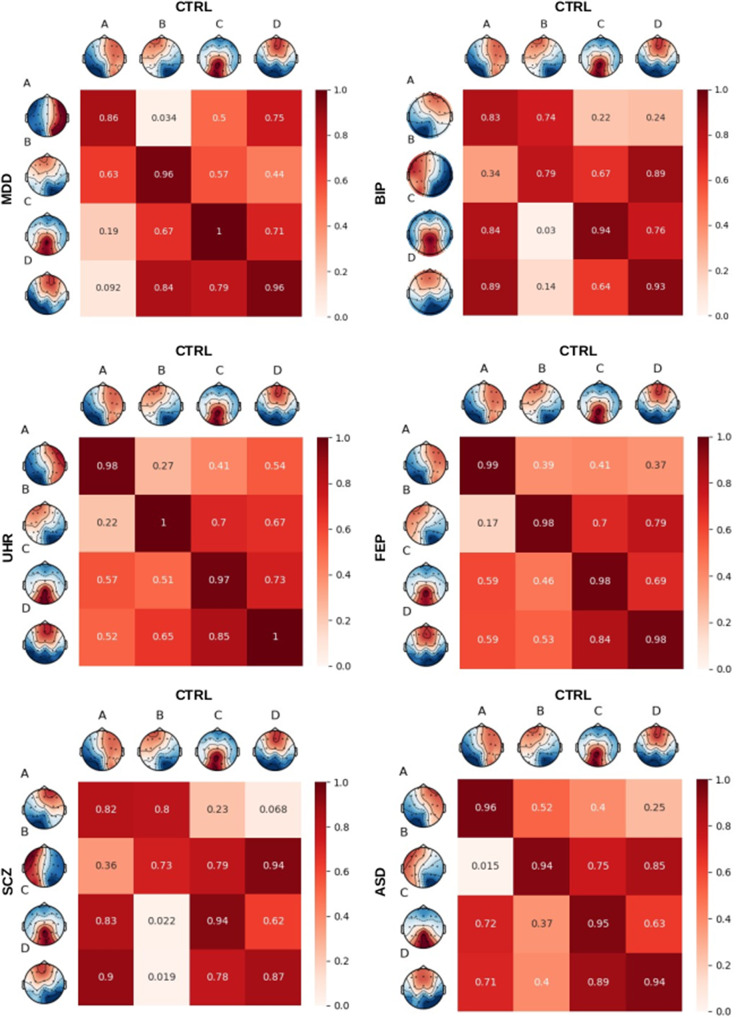
We retrospectively included 135 subjects from an early psychosis outpatient unit, with available eyes-closed resting-state 19 electrodes EEG. Individual-level then group-level modified -means clustering in controls provided four microstate maps that were then backfitted to all groups. Differences between microstate parameters (occurrence, coverage, and mean duration) were computed between controls and each group, and between disease groups.
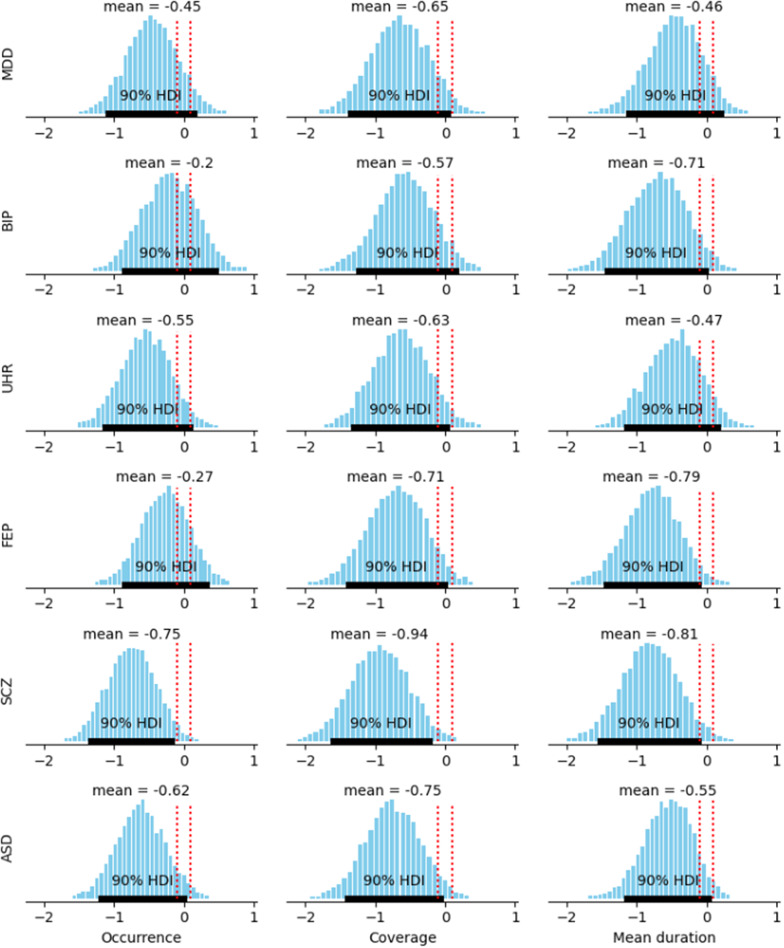
Microstate class D parameters were systematically decreased in disease groups compared with controls, with an effect size increasing along the psychosis spectrum, but also in autism. There was no difference in class C. C/D ratios of mean duration were increased only in SCZ compared with controls.
The decrease in microstate class D may be a marker of stage of psychosis, but it is not specific to it and may rather reflect a shared dimension along the schizophrenia-autism spectrum. C/D microstate imbalance may be more specific to schizophrenia.
脑电图 (EEG) 微状态转化了整个大脑中神经元网络的静息状态时间动态,可能构成精神障碍的可能标志物。我们测试了精神病、情绪和自闭症谱系障碍中占主导地位的自我参照模式(微状态 C)和注意力模式(微状态 D)之间失衡增加的假设。
我们回顾性地纳入了来自早期精神病门诊单位的 135 名受试者,他们有可用的闭眼静息状态 19 个电极脑电图。在对照组中,个体水平然后是组水平的修正均值聚类提供了四个微状态图,然后将其反向拟合到所有组。在对照组和每个组之间,以及在疾病组之间,计算了微状态参数(出现、覆盖和平均持续时间)之间的差异。
与对照组相比,疾病组的微状态 D 类参数系统降低,其效应大小沿精神病谱增加,但在自闭症中也增加。微状态 C 类没有差异。只有在 SCZ 中,微状态 C/D 类的平均持续时间比对照组增加。
微状态 D 类的减少可能是精神病阶段的标志物,但它不是特异性的,而可能反映了精神分裂症-自闭症谱系的共同维度。C/D 微状态失衡可能更特异性地指向精神分裂症。