Université Claude Bernard Lyon 1, CNRS, INSERM, Centre de Recherche en Neurosciences de Lyon CRNL U1028 UMR5292, PSYR2, Bron, France.
CH le Vinatier, Bron, France.
Hum Brain Mapp. 2023 Aug 1;44(11):4372-4389. doi: 10.1002/hbm.26387. Epub 2023 May 29.
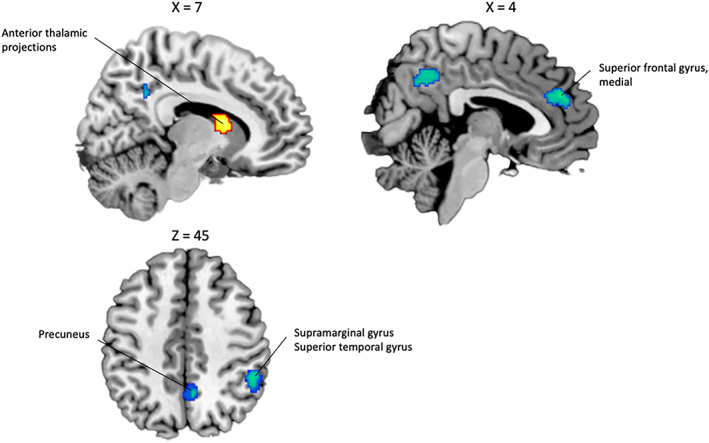
Distinguishing imagination and thoughts from information we perceived from the environment, a process called reality-monitoring, is important in everyday situations. Although reality monitoring seems to overlap with the concept of self-monitoring, which allows one to distinguish self-generated actions or thoughts from those generated by others, the two concepts remain largely separate cognitive domains and their common brain substrates have received little attention. We investigated the brain regions involved in these two cognitive processes and explored the common brain regions they share. To do this, we conducted two separate coordinate-based meta-analyses of functional magnetic resonance imaging studies assessing the brain regions involved in reality- and self-monitoring. Few brain regions survived threshold-free cluster enhancement family-wise multiple comparison correction (p < .05), likely owing to the small number of studies identified. Using uncorrected statistical thresholds recommended by Signed Differential Mapping with Permutation of Subject Images, the meta-analysis of reality-monitoring studies (k = 9 studies including 172 healthy subjects) revealed clusters in the lobule VI of the cerebellum, the right anterior medial prefrontal cortex and anterior thalamic projections. The meta-analysis of self-monitoring studies (k = 12 studies including 192 healthy subjects) highlighted the involvement of a set of brain regions including the lobule VI of the left cerebellum and fronto-temporo-parietal regions. We showed with a conjunction analysis that the lobule VI of the cerebellum was consistently engaged in both reality- and self-monitoring. The current findings offer new insights into the common brain regions underlying reality-monitoring and self-monitoring, and suggest that the neural signature of the self that may occur during self-production should persist in memories.
区分想象和思想与我们从环境中感知到的信息,这个过程被称为现实监测,在日常情况下非常重要。虽然现实监测似乎与自我监测的概念重叠,自我监测可以区分自我产生的动作或思想与他人产生的动作或思想,但这两个概念仍然是分开的认知领域,它们共同的大脑基础很少受到关注。我们研究了涉及这两个认知过程的大脑区域,并探讨了它们共同的大脑区域。为此,我们对评估现实监测和自我监测所涉及的大脑区域的功能磁共振成像研究进行了两次独立的基于坐标的荟萃分析。由于确定的研究数量较少,很少有大脑区域通过无阈值聚类增强的全脑多重比较校正(p < 0.05)。使用 Signed Differential Mapping with Permutation of Subject Images 推荐的未校正统计阈值,现实监测研究的荟萃分析(k = 9 项研究,包括 172 名健康受试者)显示小脑 VI 回、右侧前内侧前额叶皮质和前丘脑投射的聚类。自我监测研究的荟萃分析(k = 12 项研究,包括 192 名健康受试者)突出了一组大脑区域的参与,包括左小脑 VI 回和额颞顶叶区域。我们通过联合分析表明,小脑 VI 回在现实监测和自我监测中都有一致的参与。目前的研究结果为现实监测和自我监测的共同大脑区域提供了新的见解,并表明自我在自我产生过程中可能出现的神经特征应该在记忆中持续存在。