Gastroenterology and Hepatology, Veterans Affairs Medical Center and University of Utah Health School of Medicine, 30 N 1900 E SOM 4R118, Salt Lake City, UT, 84132, USA.
Internal Medicine, UT Health, San Antonio, TX, USA.
Indian J Gastroenterol. 2023 Jun;42(3):315-323. doi: 10.1007/s12664-023-01373-5. Epub 2023 May 29.
Irritable bowel syndrome (IBS) results in significant loss of quality of life. Management guidelines do not recommend fecal microbiota transplant (FMT) for IBS based on weak evidence as refined data is lacking. We performed a systematic review and meta-analysis to ascertain the pooled clinical outcomes of FMT in IBS, delivered via invasive routes.
Multiple databases were searched through January 2023 to identify studies that reported on FMT treatment in IBS by invasive routes. Standard meta-analysis methodology using the random-effects model was used. Heterogeneity was assessed by I% and 95% predication interval.
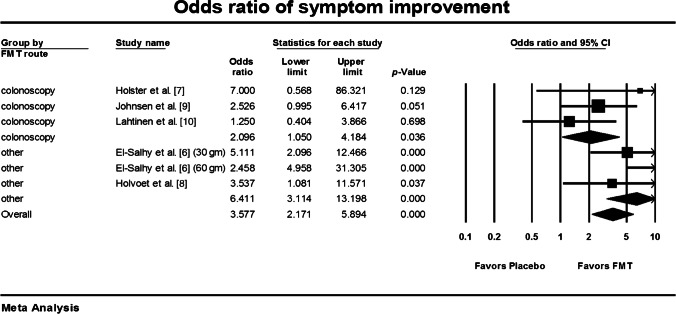
Five studies were included. As many as 377 IBS patients were assessed, of which 238 received FMT and 139 received placebo. One study used nasojejunal tubes, one esophagogastroduodenoscopy and three colonoscopy for FMT delivery. FMT via colonoscopy was performed as a one-time procedure instilled into the cecum. Two studies used 30 g of stool from a single universal donor and one study used 50-80 g of pooled donor feces. The pooled odds ratio of improvement in IBS symptoms with FMT was significantly better as compared to that of placebo OR = 2.9 (95% CI [1.6-5.2, I = 62%, p < 0.001]). This was true for studies that exclusively used colonoscopy (OR = 2.1 [1.1-4.2, p = 0.04]). In the FMT arm, 10 patients (10.6%) reported abdomen pain and worsening of symptoms with bloating and six patients (6.3%) reported diarrhea.
FMT delivered via invasive routes, especially colonoscopy, demonstrated significant improvement in IBS symptoms. A single FMT consisting of 30 g or more of single universal donor feces instilled into the cecum is the predominant modality.
肠易激综合征(IBS)导致生活质量显著下降。管理指南不建议根据缺乏细化数据的弱证据,将粪便微生物群移植(FMT)用于 IBS。我们进行了系统评价和荟萃分析,以确定通过侵袭性途径进行的 FMT 在 IBS 中的综合临床疗效。
通过搜索多个数据库,截至 2023 年 1 月,我们确定了报告通过侵袭性途径治疗 IBS 的 FMT 的研究。使用随机效应模型进行标准荟萃分析方法。通过 I%和 95%预测区间评估异质性。
共纳入 5 项研究。多达 377 例 IBS 患者接受了评估,其中 238 例接受了 FMT,139 例接受了安慰剂。一项研究使用了鼻空肠管,一项研究使用了食管胃十二指肠镜,三项研究使用了结肠镜进行 FMT 输送。结肠镜下 FMT 通过单次操作注入盲肠。两项研究使用了来自单一通用供体的 30 g 粪便,一项研究使用了 50-80 g 的混合供体粪便。与安慰剂相比,FMT 改善 IBS 症状的汇总优势比明显更好(OR=2.9[95%CI[1.6-5.2,I=62%,p<0.001])。对于仅使用结肠镜的研究,这一结果也是如此(OR=2.1[1.1-4.2,p=0.04])。在 FMT 组中,有 10 名患者(10.6%)报告出现腹痛和腹部肿胀症状恶化,6 名患者(6.3%)报告出现腹泻。
通过侵袭性途径,尤其是结肠镜下,FMT 可显著改善 IBS 症状。将 30 g 或更多来自单一通用供体的粪便单次注入盲肠是主要的治疗方式。