Department of Urology, Juntendo University Graduate School of Medicine, 2-1-1 Hongo Bunkyo-Ku, Tokyo, 1138431, Japan.
Department of Urology, Juntendo University Nerima Hospital, Tokyo, Japan.
Sci Rep. 2023 May 29;13(1):8704. doi: 10.1038/s41598-023-35790-5.
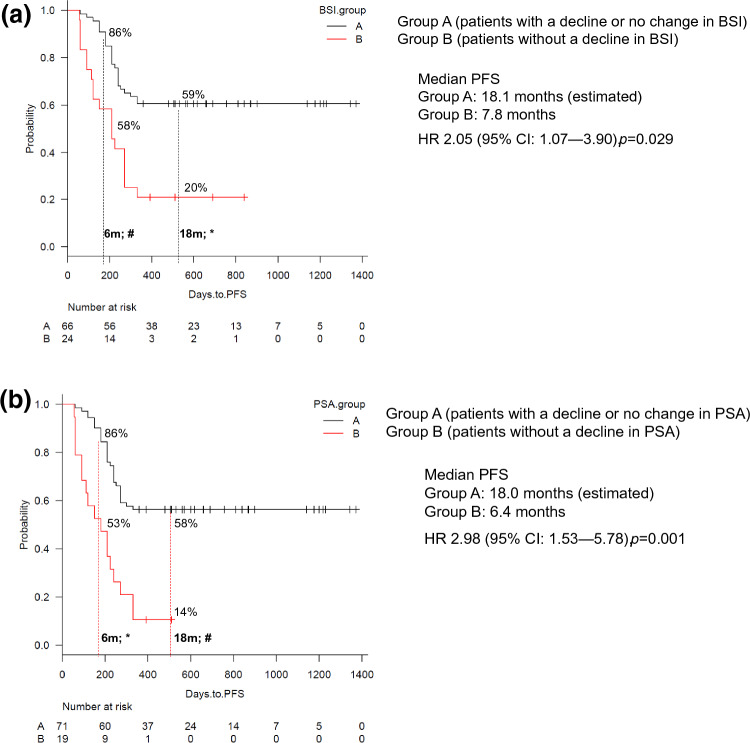
Reports of Bone Scan Index (BSI) calculations as imaging biomarkers to predict survival in patients with metastatic castration-resistant prostate cancer (mCRPC) have been mainly from retrospective studies. To evaluate the effectiveness of enzalutamide (ENZ) in Japanese patients with mCRPC and bone metastases using BSI (bone scintigraphy) and circulating tumor cell (CTC) analysis. Prospective, single-arm study at Juntendo University affiliated hospitals, Japan. Patients were administered 160 mg ENZ daily, with 3 monthly assessments: BSI, prostate specific antigen (PSA), CTC and androgen receptor splicing variant-7 (AR-V7) status. Primary endpoint: BSI-decreasing rate after ENZ treatment. Secondary endpoints: PSA-decreasing rate and progression free survival (PFS). Statistical analyses included the Wilcoxon t-test, Cox proportional hazard regression analysis, and log-rank test. Median observation period: 17.9 months, and median PFS: 13.8 (2.0-43.9) months (n = 90 patients). A decrease in BSI compared to baseline as best BSI change on ENZ treatment was evident in 69% patients at the end of the observation period (29% patients showed a complete response, BSI 0.00). At 3 months 67% patients showed a ≥ 50% PSA reduction, and 70% after ENZ treatment. PSA decline (3 months) significantly associated with a prolonged median PFS: 18.0 (estimated) versus 6.4 months (HR 2.977 [95% CI 1.53-5.78], p = 0.001). Best BSI decline response significantly associated with a prolonged PFS: 18.1(estimated) versus 7.8 months (HR 2.045 [95% CI: 1.07-3.90], p = 0.029). CTC negative status (n = 20) significantly associated with a prolonged PFS: 13.4 [estimated] vs 8.6 months (HR 2.366, 95% CI 0.97-5.71, p = 0.041). CTC positive/AR-V7 positive status significantly associated with a shorter PFS: 5.9 months (HR 8.56, 95% CI 2.40-30.43, p = 0.0087). -reduction (3 months) and BSI-reduction (on ENZ treatment) were significant response biomarkers, and a negative CTC status was a predictive factor for ENZ efficacy in patients with mCRPC.
报告称,骨扫描指数(BSI)的计算可作为预测转移性去势抵抗性前列腺癌(mCRPC)患者生存情况的影像学生物标志物,这些报告主要来自回顾性研究。本研究旨在评估恩扎卢胺(ENZ)在日本 mCRPC 伴骨转移患者中的疗效,使用 BSI(骨闪烁照相术)和循环肿瘤细胞(CTC)分析。这是一项在日本顺天堂大学附属医院开展的前瞻性、单臂研究。患者每日接受 160mg ENZ 治疗,并在 3 个月时进行评估:BSI、前列腺特异性抗原(PSA)、CTC 和雄激素受体剪接变体 7(AR-V7)状态。主要终点:ENZ 治疗后 BSI 下降率。次要终点:PSA 下降率和无进展生存期(PFS)。统计分析包括 Wilcoxon t 检验、Cox 比例风险回归分析和对数秩检验。中位观察期为 17.9 个月,中位 PFS 为 13.8(2.0-43.9)个月(n=90 例患者)。在观察期末,与基线相比,BSI 最佳变化的患者中有 69%(29%的患者为完全缓解,BSI=0.00)出现 BSI 下降。3 个月时,67%的患者 PSA 下降≥50%,70%的患者在接受 ENZ 治疗后 PSA 下降。PSA 下降(3 个月)与延长中位 PFS 显著相关:18.0(估计)与 6.4 个月(HR 2.977 [95%CI 1.53-5.78],p=0.001)。BSI 最佳下降反应与延长 PFS 显著相关:18.1(估计)与 7.8 个月(HR 2.045 [95%CI:1.07-3.90],p=0.029)。CTC 阴性(n=20)与延长 PFS 显著相关:13.4 [估计]与 8.6 个月(HR 2.366,95%CI 0.97-5.71,p=0.041)。CTC 阳性/AR-V7 阳性与较短的 PFS 显著相关:5.9 个月(HR 8.56,95%CI 2.40-30.43,p=0.0087)。BSI 下降(3 个月)和 BSI 下降(在 ENZ 治疗时)是显著的反应生物标志物,CTC 阴性是 mCRPC 患者接受 ENZ 治疗疗效的预测因素。