Chen Boya, Zhu Haiying, Yang Bo, Cao Ji
Institute of Pharmacology and Toxicology, Zhejiang Province Key Laboratory of Anti-Cancer Drug Research, College of Pharmaceutical Sciences, Zhejiang University, Hangzhou 310058, China.
The Innovation Institute for Artificial Intelligence in Medicine, Zhejiang University, Hangzhou 310058, China.
Acta Pharm Sin B. 2023 May;13(5):1976-1989. doi: 10.1016/j.apsb.2022.11.005. Epub 2022 Nov 5.
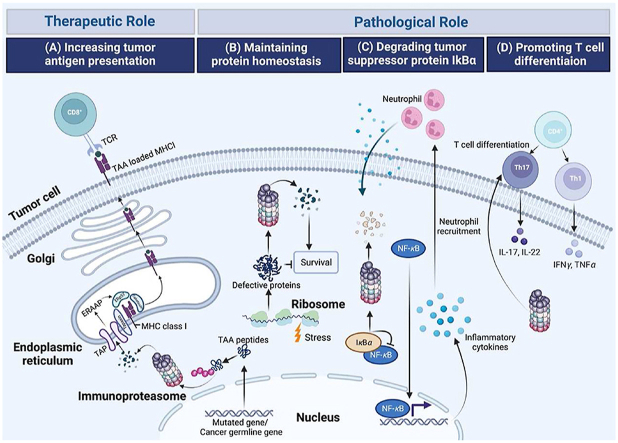
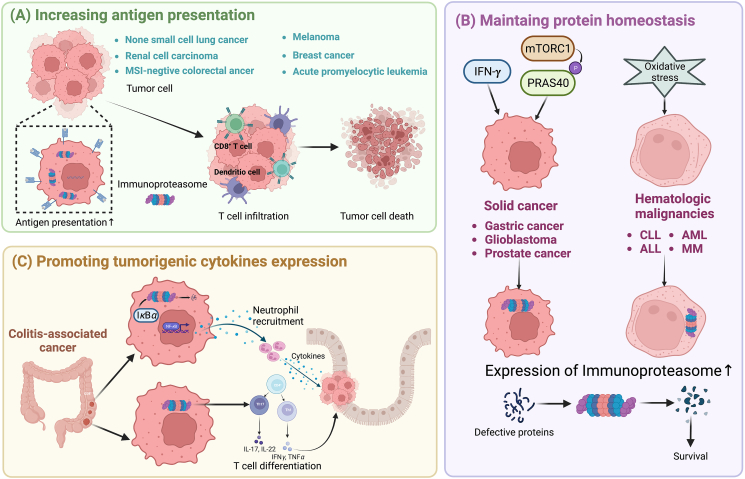
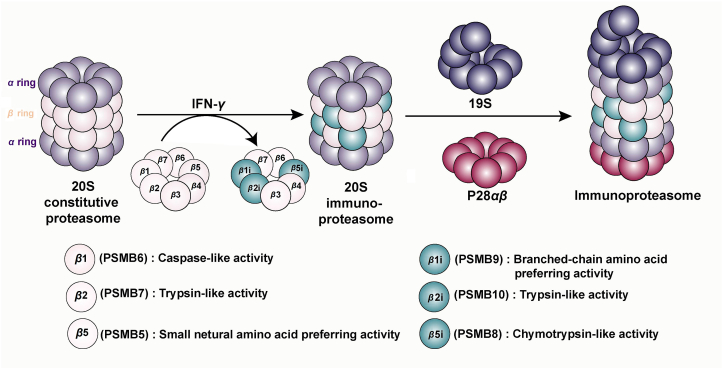
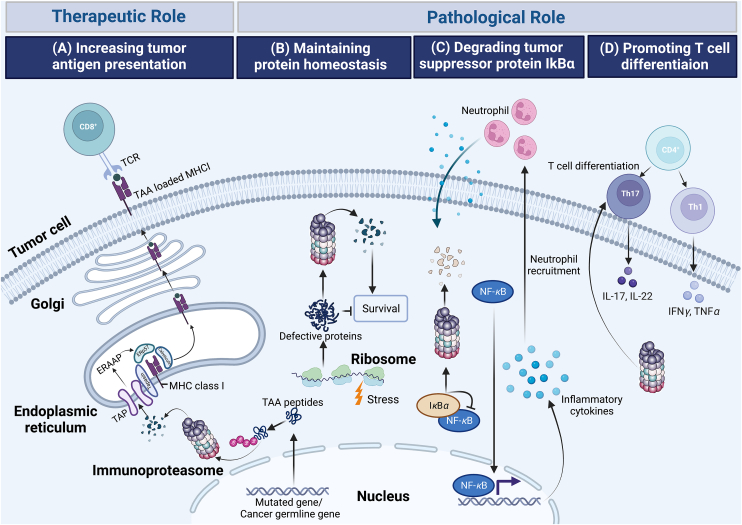
Immunoproteasome is a variant of proteasome with structural differences in 20S subunits optimizing them for the production of antigenic peptides with higher binding affinity to major histocompatibility complex (MHC)-I molecules. Apart from this primary function in antigen presentation, immunoproteasome is also responsible for the degradation of proteins, both unfolded proteins for the maintenance of protein homeostasis and tumor suppressor proteins contributing to tumor progression. The altered expression of immunoproteasome is frequently observed in cancers; however, its expression levels and effects vary among different cancer types exhibiting antagonistic roles in tumor development. This review focuses on the dichotomous role of immunoproteasome in different cancer types, as well as summarizes the current progression in immunoproteasome activators and inhibitors. Specifically targeting immunoproteasome may be a beneficial therapeutic intervention in cancer treatment and understanding the role of immunoproteasome in cancers will provide a significant therapeutic insight for the prevention and treatment of cancers.
免疫蛋白酶体是蛋白酶体的一种变体,其20S亚基存在结构差异,可优化其产生与主要组织相容性复合体(MHC)-I分子具有更高结合亲和力的抗原肽。除了在抗原呈递中的这一主要功能外,免疫蛋白酶体还负责蛋白质的降解,包括用于维持蛋白质稳态的未折叠蛋白以及促进肿瘤进展的肿瘤抑制蛋白。免疫蛋白酶体的表达改变在癌症中经常被观察到;然而,其表达水平和作用在不同癌症类型中有所不同,在肿瘤发展中表现出拮抗作用。本综述重点关注免疫蛋白酶体在不同癌症类型中的双重作用,并总结了免疫蛋白酶体激活剂和抑制剂的当前进展。特异性靶向免疫蛋白酶体可能是癌症治疗中一种有益的治疗干预措施,了解免疫蛋白酶体在癌症中的作用将为癌症的预防和治疗提供重要的治疗见解。