• 文献检索
  • 文档翻译
  • 深度研究
  • 学术资讯
  • Suppr Zotero 插件Zotero 插件
  • 邀请有礼
  • 套餐&价格
  • 历史记录
应用&插件
Suppr Zotero 插件Zotero 插件浏览器插件Mac 客户端Windows 客户端微信小程序
定价
高级版会员购买积分包购买API积分包
服务
文献检索文档翻译深度研究API 文档MCP 服务
关于我们
关于 Suppr公司介绍联系我们用户协议隐私条款
关注我们

Suppr 超能文献

核心技术专利:CN118964589B侵权必究
粤ICP备2023148730 号-1Suppr @ 2026

文献检索

告别复杂PubMed语法,用中文像聊天一样搜索,搜遍4000万医学文献。AI智能推荐,让科研检索更轻松。

立即免费搜索

文件翻译

保留排版,准确专业,支持PDF/Word/PPT等文件格式,支持 12+语言互译。

免费翻译文档

深度研究

AI帮你快速写综述,25分钟生成高质量综述,智能提取关键信息,辅助科研写作。

立即免费体验

在元社交媒体平台上宣传替代癌症治疗方法和途径:内容分析

Advertising Alternative Cancer Treatments and Approaches on Meta Social Media Platforms: Content Analysis.

作者信息

Zenone Marco, Snyder Jeremy, Bélisle-Pipon Jean-Christophe, Caulfield Timothy, van Schalkwyk May, Maani Nason

机构信息

Faculty of Public Health and Policy, London School of Hygiene and Tropical Medicine, London, United Kingdom.

Faculty of Health Sciences, Simon Fraser University, Burnaby, BC, Canada.

出版信息

JMIR Infodemiology. 2023 May 31;3:e43548. doi: 10.2196/43548.

DOI:10.2196/43548
PMID:37256649
原文链接:https://pmc.ncbi.nlm.nih.gov/articles/PMC10267786/
Abstract

BACKGROUND

Alternative cancer treatment is associated with a greater risk of death than cancer patients undergoing conventional treatments. Anecdotal evidence suggests cancer patients view paid advertisements promoting alternative cancer treatment on social media, but the extent and nature of this advertising remain unknown. This context suggests an urgent need to investigate alternative cancer treatment advertising on social media.

OBJECTIVE

This study aimed to systematically analyze the advertising activities of prominent alternative cancer treatment practitioners on Meta platforms, including Facebook, Instagram, Messenger, and Audience Network. We specifically sought to determine (1) whether paid advertising for alternative cancer treatment occurs on Meta social media platforms, (2) the strategies and messages of alternative cancer providers to reach and appeal to prospective patients, and (3) how the efficacy of alternative treatments is portrayed.

METHODS

Between December 6, 2021, and December 12, 2021, we collected active advertisements from alternative cancer clinics using the Meta Ad Library. The information collected included identification number, URL, active/inactive status, dates launched/ran, advertiser page name, and a screenshot (image) or recording (video) of the advertisement. We then conducted a content analysis to determine how alternative cancer providers communicate the claimed benefits of their services and evaluated how they portrayed alternative cancer treatment efficacy.

RESULTS

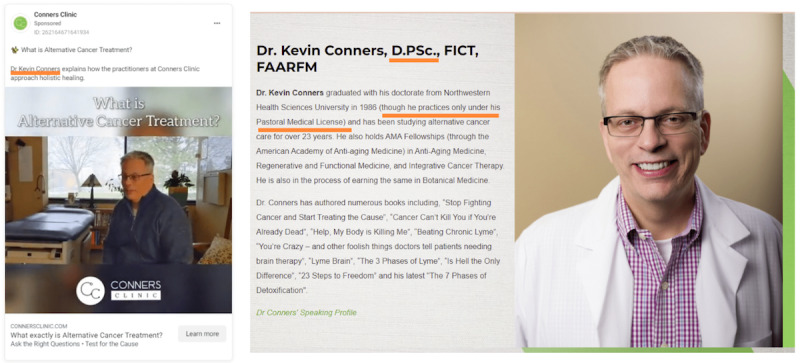
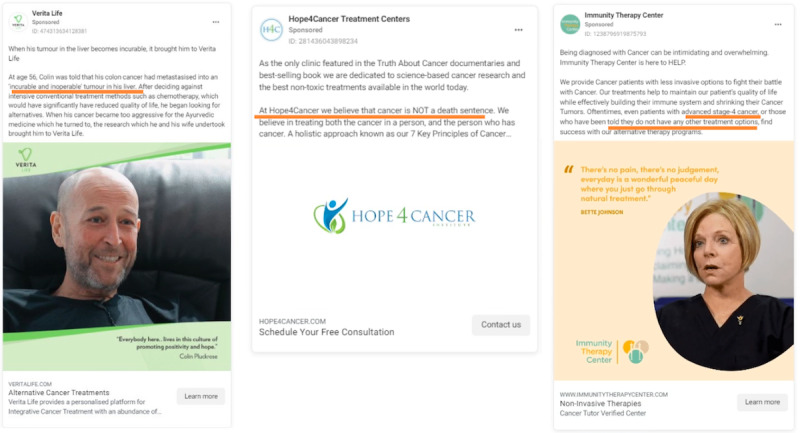
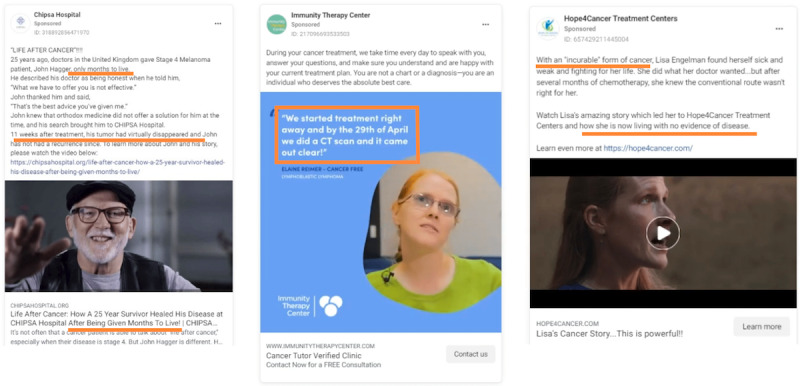
We identified 310 paid advertisements from 11 alternative cancer clinics on Meta (Facebook, Instagram, or Messenger) marketing alternative treatment approaches, care, and interventions. Alternative cancer providers appealed to prospective patients through eight strategies: (1) advertiser representation as a legitimate medical provider (n=289, 93.2%); (2) appealing to persons with limited treatments options (n=203, 65.5%); (3) client testimonials (n=168, 54.2%); (4) promoting holistic approaches (n=121, 39%); (5) promoting messages of care (n=81, 26.1%); (6) rhetoric related to science and research (n=72, 23.2%); (7) rhetoric pertaining to the latest technology (n=63, 20.3%); and (8) focusing treatment on cancer origins and cause (n=43, 13.9%). Overall, 25.8% (n=80) of advertisements included a direct statement claiming provider treatment can cure cancer or prolong life.

CONCLUSIONS

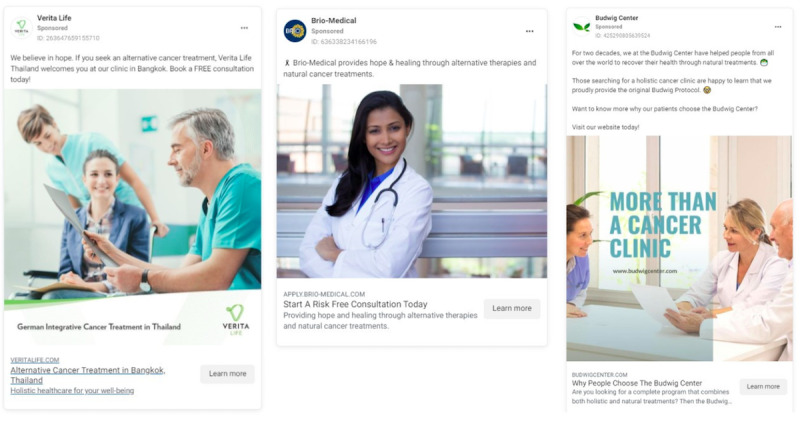
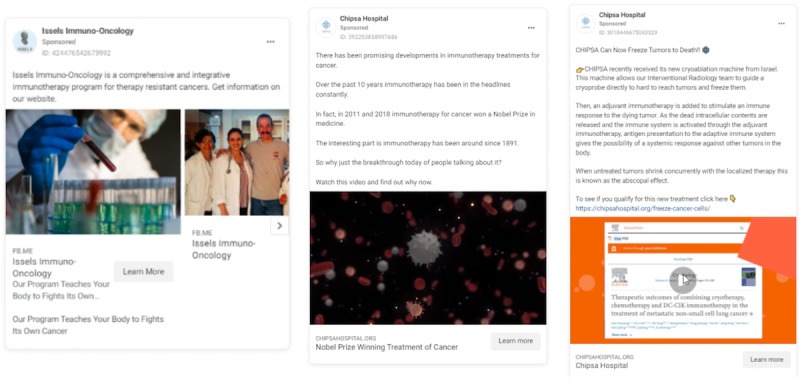
Our results provide evidence alternative cancer providers are using Meta advertising products to market scientifically unsupported cancer treatments. Advertisements regularly referenced "alternative" and "natural" treatment approaches to cancer. Imagery and text content that emulated evidence-based medical providers created the impression that the offered treatments were effective medical options for cancer. Advertisements exploited the hope of patients with terminal and poor prognoses by sharing testimonials of past patients who allegedly were cured or had their lives prolonged. We recommend that Meta introduce a mandatory, human-led authorization process that is not reliant upon artificial intelligence for medical-related advertisers before giving advertising permissions. Further research should focus on the conflict of interest between social media platforms advertising products and public health.
https://cdn.ncbi.nlm.nih.gov/pmc/blobs/a466/10267786/338689ed87e4/infodemiology_v3i1e43548_fig5.jpg
https://cdn.ncbi.nlm.nih.gov/pmc/blobs/a466/10267786/f7175f0e2da2/infodemiology_v3i1e43548_fig1.jpg
https://cdn.ncbi.nlm.nih.gov/pmc/blobs/a466/10267786/0de450ab8365/infodemiology_v3i1e43548_fig2.jpg
https://cdn.ncbi.nlm.nih.gov/pmc/blobs/a466/10267786/4a5f47b2ee55/infodemiology_v3i1e43548_fig3.jpg
https://cdn.ncbi.nlm.nih.gov/pmc/blobs/a466/10267786/621215a9dec8/infodemiology_v3i1e43548_fig4.jpg
https://cdn.ncbi.nlm.nih.gov/pmc/blobs/a466/10267786/338689ed87e4/infodemiology_v3i1e43548_fig5.jpg
https://cdn.ncbi.nlm.nih.gov/pmc/blobs/a466/10267786/f7175f0e2da2/infodemiology_v3i1e43548_fig1.jpg
https://cdn.ncbi.nlm.nih.gov/pmc/blobs/a466/10267786/0de450ab8365/infodemiology_v3i1e43548_fig2.jpg
https://cdn.ncbi.nlm.nih.gov/pmc/blobs/a466/10267786/4a5f47b2ee55/infodemiology_v3i1e43548_fig3.jpg
https://cdn.ncbi.nlm.nih.gov/pmc/blobs/a466/10267786/621215a9dec8/infodemiology_v3i1e43548_fig4.jpg
https://cdn.ncbi.nlm.nih.gov/pmc/blobs/a466/10267786/338689ed87e4/infodemiology_v3i1e43548_fig5.jpg
摘要

背景

与接受传统治疗的癌症患者相比,替代癌症治疗与更高的死亡风险相关。轶事证据表明,癌症患者会在社交媒体上查看推广替代癌症治疗的付费广告,但此类广告的范围和性质仍不明确。这种情况表明迫切需要对社交媒体上的替代癌症治疗广告进行调查。

目的

本研究旨在系统分析Meta平台(包括Facebook、Instagram、Messenger和受众网络)上知名替代癌症治疗从业者的广告活动。我们特别试图确定:(1)Meta社交媒体平台上是否存在替代癌症治疗的付费广告;(2)替代癌症治疗提供者吸引潜在患者的策略和信息;(3)替代治疗的疗效是如何被描述的。

方法

在2021年12月6日至2021年12月12日期间,我们使用Meta广告库收集了替代癌症诊所的活跃广告。收集的信息包括识别号、网址、活跃/不活跃状态、发布/运行日期、广告商页面名称以及广告的屏幕截图(图像)或录制内容(视频)。然后,我们进行了内容分析,以确定替代癌症治疗提供者如何传达其服务所宣称的益处,并评估他们如何描述替代癌症治疗的疗效。

结果

我们在Meta(Facebook、Instagram或Messenger)上识别出了来自11家替代癌症诊所的310条付费广告,这些广告推销替代治疗方法、护理和干预措施。替代癌症治疗提供者通过八种策略吸引潜在患者:(1)将广告商表现为合法的医疗提供者(n = 289,93.2%);(2)吸引治疗选择有限的人群(n = 203,65.5%);(3)客户推荐(n = 168,54.2%);(4)推广整体方法(n = 121,39%);(5)推广关怀信息(n = 81,26.1%);(6)与科学和研究相关的言辞(n = 72,23.2%);(7)与最新技术相关的言辞(n = 63,20.3%);(8)将治疗重点放在癌症起源和病因上(n = 43,13.9%)。总体而言,25.8%(n = 80)的广告包含直接声明,声称提供者的治疗可以治愈癌症或延长生命。

结论

我们的结果表明,替代癌症治疗提供者正在使用Meta广告产品来推销缺乏科学依据的癌症治疗方法。广告经常提及癌症的“替代”和“自然”治疗方法。模仿循证医学提供者的图像和文本内容给人一种印象,即所提供的治疗是有效的癌症医疗选择。广告通过分享据称已治愈或延长生命的既往患者的推荐,利用了晚期和预后不良患者的希望。我们建议Meta在给予医疗相关广告商广告许可之前,引入一个强制性的、由人工主导的授权程序,该程序不依赖人工智能。进一步的研究应关注社交媒体平台广告产品与公共卫生之间的利益冲突。

相似文献

1
Advertising Alternative Cancer Treatments and Approaches on Meta Social Media Platforms: Content Analysis.在元社交媒体平台上宣传替代癌症治疗方法和途径:内容分析
JMIR Infodemiology. 2023 May 31;3:e43548. doi: 10.2196/43548.
2
Should Facebook advertisements promoting a physical activity smartphone app be image or video-based, and should they promote benefits of being active or the app attributes?Facebook 广告宣传一款促进身体活动的智能手机应用程序时,应该使用图像还是视频?是宣传活动的好处还是应用程序的属性?
Transl Behav Med. 2021 Dec 14;11(12):2136-2143. doi: 10.1093/tbm/ibab101.
3
Vaccine-related advertising in the Facebook Ad Archive.脸书广告档案中的疫苗相关广告。
Vaccine. 2020 Jan 16;38(3):512-520. doi: 10.1016/j.vaccine.2019.10.066. Epub 2019 Nov 13.
4
Global reach of direct-to-consumer advertising using social media for illicit online drug sales.利用社交媒体进行非法在线药品销售的直接面向消费者广告的全球影响力。
J Med Internet Res. 2013 May 29;15(5):e105. doi: 10.2196/jmir.2610.
5
Using Web-Based Social Media to Recruit Heavy-Drinking Young Adults for Sleep Intervention: Prospective Observational Study.利用基于网络的社交媒体招募重度饮酒的年轻成年人参与睡眠干预:前瞻性观察研究。
J Med Internet Res. 2020 Aug 11;22(8):e17449. doi: 10.2196/17449.
6
Evaluating the effectiveness of a physical activity social media advertising campaign using Facebook, Facebook Messenger, and Instagram.评估使用 Facebook、Facebook Messenger 和 Instagram 进行的体育活动社交媒体广告活动的效果。
Transl Behav Med. 2021 Apr 7;11(3):870-881. doi: 10.1093/tbm/ibaa139.
7
Pharmaceutical companies and their drugs on social media: a content analysis of drug information on popular social media sites.制药公司及其药品在社交媒体上的情况:对热门社交媒体网站上药品信息的内容分析。
J Med Internet Res. 2015 Jun 1;17(6):e130. doi: 10.2196/jmir.4357.
8
Youth Study Recruitment Using Paid Advertising on Instagram, Snapchat, and Facebook: Cross-Sectional Survey Study.利用Instagram、Snapchat和Facebook上的付费广告招募青年研究对象:横断面调查研究
JMIR Public Health Surveill. 2019 Oct 9;5(4):e14080. doi: 10.2196/14080.
9
Social Media Recruitment Strategies to Recruit Pregnant Women Into a Longitudinal Observational Cohort Study: Usability Study.社交媒体招聘策略招募孕妇参加纵向观察队列研究:可用性研究。
J Med Internet Res. 2022 Dec 12;24(12):e40298. doi: 10.2196/40298.
10
General Audience Engagement With Antismoking Public Health Messages Across Multiple Social Media Sites: Comparative Analysis.多社交媒体网站上的反吸烟公共卫生信息对普通受众的吸引力:比较分析。
JMIR Public Health Surveill. 2021 Feb 19;7(2):e24429. doi: 10.2196/24429.

引用本文的文献

1
Challenging Reward Structures and Organizational Cultures that Propagate Stem Cell Hyperbole.具有挑战性的奖励结构和宣扬干细胞夸张说法的组织文化。
Stem Cell Rev Rep. 2025 Aug 18. doi: 10.1007/s12015-025-10955-z.
2
Generative artificial intelligence-mediated confirmation bias in health information seeking.生成式人工智能介导的健康信息搜索中的确认偏差。
Ann N Y Acad Sci. 2025 Aug;1550(1):23-36. doi: 10.1111/nyas.15413. Epub 2025 Jul 27.
3
Who funds the WHO Foundation? A transparency analysis of donation disclosures over the first 3 years of its operation.

本文引用的文献

1
A realist review of voluntary actions by the food and beverage industry and implications for public health and policy in low- and middle-income countries.对食品饮料行业自愿行动的现实主义综述及其对低收入和中等收入国家公共卫生与政策的影响。
Nat Food. 2022 Aug;3(8):650-663. doi: 10.1038/s43016-022-00552-5. Epub 2022 Aug 5.
2
Back to our roots or sowing new seeds: thinking anew on the paradigms of health, harm and disease.回归本源或播下新的种子:重新思考健康、伤害和疾病的范式。
J Public Health (Oxf). 2022 Nov 21;44(Suppl 1):i28-i33. doi: 10.1093/pubmed/fdac093.
3
Association Between Exposure to Tobacco Content on Social Media and Tobacco Use: A Systematic Review and Meta-analysis.
谁为世界卫生组织基金会提供资金?对其运营头三年捐赠披露情况的透明度分析。
BMJ Glob Health. 2025 Jul 23;10(7):e018932. doi: 10.1136/bmjgh-2025-018932.
4
Content analysis of substance use disorder recovery discourse on Twitter: From personal recovery narratives to marketing of addiction treatment.推特上物质使用障碍康复话语的内容分析:从个人康复叙事到成瘾治疗营销
Alcohol Clin Exp Res (Hoboken). 2025 Mar;49(3):629-640. doi: 10.1111/acer.15531. Epub 2025 Feb 22.
5
Alternative Health and Conventional Medicine Discourse About Cancer on TikTok: Computer Vision Analysis of TikTok Videos.TikTok上替代医学与传统医学关于癌症的论述:TikTok视频的计算机视觉分析
J Med Internet Res. 2024 Dec 9;26:e60283. doi: 10.2196/60283.
6
Source credibility: a necessary North Star in cancer care.来源可信度:癌症护理中一颗必要的北极星。
BJC Rep. 2024 Aug 6;2(1):56. doi: 10.1038/s44276-024-00075-5.
7
Selling Misleading "Cancer Cure" Books on Amazon: Systematic Search on Amazon.com and Thematic Analysis.在亚马逊上销售误导性的“癌症治愈”书籍:对亚马逊网站的系统搜索和主题分析。
J Med Internet Res. 2024 Oct 8;26:e56354. doi: 10.2196/56354.
8
Alternative cancer clinics' use of Google listings and reviews to mislead potential patients.另类癌症诊所利用谷歌列表和评论误导潜在患者。
BJC Rep. 2024;2(1):55. doi: 10.1038/s44276-024-00071-9. Epub 2024 Aug 6.
9
Prioritising Key Concepts for informed health choices in cancer: An evidence-based online educational programme.为癌症患者做出明智的健康选择确定关键概念:一项基于证据的在线教育计划。
PEC Innov. 2024 Jun 20;5:100311. doi: 10.1016/j.pecinn.2024.100311. eCollection 2024 Dec 15.
社交媒体中烟草内容暴露与烟草使用的关联:系统评价和荟萃分析。
JAMA Pediatr. 2022 Sep 1;176(9):878-885. doi: 10.1001/jamapediatrics.2022.2223.
4
The Social Media Industry as a Commercial Determinant of Health.社交媒体行业作为健康的商业决定因素。
Int J Health Policy Manag. 2023;12:6840. doi: 10.34172/ijhpm.2022.6840. Epub 2022 Apr 27.
5
Online Medical Misinformation in Cancer: Distinguishing Fact From Fiction.网络癌症医疗谣言:辨别真假。
JCO Oncol Pract. 2022 Aug;18(8):584-589. doi: 10.1200/OP.21.00764. Epub 2022 Mar 31.
6
The Paradoxical Relationship Between Health Promotion and the Social Media Industry.健康促进与社交媒体产业之间的矛盾关系。
Health Promot Pract. 2023 May;24(3):571-574. doi: 10.1177/15248399211064640. Epub 2021 Dec 29.
7
Instagram and prostate cancer: using validated instruments to assess the quality of information on social media.Instagram 和前列腺癌:使用经过验证的工具评估社交媒体上的信息质量。
Prostate Cancer Prostatic Dis. 2022 Apr;25(4):791-793. doi: 10.1038/s41391-021-00473-7. Epub 2021 Dec 1.
8
Cancer Communication and User Engagement on Chinese Social Media: Content Analysis and Topic Modeling Study.中文社交媒体上的癌症传播和用户参与:内容分析和主题建模研究。
J Med Internet Res. 2021 Nov 10;23(11):e26310. doi: 10.2196/26310.
9
Pre-emption strategies to block taxes on sugar-sweetened beverages: A framing analysis of Facebook advertising in support of Washington state initiative-1634.抢占策略以阻止对含糖饮料征税:支持华盛顿州 1634 号倡议的 Facebook 广告的框架分析。
Glob Public Health. 2022 Aug-Sep;17(9):1854-1867. doi: 10.1080/17441692.2021.1977971. Epub 2021 Sep 19.
10
Using Social Media for Peer-to-Peer Cancer Support: Interviews With Young Adults With Cancer.利用社交媒体进行癌症患者之间的互助支持:对年轻癌症患者的访谈
JMIR Cancer. 2021 Sep 2;7(3):e28234. doi: 10.2196/28234.