Faculty of Public Health and Policy, London School of Hygiene & Tropical Medicine, London, United Kingdom.
Health Law Institute, Faculty of Law, University of Alberta, Edmonton, AB, Canada.
J Med Internet Res. 2024 Oct 8;26:e56354. doi: 10.2196/56354.
While the evidence base on web-based cancer misinformation continues to develop, relatively little is known about the extent of such information on the world's largest e-commerce website, Amazon. Multiple media reports indicate that Amazon may host on its platform questionable cancer-related products for sale, such as books on purported cancer cures. This context suggests an urgent need to evaluate Amazon.com for cancer misinformation.
This study sought to (1) examine to what extent are misleading cancer cure books for sale on Amazon.com and (2) determine how cancer cure books on Amazon.com provide misleading cancer information.
We searched "cancer cure" on Amazon.com and retrieved the top 1000 English-language book search results. We reviewed the books' descriptions and titles to determine whether the books provided misleading cancer cure or treatment information. We considered a book to be misleading if it suggested scientifically unsupported cancer treatment approaches to cure or meaningfully treat cancer. Among books coded as misleading, we conducted an inductive latent thematic analysis to determine the informational value the books sought to offer.
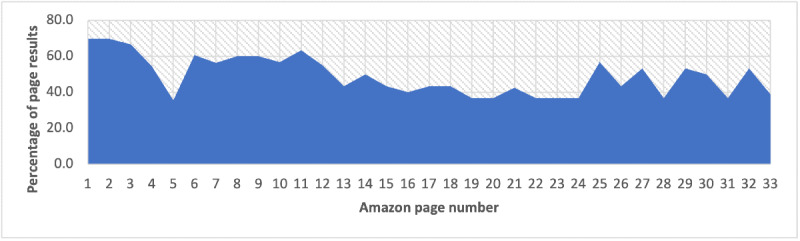
Nearly half (494/1000, 49.4%) of the sampled "cancer cure" books for sale on Amazon.com appeared to contain misleading cancer treatment and cure information. Overall, 17 (51.5%) out of 33 Amazon.com results pages had 50% or more of the books coded as misleading. The first search result page had the highest percentage of misleading books (23/33, 69.7%). Misleading books (n=494) contained eight themes: (1) claims of efficacious cancer cure strategies (n=451, 91.3%), (2) oversimplifying cancer and cancer treatment (n=194, 39.3%), (3) falsely justifying ineffective treatments as science based (n=189, 38.3%), (4) discrediting conventional cancer treatments (n=169, 34.2%), (5) finding the true cause of cancer (n=133, 26.9%), (6) homogenizing cancer (n=132, 26.7%), (7) discovery of new cancer treatments (n=119, 24.1%), and (8) cancer cure suppression (n=82, 16.6%).
The results demonstrate that misleading cancer cure books are for sale, visible, and prevalent on Amazon.com, with prominence in initial search hits. These misleading books for sale on Amazon can be conceived of as forming part of a wider, cross-platform, web-based information environment in which misleading cancer cures are often given prominence. Our results suggest that greater enforcement is needed from Amazon and that cancer-focused organizations should engage in preemptive misinformation debunking.
虽然有关网络癌症错误信息的证据基础不断发展,但对于世界上最大的电子商务网站亚马逊上此类信息的程度,人们知之甚少。多项媒体报道表明,亚马逊可能在其平台上托管销售有问题的癌症相关产品,例如关于所谓癌症治疗方法的书籍。这种情况表明迫切需要对亚马逊网站进行癌症错误信息评估。
本研究旨在(1)考察亚马逊网站上销售的误导性癌症治疗书籍的程度,以及(2)确定亚马逊网站上的癌症治疗书籍如何提供误导性癌症信息。
我们在亚马逊网站上搜索“癌症治疗”,并检索了前 1000 个英文书籍搜索结果。我们审查了书籍的描述和标题,以确定书籍是否提供了有关癌症治疗或治疗的误导性信息。如果书籍提供了未经科学支持的癌症治疗方法来治愈或有效治疗癌症,我们认为该书籍具有误导性。在被编码为具有误导性的书籍中,我们进行了归纳性潜在主题分析,以确定书籍所提供的信息价值。
亚马逊网站上销售的近一半(1000 本中的 494 本,49.4%)“癌症治疗”书籍似乎包含有关癌症治疗和治疗的误导性信息。总体而言,在 33 个亚马逊网站结果页面中,有 17 个(51.5%)页面上有 50%或更多的书籍被编码为具有误导性。第一搜索结果页面上的误导性书籍比例最高(23/33,69.7%)。具有误导性的书籍(n=494)包含八个主题:(1)有效的癌症治疗方法的主张(n=451,91.3%),(2)对癌症和癌症治疗的过度简化(n=194,39.3%),(3)错误地将无效治疗方法视为基于科学(n=189,38.3%),(4)诋毁常规癌症治疗方法(n=169,34.2%),(5)寻找癌症的真正原因(n=133,26.9%),(6)癌症的同质化(n=132,26.7%),(7)新的癌症治疗方法的发现(n=119,24.1%),以及(8)癌症治疗方法的抑制(n=82,16.6%)。
结果表明,在亚马逊网站上销售、可见且普遍存在误导性癌症治疗书籍,并且在初始搜索结果中占据显著地位。这些在亚马逊上销售的误导性书籍可以被视为更广泛的跨平台网络信息环境的一部分,其中经常突出显示误导性癌症治疗方法。我们的研究结果表明,亚马逊需要加强执法力度,癌症相关组织应该积极参与预先消除错误信息。