School of Materials Engineering, Purdue University, West Lafayette, IN 47907, USA.
Sandia National Laboratories, Albuquerque, NM 87185, USA.
Sci Adv. 2023 Jun 2;9(22):eadd9780. doi: 10.1126/sciadv.add9780. Epub 2023 May 31.
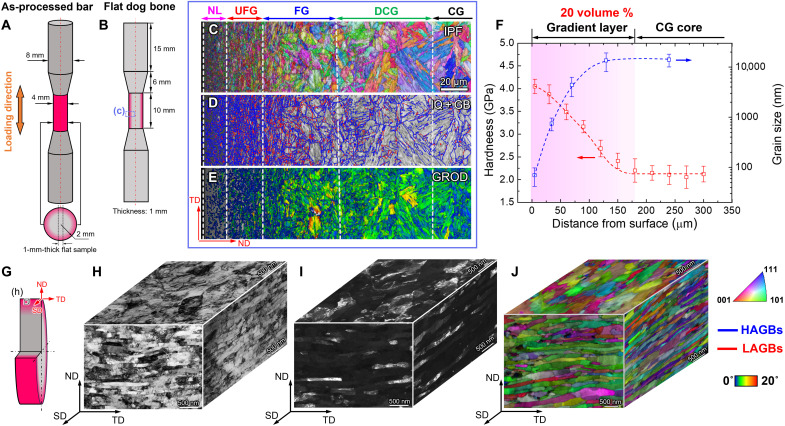
Nanostructured metallic materials with abundant high-angle grain boundaries exhibit high strength and good radiation resistance. While the nanoscale grains induce high strength, they also degrade tensile ductility. We show that a gradient nanostructured ferritic steel exhibits simultaneous improvement in yield strength by 36% and uniform elongation by 50% compared to the homogenously structured counterpart. In situ tension studies coupled with electron backscattered diffraction analyses reveal intricate coordinated deformation mechanisms in the gradient structures. The outermost nanolaminate grains sustain a substantial plastic strain via a profound deformation mechanism involving prominent grain reorientation. This synergistic plastic co-deformation process alters the rupture mode in the post-necking regime, thus delaying the onset of fracture. The present discovery highlights the intrinsic plasticity of nanolaminate grains and their significance in simultaneous improvement of strength and tensile ductility of structural metallic materials.
具有丰富高角度晶界的纳米结构金属材料表现出高强度和良好的抗辐射能力。虽然纳米晶粒诱导出高强度,但也降低了拉伸延展性。我们表明,梯度纳米结构铁素体钢与均匀结构的相比,屈服强度提高了 36%,均匀延伸率提高了 50%。原位拉伸研究结合电子背散射衍射分析揭示了梯度结构中复杂的协调变形机制。最外层的纳米层晶粒通过涉及明显晶粒重取向的深刻变形机制来承受大量的塑性应变。这种协同塑性共变形过程改变了颈缩后期的断裂模式,从而延迟了断裂的发生。本发现强调了纳米层晶粒的固有塑性及其在同时提高结构金属材料的强度和拉伸延展性方面的重要性。