Faculty of Mechanical Engineering, University of Tabriz, Tabriz, Iran.
Sci Rep. 2023 May 31;13(1):8812. doi: 10.1038/s41598-023-36071-x.
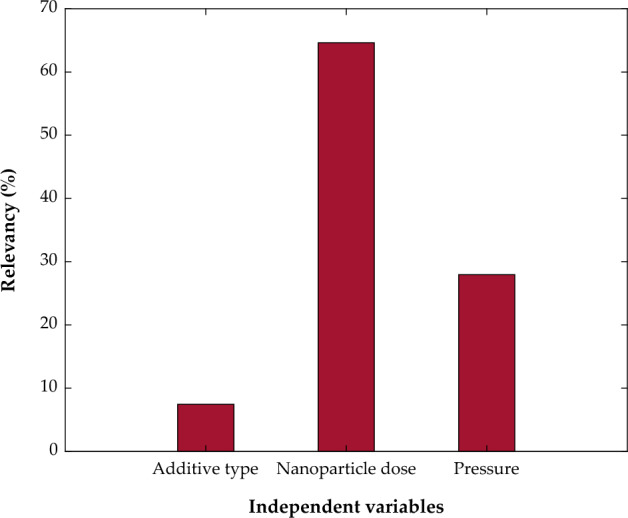
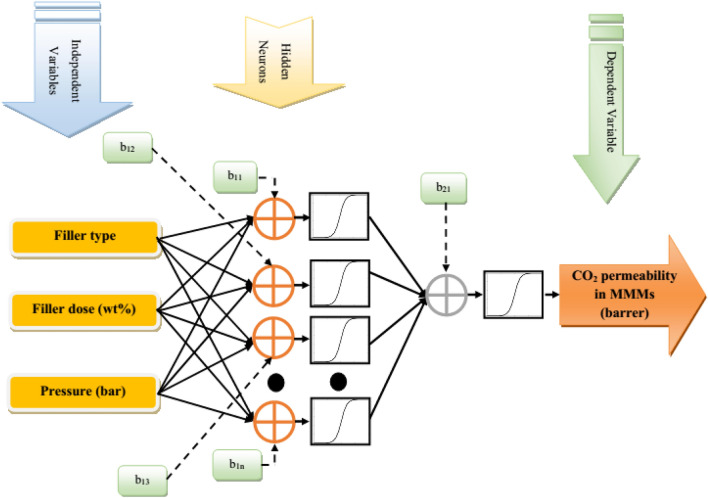
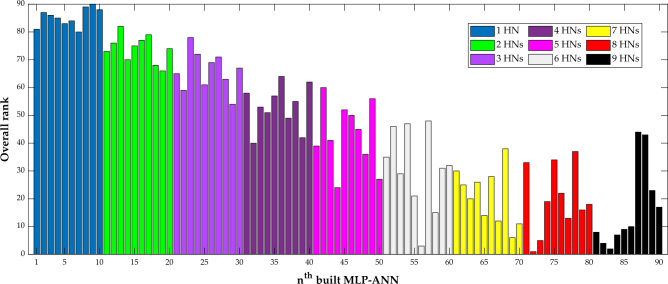
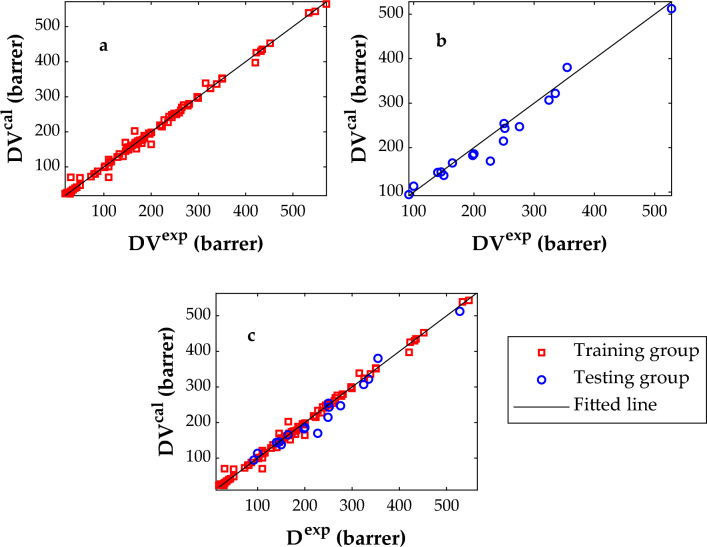
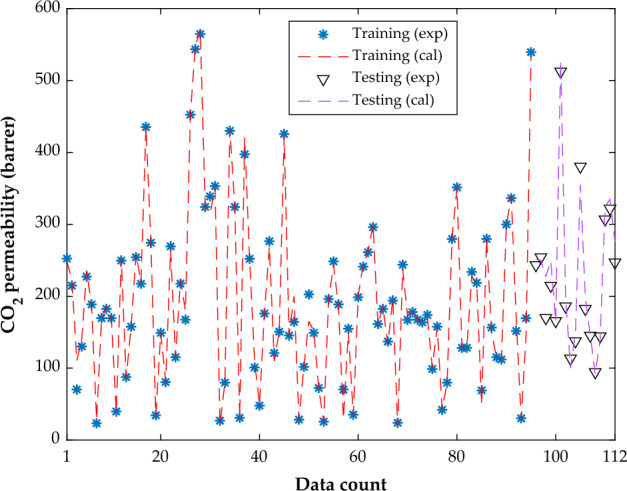
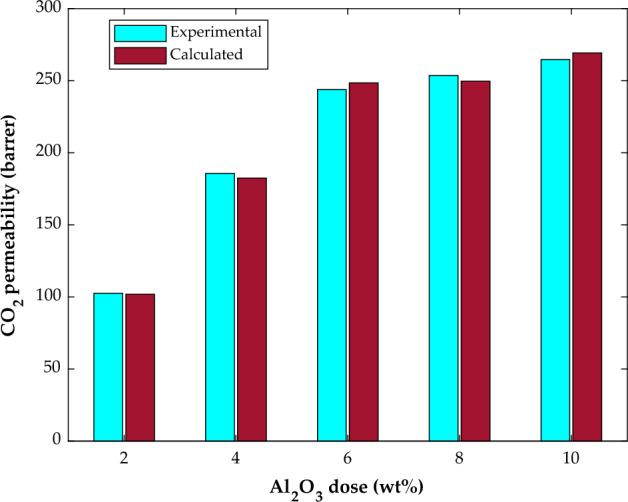
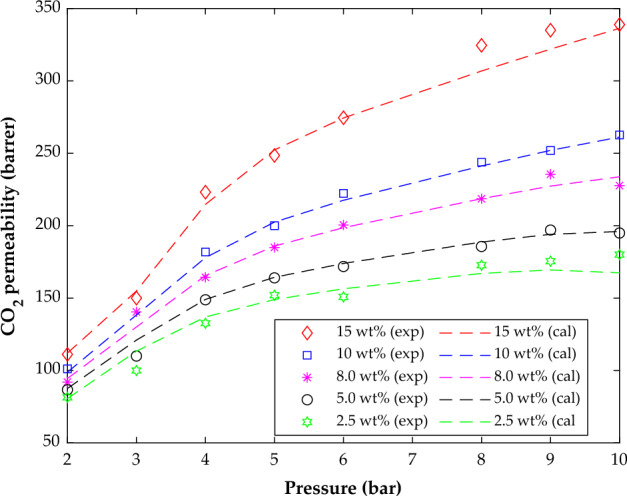
Membranes are a potential technology to reduce energy consumption as well as environmental challenges considering the separation processes. A new class of this technology, namely mixed matrix membrane (MMM) can be fabricated by dispersing solid substances in a polymeric medium. In this way, the poly(4-methyl-1-pentene)-based MMMs have attracted great attention to capturing carbon dioxide (CO), which is an environmental pollutant with a greenhouse effect. The CO permeability in different MMMs constituted of poly(4-methyl-1-pentene) (PMP) and nanoparticles was comprehensively analyzed from the experimental point of view. In addition, a straightforward mathematical model is necessary to compute the CO permeability before constructing the related PMP-based separation process. Hence, the current study employs multilayer perceptron artificial neural networks (MLP-ANN) to relate the CO permeability in PMP/nanoparticle MMMs to the membrane composition (additive type and dose) and pressure. Accordingly, the effect of these independent variables on CO permeability in PMP-based membranes is explored using multiple linear regression analysis. It was figured out that the CO permeability has a direct relationship with all independent variables, while the nanoparticle dose is the strongest one. The MLP-ANN structural features have efficiently demonstrated an appealing potential to achieve the highest accurate prediction for CO permeability. A two-layer MLP-ANN with the 3-8-1 topology trained by the Bayesian regulation algorithm is identified as the best model for the considered problem. This model simulates 112 experimentally measured CO permeability in PMP/ZnO, PMP/AlO, PMP/TiO, and PMP/TiO-NT with an excellent absolute average relative deviation (AARD) of lower than 5.5%, mean absolute error (MAE) of 6.87 and correlation coefficient (R) of higher than 0.99470. It was found that the mixed matrix membrane constituted of PMP and TiO-NT (functionalized nanotube with titanium dioxide) is the best medium for CO separation.
膜是一种有前途的技术,可以减少能源消耗和环境挑战,特别是在分离过程中。这种技术的一个新类别,即混合基质膜(MMM)可以通过在聚合物基质中分散固体物质来制造。通过这种方式,基于聚(4-甲基-1-戊烯)的 MMM 吸引了人们对捕获二氧化碳(CO)的极大关注,CO 是一种具有温室效应的环境污染物。从实验角度综合分析了由聚(4-甲基-1-戊烯)(PMP)和纳米粒子组成的不同 MMM 中的 CO 渗透率。此外,在构建相关的基于 PMP 的分离过程之前,需要一个简单的数学模型来计算 CO 渗透率。因此,本研究采用多层感知器人工神经网络(MLP-ANN)将 PMP/纳米粒子 MMM 中的 CO 渗透率与膜组成(添加剂类型和剂量)和压力联系起来。因此,使用多元线性回归分析探讨了这些自变量对基于 PMP 的膜中 CO 渗透率的影响。结果表明,CO 渗透率与所有自变量直接相关,而纳米粒子剂量是最强的一个。MLP-ANN 结构特征有效地证明了实现 CO 渗透率最高准确预测的诱人潜力。通过贝叶斯调节算法训练的具有 3-8-1 拓扑结构的两层 MLP-ANN 被确定为考虑问题的最佳模型。该模型模拟了 112 个实验测量的 PMP/ZnO、PMP/AlO、PMP/TiO 和 PMP/TiO-NT 中的 CO 渗透率,具有出色的绝对平均相对偏差(AARD)低于 5.5%、平均绝对误差(MAE)为 6.87 和相关系数(R)高于 0.99470。发现由 PMP 和 TiO-NT(用二氧化钛功能化的纳米管)组成的混合基质膜是 CO 分离的最佳介质。