MMWR Morb Mortal Wkly Rep. 2023 Jun 2;72(22):593-596. doi: 10.15585/mmwr.mm7222a1.
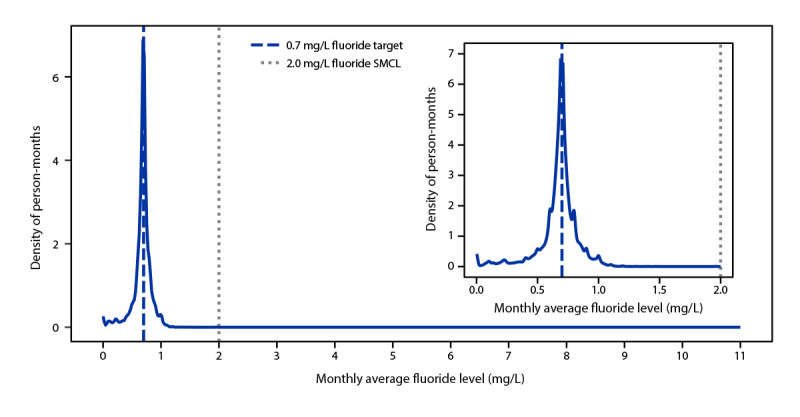
Drinking water fluoridated at the level recommended by the U.S. Public Health Service (USPHS) reduces dental caries (cavities) by approximately 25% in children and adults (1). USPHS recommends fluoride levels to achieve oral health benefits and minimize risks associated with excess fluoride exposure. To provide the benefits of community water fluoridation, water systems should target a level of 0.7 mg/L and maintain levels ≥0.6 mg/L (2). The Environmental Protection Agency (EPA) sets a safety standard at 2.0 mg/L to prevent mild or moderate dental fluorosis, a condition that causes changes in the appearance of tooth enamel caused by hypermineralization resulting from excess fluoride intake during tooth-forming years (i.e., before age 8 years). During 2016-2021, fluoride measurements for 16.3% of population-weighted monthly fluoride measurements (person-months) reported by community water systems to CDC's Water Fluoridation Reporting System (WFRS) were <0.6 mg/L; only 0.01% of person-months exceeded 2.0 mg/L. More than 80% of population-weighted fluoride measurements from community water systems reporting to WFRS were above 0.6 mg/L. Although 0.7 mg/L is the recommended optimal level, ≥0.6 mg/L is still effective for the prevention of caries. A total of 4,080 community water systems safely fluoridated water 99.99% of the time with levels below the secondary safety standard of 2.0 mg/L. Water systems are encouraged to work with their state programs to report their fluoride data into WFRS and meet USPHS recommendations to provide the full benefit of fluoridation for caries prevention.
饮用水氟化至美国公共卫生服务部(USPHS)建议的水平可使儿童和成人的龋齿(蛀牙)减少约 25%(1)。USPHS 建议氟化物水平以实现口腔健康益处,并将与过量氟暴露相关的风险降至最低。为了提供社区水氟化的益处,水系统应将目标设定为 0.7mg/L 的水平,并保持≥0.6mg/L 的水平(2)。美国环境保护署(EPA)设定了 2.0mg/L 的安全标准,以防止轻度或中度氟斑牙,这是一种由于在牙齿形成期间(即 8 岁之前)过量氟摄入导致牙齿釉质外观发生变化的病症hypermineralization。在 2016-2021 年期间,CDC 的水氟化报告系统(WFRS)报告的社区水系统进行的人群加权每月氟化物测量(人月)中,有 16.3%的氟化物测量值<0.6mg/L;只有 0.01%的人月超过 2.0mg/L。从向 WFRS 报告的社区水系统进行的人群加权氟化物测量中,有超过 80%的测量值高于 0.6mg/L。尽管 0.7mg/L 是推荐的最佳水平,但≥0.6mg/L 仍然有效预防龋齿。共有 4080 个社区水系统以低于二级安全标准 2.0mg/L 的水平安全地对水进行氟化,时间长达 99.99%。鼓励水系统与其州计划合作,将其氟化物数据报告到 WFRS,并符合 USPHS 的建议,以充分发挥氟化对龋齿预防的益处。