Institute of Medical Sciences, Tzu Chi University, Hualien, Taiwan.
Tzu Chi University Research Center for Big Data Teaching, Research and Statistic Consultation, Hualien, Taiwan.
Front Endocrinol (Lausanne). 2023 May 17;14:1108097. doi: 10.3389/fendo.2023.1108097. eCollection 2023.
Early Identifying and characterizing patients with diabetic macular edema (DME) is essential for individualized treatment and outcome optimization. This study aimed to timely investigate optical coherence tomography (OCT) biomarkers of DME refractory to intravitreal anti-vascular endothelial growth factor (VEGF) therapy.
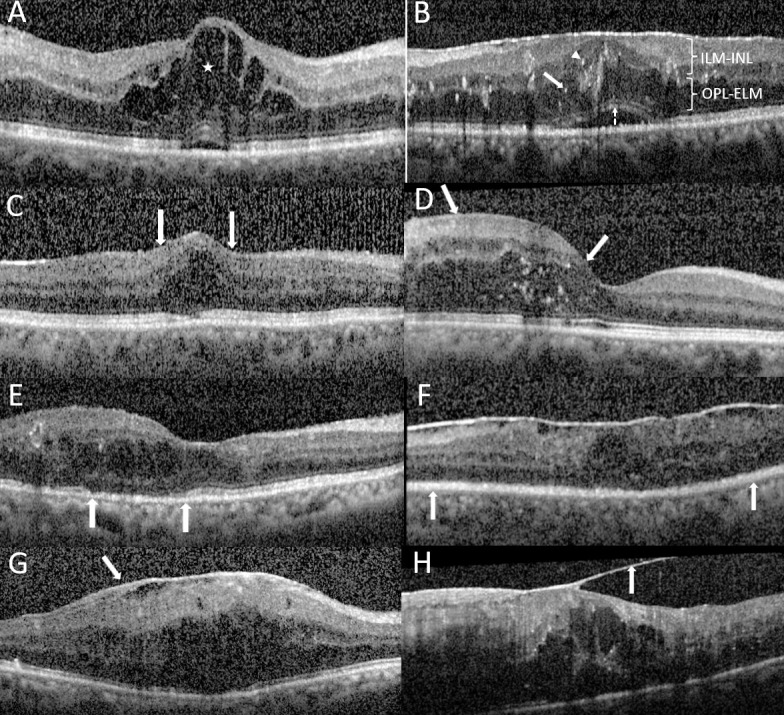
We retrospective reviewed 72 eyes from 44 treatment-naïve patients who were treated with intravitreal anti-VEGF for DME. OCT scans prior to anti-VEGF were evaluated for serous retinal detachment (SRD), size of outer nuclear layer cystoid changes, diffuse retinal thickening, integrity of the inner segment-outer segment (IS-OS) junction, quantity and location of hyperreflective foci, vitreomacular interface abnormalities, and epiretinal membrane (ERM). The Baseline best-corrected visual acuity (BCVA) and central macular thickness was recorded at baseline and 4 months after treatment with anti-VEGF. The main outcome measure was the correlation between spectral-domain OCT measurements and BCVA response at baseline and after anti-VEGF treatment (mean change from baseline; ≥ 10 Early Treatment Diabetic Retinopathy Study letters in BCVA).
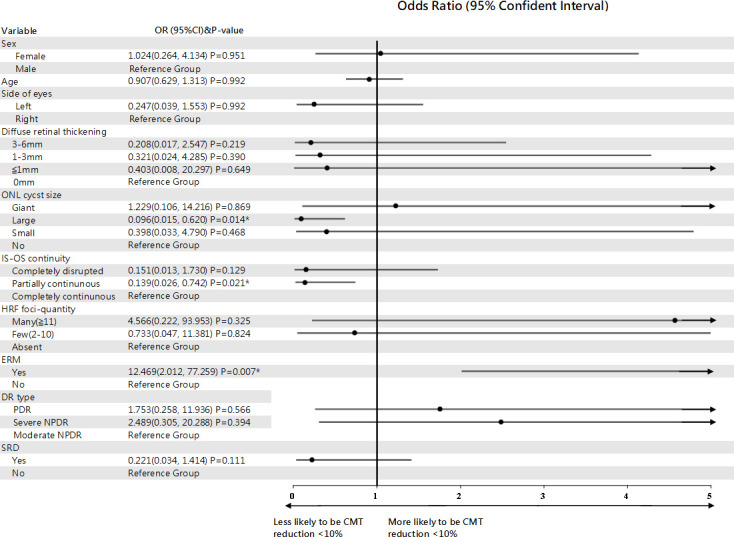
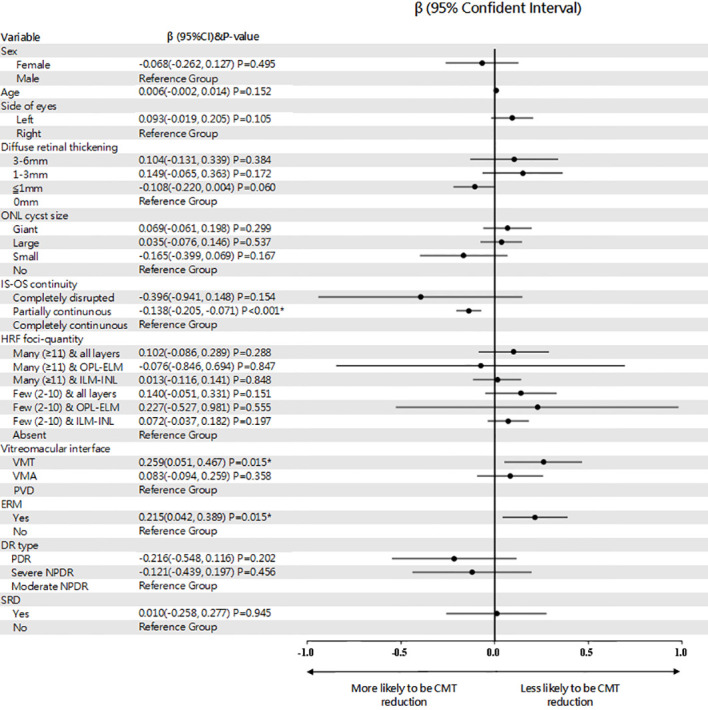
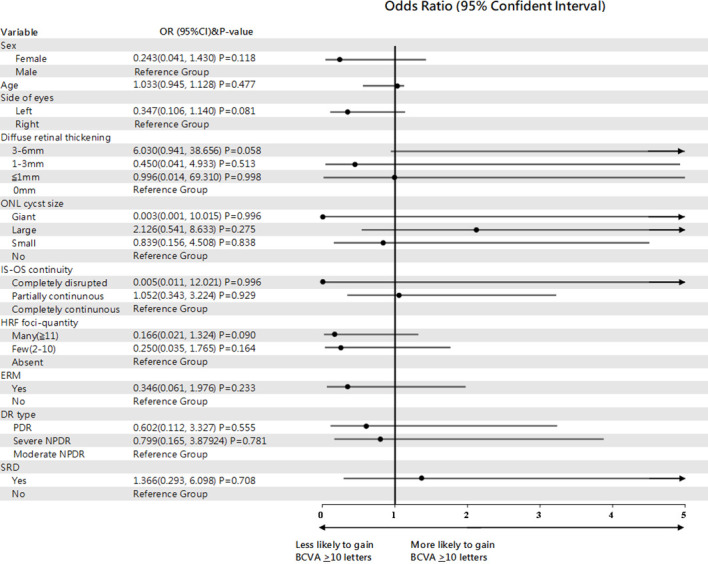
Partially continuous IS-OS layers (partially vs. completely continuous: β, -0.138; Wald chi-square, 16.392; P<0.001) was predictor of better response to anti-VEGF treatment. In contrast, ERM (present vs. absent ERM: β, 0.215; Wald chi-square, 5.921; P=0.015) and vitreomacular traction (vitreomacular traction vs. posterior vitreous detachment: β=0.259; Wald chi-square=5.938; P=0.015) were the predictors of poor response. The improvement of BCVA trended toward the OCT predictive value of central macular thickness reduction; however, this was not significant.
Partially continuous IS-OS layers is predictive of better response to anti-VEGF therapy in DME. Meanwhile, ERM is a significant predictor of poor response.
早期识别和描述糖尿病性黄斑水肿(DME)患者对于个体化治疗和优化预后至关重要。本研究旨在及时研究对玻璃体内抗血管内皮生长因子(VEGF)治疗无反应的 DME 的光学相干断层扫描(OCT)生物标志物。
我们回顾性分析了 44 例初治患者的 72 只眼,这些患者均因 DME 接受了玻璃体内抗 VEGF 治疗。在接受抗 VEGF 治疗之前,对浆液性视网膜脱离(SRD)、外核层囊样改变的大小、弥漫性视网膜增厚、内节-外节(IS-OS)连接的完整性、高反射焦点的数量和位置、玻璃体黄斑界面异常和视网膜前膜(ERM)进行了 OCT 扫描。在基线和玻璃体内抗 VEGF 治疗后 4 个月记录了最佳矫正视力(BCVA)和中央黄斑厚度的基线值。主要观察指标为 OCT 测量值与基线和抗 VEGF 治疗后 BCVA 反应之间的相关性(BCVA 从基线的平均变化;≥10 个早期糖尿病性视网膜病变研究字母)。
部分连续的 IS-OS 层(部分连续与完全连续:β,-0.138;Wald 卡方,16.392;P<0.001)是抗 VEGF 治疗反应更好的预测因素。相比之下,ERM(存在与不存在 ERM:β,0.215;Wald 卡方,5.921;P=0.015)和玻璃体黄斑牵引(玻璃体黄斑牵引与后玻璃体脱离:β=0.259;Wald 卡方=5.938;P=0.015)是预后不良的预测因素。BCVA 的改善趋势与 OCT 预测的中央黄斑厚度降低值一致;然而,这并不显著。
部分连续的 IS-OS 层是 DME 对抗 VEGF 治疗反应更好的预测因素。同时,ERM 是预后不良的重要预测因素。