Institute of Animal Husbandry and Veterinary Medicine, Jiangxi Academy of Agricultural Sciences, Nanchang 330200, China.
Institute of Animal Husbandry and Veterinary Medicine, Jiangxi Academy of Agricultural Sciences, Nanchang 330200, China.
Poult Sci. 2023 Aug;102(8):102753. doi: 10.1016/j.psj.2023.102753. Epub 2023 May 23.
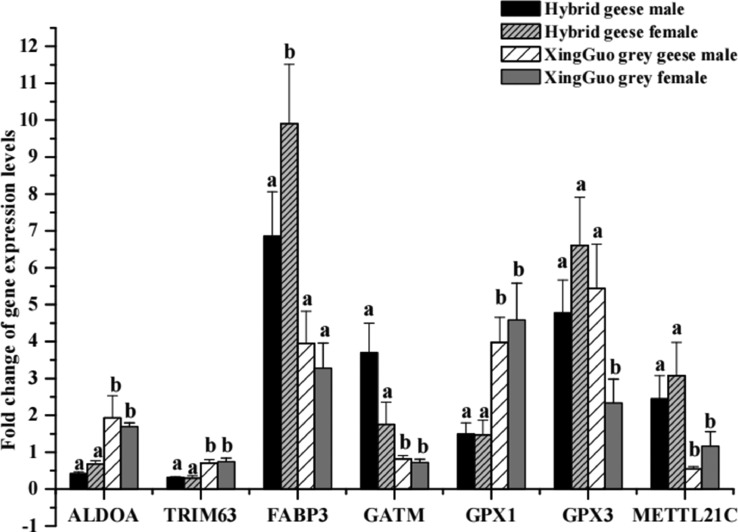
Here, we examined the effects of crossbreeding and sex on growth performance, slaughter performance, and meat quality in Xingguo gray (XG) goose, using transcriptomic and metabolomic techniques. The experiment was conducted using 400 goslings (1-day old) of 2 genotypes: the XG breed and its ternary hybrids [F geese; (XG Goose♂ × Yangzhou Goose♀)♀ × Shitou Goose♂]. The goslings were divided into 4 groups: female XG, male XG, female F geese, and male F geese, and growth parameters were examined at 70 d of age, using 30 birds from each group. Following slaughter, samples of breast and thigh muscles were collected from each group for chemical, metabolome, and transcriptome analyses. Growth rate, live body and slaughter weights, meat chemical composition, and muscle fiber diameter were affected by crossbreeding and sex. Crossbreeding significantly improved the dressing percentage, semieviscerated rate, eviscerated yield, and abdominal fat yield of XG geese. To clarify the potential regulatory network affected by crossbreeding and sex, we used RNA-seq and nontargeted metabolomics to detect changes in male and female goose breast muscle. The transcriptome results showed that there were 534, 323, 297, and 492 differently expressed genes (DEGs) among the 4 comparison groups (XG-Female vs. F-Female, XG-Male vs. F-Male, F-Male vs. F-Female, and XG-Male vs. XG-Female, respectively) that were mainly related to muscle growth and development and fatty acid metabolism pathways. A total of 141 significantly differentially accumulated metabolites (DAMs) were enriched in serine and threonine, propionate, and pyruvate metabolism. Finally, we comprehensively analyzed the metabolome and transcriptome data and found that many DEGs and DAMs played crucial roles in lipid metabolism and muscle growth and development. In summary, crossbreeding can improve XG goose production performance and affect breast muscle gene expression and metabolites in both female and male geese.
在这里,我们使用转录组学和代谢组学技术研究了杂交和性别的交叉对兴国灰鹅(XG)生长性能、屠宰性能和肉质的影响。该实验使用了 400 只体重为 400 克的雏鹅(1 日龄),有 2 个基因型:XG 品种及其三元杂交种[F 鹅;(XG 鹅♂×扬州鹅♀)♀×石头鹅♂]。将雏鹅分为 4 组:雌性 XG、雄性 XG、雌性 F 鹅和雄性 F 鹅,每组 30 只,在 70 日龄时检查生长参数。生长速度、活体和屠宰体重、肉质化学成分和肌肉纤维直径受杂交和性别的影响。杂交显著提高了 XG 鹅的屠宰率、半净膛率、净膛率和腹脂率。为了阐明受杂交和性别的潜在调控网络,我们使用 RNA-seq 和非靶向代谢组学检测了雌雄鹅胸肌的变化。转录组结果表明,在 4 个比较组(XG-Female vs. F-Female、XG-Male vs. F-Male、F-Male vs. F-Female 和 XG-Male vs. XG-Female)中,有 534、323、297 和 492 个差异表达基因(DEGs),主要与肌肉生长和发育以及脂肪酸代谢途径有关。共有 141 个差异显著的代谢物(DAMs)在丝氨酸和苏氨酸、丙酸盐和丙酮酸代谢中富集。最后,我们综合分析了代谢组学和转录组学数据,发现许多 DEGs 和 DAMs 在脂质代谢和肌肉生长发育中发挥着关键作用。总之,杂交可以提高 XG 鹅的生产性能,并影响雌雄鹅的胸肌基因表达和代谢物。