Institute for Regeneration & Repair, University of Edinburgh, Edinburgh, UK.
Division of Molecular and Clinical Medicine, University of Dundee, Dundee, UK.
Nat Rev Gastroenterol Hepatol. 2023 Oct;20(10):679-688. doi: 10.1038/s41575-023-00796-x. Epub 2023 Jun 2.
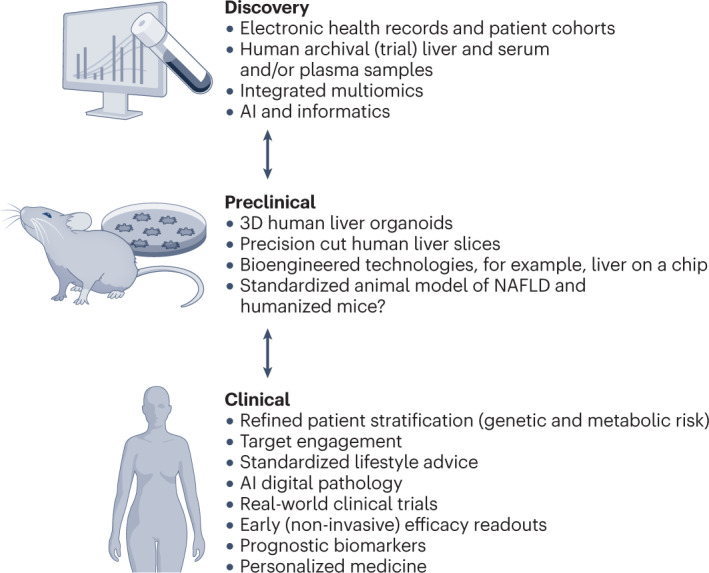
Nonalcoholic steatohepatitis (NASH) might soon become the leading cause of end-stage liver disease and indication for liver transplantation worldwide. Fibrosis severity is the only histological predictor of liver-related morbidity and mortality in NASH identified to date. Moreover, fibrosis regression is associated with improved clinical outcomes. However, despite numerous clinical trials of plausible drug candidates, an approved antifibrotic therapy remains elusive. Increased understanding of NASH susceptibility and pathogenesis, emerging human multiomics profiling, integration of electronic health record data and modern pharmacology techniques hold enormous promise in delivering a paradigm shift in antifibrotic drug development in NASH. There is a strong rationale for drug combinations to boost efficacy, and precision medicine strategies targeting key genetic modifiers of NASH are emerging. In this Perspective, we discuss why antifibrotic effects observed in NASH pharmacotherapy trials have been underwhelming and outline potential approaches to improve the likelihood of future clinical success.
非酒精性脂肪性肝炎(NASH)可能很快成为全球终末期肝病和肝移植的主要原因。迄今为止,纤维化严重程度是 NASH 中唯一确定的与肝脏相关发病率和死亡率相关的组织学预测因素。此外,纤维化消退与改善临床结局相关。然而,尽管对许多有希望的药物候选物进行了临床试验,但仍未找到一种批准的抗纤维化治疗方法。对 NASH 易感性和发病机制的深入了解、新兴的人类多组学分析、电子健康记录数据的整合以及现代药理学技术,为 NASH 抗纤维化药物开发带来范式转变带来了巨大的希望。联合用药以提高疗效具有充分的理由,针对 NASH 的关键遗传修饰物的精准医学策略也正在出现。在本观点中,我们讨论了为什么 NASH 药物治疗试验中观察到的抗纤维化作用令人失望,并概述了提高未来临床成功可能性的潜在方法。