Lu Chenmiao, Al-Juaid Rawan, Al-Amri Mohammad
Department of Rehabilitation Medicine, The First Affiliated Hospital of Zhejiang University School of Medicine, Zhejiang, China.
Physical Therapy Department, Almuwaih General Hospital, Ministry of Health, Taif, Saudi Arabia.
JMIR Form Res. 2023 Jun 5;7:e42769. doi: 10.2196/42769.
Inclined walking is a challenging task that requires active neuromuscular control to maintain stability. However, the adaptive strategies that preserve stability during inclined walking are not well understood. Investigating the effects of self-paced inclined treadmill walking on gait stability characteristics and the activation patterns of key lower limb muscles can provide insights into these strategies.
The aim of this study was to investigate the effects of self-paced inclined treadmill walking on gait stability characteristics and the activation of key lower limb muscles.
Twenty-eight able-bodied individuals (mean age 25.02, SD 2.06 years) walked on an augmented instrumented treadmill for 3 minutes at 3 inclination angles (-8°, 0°, and 8°) at their preferred walking speed. Changes in gait characteristics (ie, stability, walking speed, spatial-temporal, kinematic, and muscle forces) across inclination angles were assessed using a repeated measures ANOVA and the Friedman test.
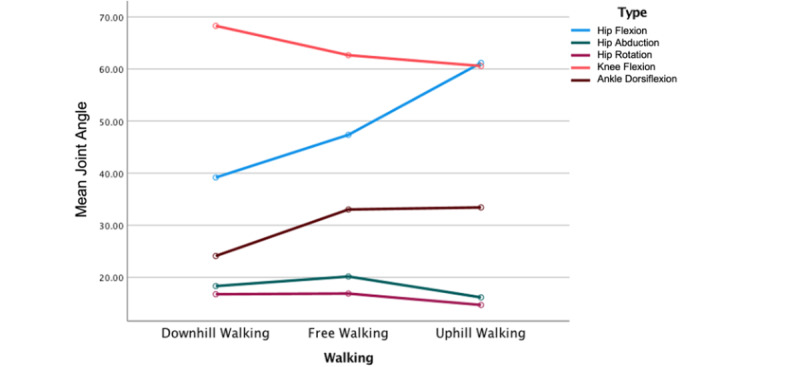
The study revealed that inclined treadmill walking has a significant impact on gait characteristics (P<.001). Changes were observed in spatial-temporal parameters, joint angles, and muscle activations depending on the treadmill inclination. Specifically, stability and walking speed decreased significantly during uphill walking, indicating that it was the most challenging walking condition. Uphill walking also led to a decrease in spatial parameters by at least 13.53% and a 5.26% to 10.96% increase in temporal parameters. Furthermore, joint kinematics and peak activation of several muscles, including the hamstrings (biceps femoris, long head=109.5%, biceps femoris, short head=53.3%, semimembranosus=98.9%, semitendinosus=90.9%), gastrocnemius (medial gastrocnemius=40.6%, lateral gastrocnemius=35.3%), and vastii muscles (vastus intermedius=12.8%, vastus lateralis=16.7%) increased significantly during uphill walking. In contrast, downhill walking resulted in bilateral reductions in spatial-temporal gait parameters, with knee flexion increasing and hip flexion and ankle dorsiflexion decreasing. The peak activation of antagonist muscles, such as the quadriceps, tibialis anterior, and tibialis posterior, significantly increased during downhill walking (rectus femoris=97.7%, vastus lateralis =70.6%, vastus intermedius=68.7%, tibialis anterior=72%, tibialis posterior=107.1%).
Our findings demonstrate that able-bodied individuals adopt specific walking patterns during inclined treadmill walking to maintain a comfortable and safe walking performance. The results suggest that inclined treadmill walking has the potential to serve as a functional assessment and rehabilitation tool for gait stability by targeting muscle training. Future research should investigate the effects of inclined treadmill walking on individuals with gait impairments and the potential benefits of targeted muscle training. A better understanding of the adaptive strategies used during inclined walking may lead to the development of more effective rehabilitation interventions for individuals with lower limb injuries.
倾斜行走是一项具有挑战性的任务,需要积极的神经肌肉控制来维持稳定性。然而,在倾斜行走过程中保持稳定性的适应性策略尚未得到充分理解。研究自定步速的倾斜跑步机行走对步态稳定性特征和关键下肢肌肉激活模式的影响,可以深入了解这些策略。
本研究旨在探讨自定步速的倾斜跑步机行走对步态稳定性特征和关键下肢肌肉激活的影响。
28名身体健康的个体(平均年龄25.02岁,标准差2.06岁)在一台增强型仪器化跑步机上,以其偏好的步行速度在3个倾斜角度(-8°、0°和8°)下行走3分钟。使用重复测量方差分析和弗里德曼检验评估不同倾斜角度下步态特征(即稳定性、步行速度、时空参数、运动学和肌肉力量)的变化。
研究表明,倾斜跑步机行走对步态特征有显著影响(P<0.001)。根据跑步机倾斜度,在时空参数、关节角度和肌肉激活方面观察到了变化。具体而言,上坡行走时稳定性和步行速度显著降低,表明这是最具挑战性的行走条件。上坡行走还导致空间参数至少降低13.53%,时间参数增加5.26%至10.96%。此外,上坡行走时,包括腘绳肌(股二头肌长头=109.5%,股二头肌短头=53.3%,半膜肌=98.9%,半腱肌=90.9%)、腓肠肌(内侧腓肠肌=40.6%,外侧腓肠肌=35.3%)和股四头肌(股中间肌=12.8%,股外侧肌=16.7%)在内的几块肌肉的关节运动学和峰值激活显著增加。相比之下,下坡行走导致双侧时空步态参数降低,膝关节屈曲增加,髋关节屈曲和踝关节背屈减少。下坡行走时,拮抗肌如股四头肌、胫骨前肌和胫骨后肌的峰值激活显著增加(股直肌=97.7%,股外侧肌=70.6%,股中间肌=68.7%,胫骨前肌=72%,胫骨后肌=107.1%)。
我们的研究结果表明,身体健康的个体在倾斜跑步机行走过程中采用特定的行走模式来维持舒适和安全的行走表现。结果表明,倾斜跑步机行走有潜力通过针对性的肌肉训练作为步态稳定性的功能评估和康复工具。未来的研究应调查倾斜跑步机行走对步态受损个体的影响以及针对性肌肉训练的潜在益处。更好地理解倾斜行走过程中使用的适应性策略可能会导致为下肢受伤个体开发更有效的康复干预措施。
