Laboratory of Plant Molecular Physiology, Department of Applied Biological Chemistry, Graduate School of Agricultural and Life Sciences, University of Tokyo, 113-8657, Bunkyo-ku, Tokyo, Japan.
Institute of Crop Science, National Agriculture and Food Research Organization 305-8518, Tsukuba, Ibaraki, Japan.
Proc Natl Acad Sci U S A. 2023 Jun 13;120(24):e2221863120. doi: 10.1073/pnas.2221863120. Epub 2023 Jun 5.
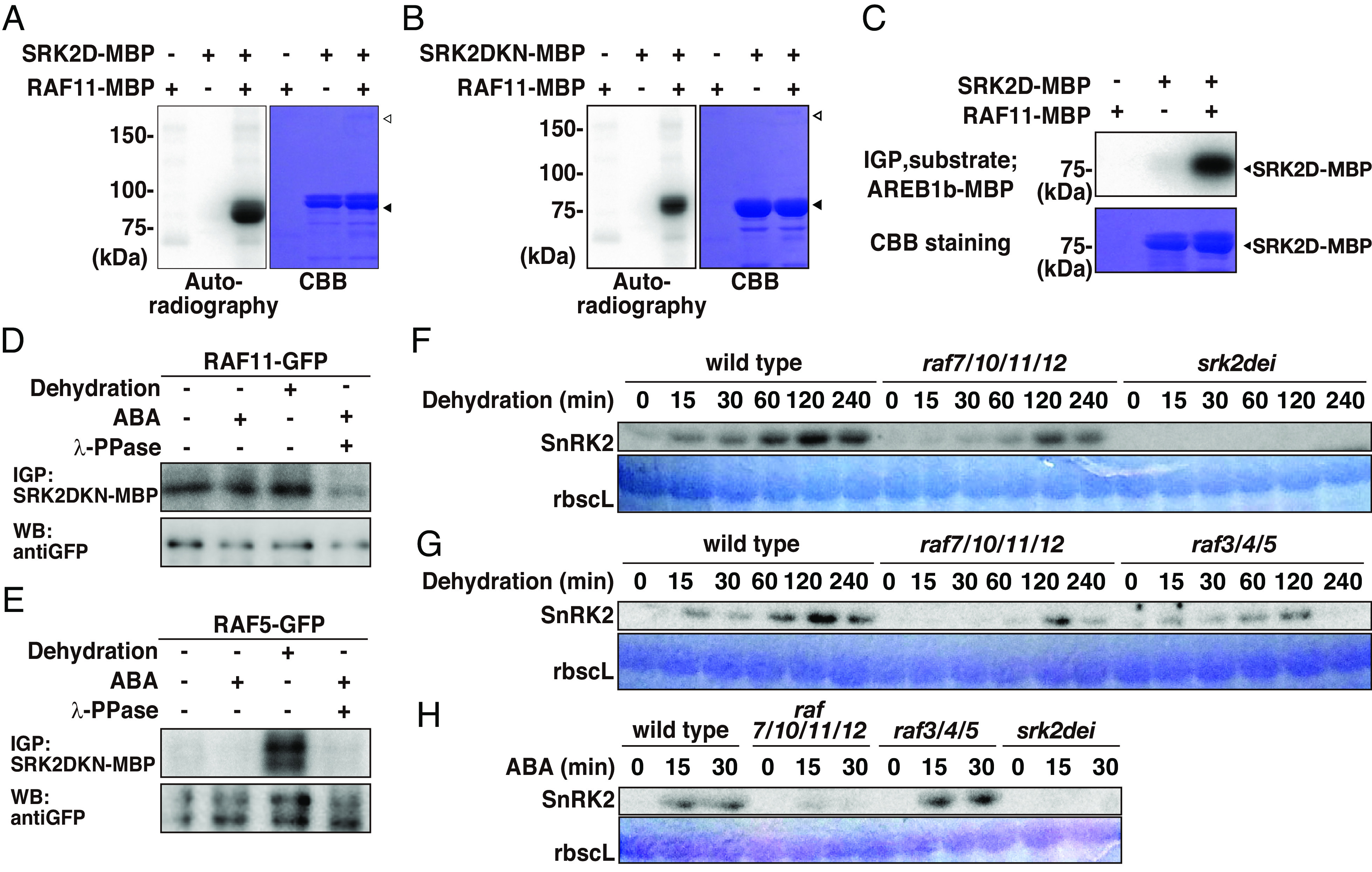
Osmotic stresses, such as drought and high salinity, adversely affect plant growth and productivity. The phytohormone abscisic acid (ABA) accumulates in response to osmotic stress and enhances stress tolerance in plants by triggering multiple physiological responses through ABA signaling. Subclass III SNF1-related protein kinases 2 (SnRK2s) are key regulators of ABA signaling. Although SnRK2s have long been considered to be self-activated by autophosphorylation after release from PP2C-mediated inhibition, they were recently revealed to be activated by two independent subfamilies of group B Raf-like kinases, B2-RAFs and B3-RAFs, under osmotic stress conditions. However, the relationship between SnRK2 phosphorylation by these RAFs and SnRK2 autophosphorylation and the individual physiological roles of each RAF subfamily remain unknown. In this study, we indicated that B2-RAFs are constantly active and activate SnRK2s when released from PP2C-mediated inhibition by ABA-binding ABA receptors, whereas B3-RAFs are activated only under stress conditions in an ABA-independent manner and enhance SnRK2 activity. Autophosphorylation of subclass III SnRK2s is not sufficient for ABA responses, and B2-RAFs are needed to activate SnRK2s in an ABA-dependent manner. Using plants grown in soil, we found that B2-RAFs regulate subclass III SnRK2s at the early stage of drought stress, whereas B3-RAFs regulate SnRK2s at the later stage. Thus, B2-RAFs are essential kinases for the activation of subclass III SnRK2s in response to ABA under mild osmotic stress conditions, and B3-RAFs function as enhancers of SnRK2 activity under severe stress conditions.
渗透胁迫,如干旱和高盐度,会对植物的生长和生产力产生不利影响。植物激素脱落酸(ABA)在渗透胁迫下积累,并通过 ABA 信号触发多种生理反应,增强植物的胁迫耐受性。第三类 SNF1 相关蛋白激酶 2(SnRK2s)是 ABA 信号的关键调节剂。尽管 SnRK2s 长期以来被认为是在从 PP2C 介导的抑制中释放后通过自身磷酸化而被激活的,但最近发现它们在渗透胁迫条件下,被 B 类 Raf 样激酶的两个独立亚家族 B2-RAFs 和 B3-RAFs 激活。然而,这些 RAF 对 SnRK2 的磷酸化与 SnRK2 的自身磷酸化之间的关系,以及每个 RAF 亚家族的个体生理作用仍然未知。在这项研究中,我们表明 B2-RAFs 在 ABA 结合 ABA 受体从 PP2C 介导的抑制中释放后一直处于活跃状态,并激活 SnRK2s,而 B3-RAFs 仅在应激条件下以 ABA 非依赖性方式被激活,并增强 SnRK2 活性。第三类 SnRK2s 的自身磷酸化不足以产生 ABA 反应,需要 B2-RAFs 以 ABA 依赖的方式激活 SnRK2s。使用在土壤中生长的植物,我们发现 B2-RAFs 在干旱胁迫的早期阶段调节第三类 SnRK2s,而 B3-RAFs 在后期阶段调节 SnRK2s。因此,B2-RAFs 是在轻度渗透胁迫条件下 ABA 响应中激活第三类 SnRK2s 的必需激酶,而 B3-RAFs 在严重胁迫条件下作为 SnRK2 活性的增强剂发挥作用。