Department of Occupational Therapy and Physiotherapy, Aalborg University Hospital, Aalborg, Denmark.
Department of Orthopaedic Surgery, Aalborg University Hospital, Aalborg University, 18-22 Hobrovej, 9000, Aalborg, Denmark.
Arch Orthop Trauma Surg. 2023 Nov;143(11):6865-6874. doi: 10.1007/s00402-023-04915-w. Epub 2023 Jun 6.
Interpretation of patient-reported outcome scores such as the Hip Disability and Osteoarthritis Outcome Score (HOOS) can be improved with use of reference values. The aim of the study was to establish population-based reference values for the HOOS' five subscales and its short-form HOOS-12.
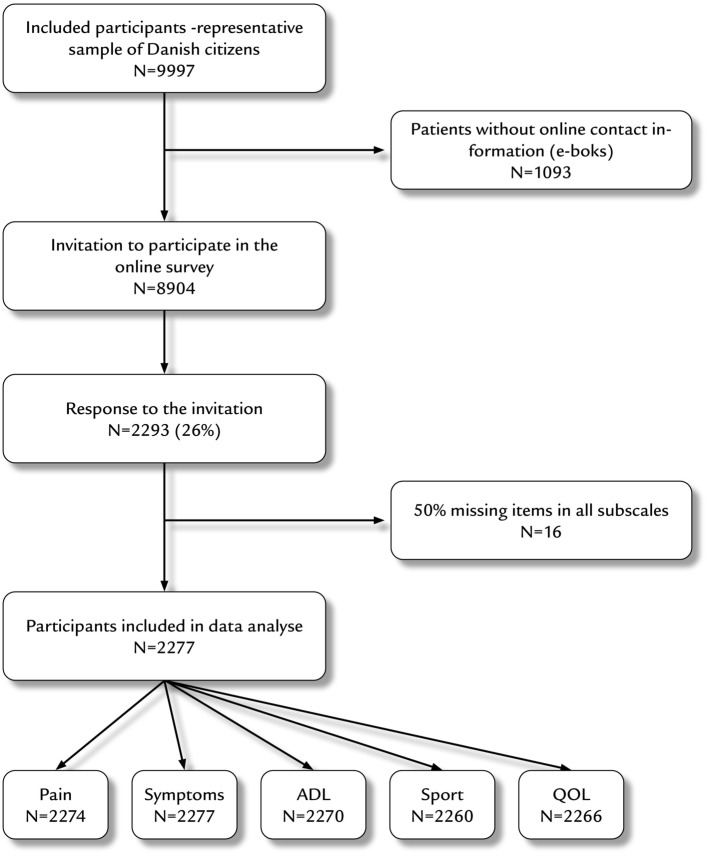
A representative sample of 9997 Danish citizens 18 years and older were identified. The population record-based sample was based on seven predefined age groups and an equal sex distribution within each age group. A national secure electronic system was used to send the HOOS questionnaire and one supplementary question regarding previous hip complaints to all participants.
2277 participants completed the HOOS, 947 women (42%) and 1330 men (58%). The mean HOOS subscale scores were: pain 86.9 (95% CI 86.1-87.7), symptoms 83.7 (95% CI 82.9-84.5), ADL 88.2 (95% CI 87.5-89.0), sport and recreation function 83.1 (95% CI 82.0-84.1), QOL 82.7 (95% CI 81.8-83.6). The youngest age group reported better mean scores in four subscales compared to the oldest age group (pain 91.7 vs. 84.5, mean difference 7.2 95% CI 0.4-14.0), (ADL 94.6 points vs. 83.2, mean difference 11.4 95% CI 4.9-17.8), (sport and recreation function 91.5 points vs. 73.8 points, mean difference 17.7 95% CI 9.0-26.4), (QOL 88.9 points vs. 78.8, mean difference 10.1 points 95% CI 2.0-18.2). Participants with a self-reported hip complaint had worse HOOS scores across all subscales (mean difference range 22.1-34.6). Super obese patients (BMI > 40) had > 12.5 points worse scores across the five HOOS subscales. Results were similar for the HOOS-12.
This study provides reference values for the HOOS and its short form HOOS-12. Results show that older patients and patients with a BMI over 40 have worse HOOS and HOOS-12 scores that may be of clinical importance in the interpretation of scores both when evaluating potential for improvement and post-treatment results.
通过使用参考值,可以提高对患者报告的结果评分(如髋关节残疾和骨关节炎结果评分(HOOS))的解释。本研究的目的是建立 HOOS 五个分量表及其简化版 HOOS-12 的基于人群的参考值。
确定了 9997 名丹麦 18 岁及以上的代表性样本。基于七个预定义的年龄组和每个年龄组内相等的性别分布,从人口记录中抽取样本。使用国家安全电子系统向所有参与者发送 HOOS 问卷和一个关于先前髋关节问题的补充问题。
2277 名参与者完成了 HOOS 调查,其中 947 名女性(42%)和 1330 名男性(58%)。HOOS 分量表的平均评分分别为:疼痛 86.9(95%CI 86.1-87.7)、症状 83.7(95%CI 82.9-84.5)、ADL 88.2(95%CI 87.5-89.0)、运动和娱乐功能 83.1(95%CI 82.0-84.1)、生活质量 82.7(95%CI 81.8-83.6)。最年轻的年龄组在四个分量表中的平均评分均高于最年长的年龄组(疼痛 91.7 比 84.5,平均差异 7.2 95%CI 0.4-14.0)、(ADL 94.6 分比 83.2 分,平均差异 11.4 95%CI 4.9-17.8)、(运动和娱乐功能 91.5 分比 73.8 分,平均差异 17.7 95%CI 9.0-26.4)、(生活质量 88.9 分比 78.8 分,平均差异 10.1 分 95%CI 2.0-18.2)。自我报告髋关节问题的参与者在所有分量表上的 HOOS 评分均较差(平均差异范围 22.1-34.6)。超级肥胖患者(BMI>40)在五个 HOOS 分量表上的得分差了超过 12.5 分。HOOS-12 的结果相似。
本研究为 HOOS 及其简化版 HOOS-12 提供了参考值。结果表明,年龄较大的患者和 BMI 超过 40 的患者的 HOOS 和 HOOS-12 评分较差,这在解释评分时可能具有临床意义,无论是在评估潜在改善还是治疗后结果时。