Yu Wenhui, Xie Zhongyu, Li Jinteng, Lin Jiajie, Su Zepeng, Che Yunshu, Ye Feng, Zhang Zhaoqiang, Xu Peitao, Zeng Yipeng, Xu Xiaojun, Li Zhikun, Feng Pei, Mi Rujia, Wu Yanfeng, Shen Huiyong
Department of Orthopedics, The Eighth Affiliated Hospital, Sun Yat-sen University, Shenzhen, 518003, PR China.
Shenzhen Key Laboratory of Ankylosing Spondylitis, Shenzhen, 518003, PR China.
Bone Res. 2023 Jun 7;11(1):30. doi: 10.1038/s41413-023-00267-8.
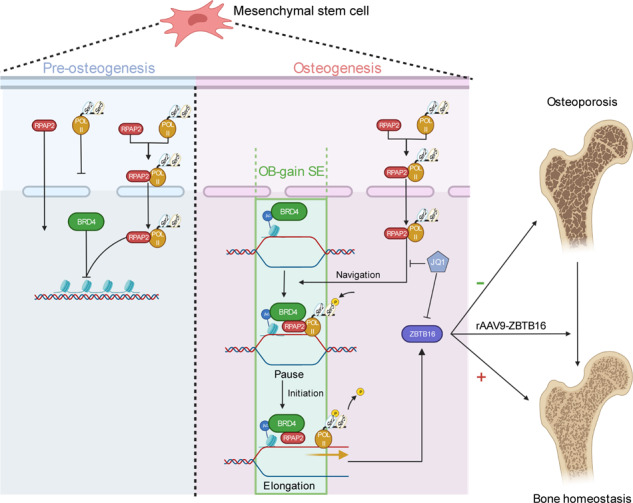
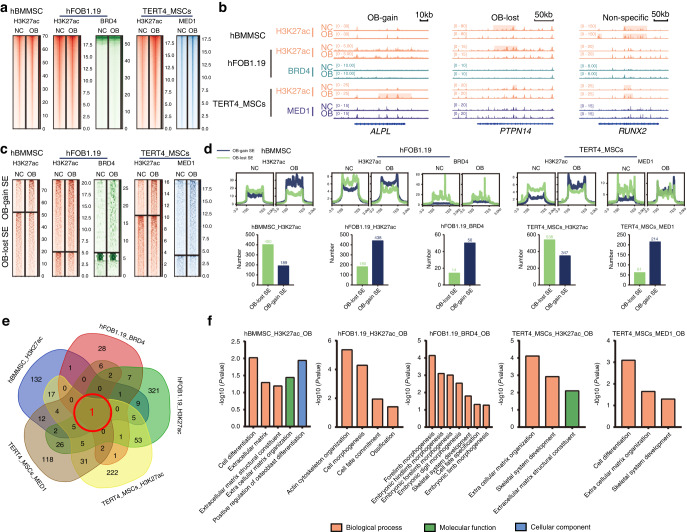
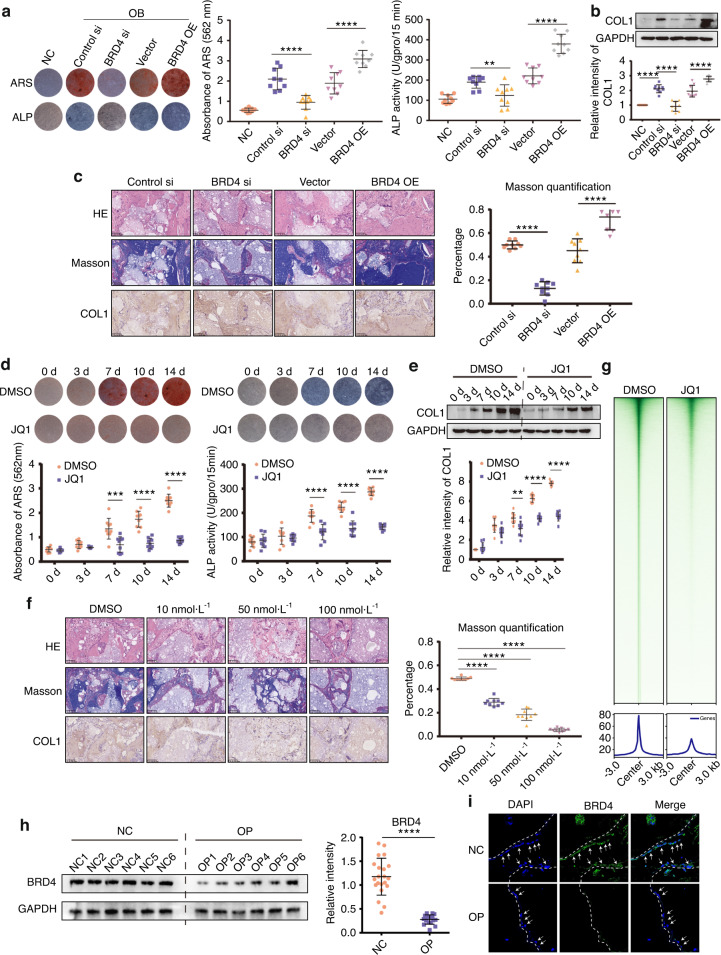
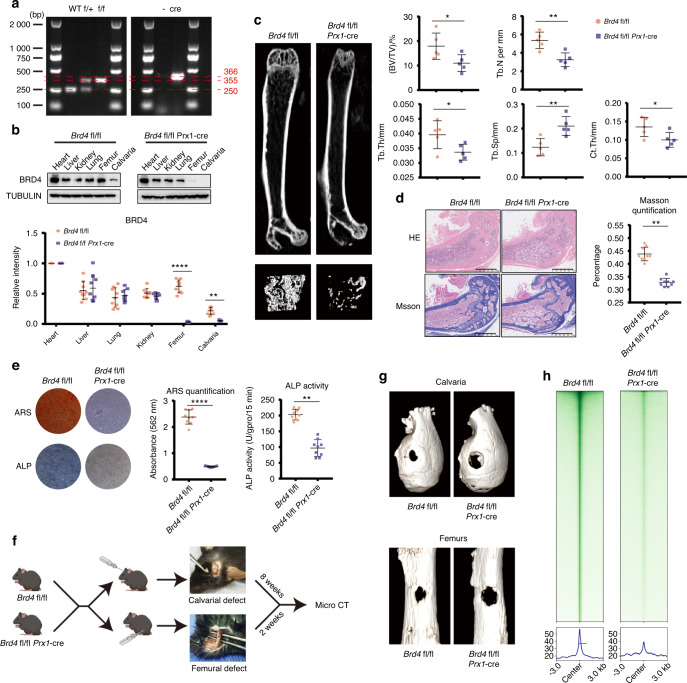
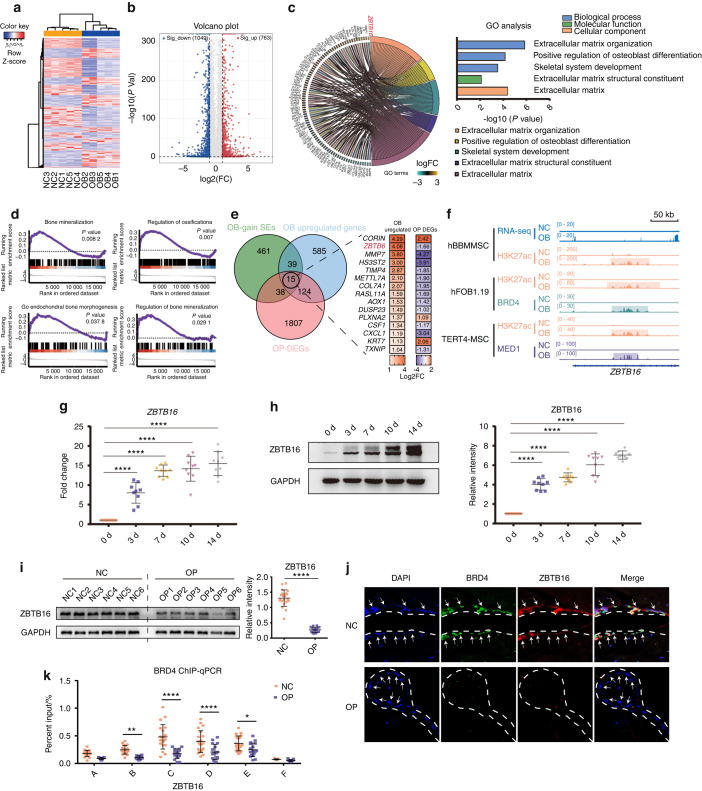
As the major cell precursors in osteogenesis, mesenchymal stem cells (MSCs) are indispensable for bone homeostasis and development. However, the primary mechanisms regulating osteogenic differentiation are controversial. Composed of multiple constituent enhancers, super enhancers (SEs) are powerful cis-regulatory elements that identify genes that ensure sequential differentiation. The present study demonstrated that SEs were indispensable for MSC osteogenesis and involved in osteoporosis development. Through integrated analysis, we identified the most common SE-targeted and osteoporosis-related osteogenic gene, ZBTB16. ZBTB16, positively regulated by SEs, promoted MSC osteogenesis but was expressed at lower levels in osteoporosis. Mechanistically, SEs recruited bromodomain containing 4 (BRD4) at the site of ZBTB16, which then bound to RNA polymerase II-associated protein 2 (RPAP2) that transported RNA polymerase II (POL II) into the nucleus. The subsequent synergistic regulation of POL II carboxyterminal domain (CTD) phosphorylation by BRD4 and RPAP2 initiated ZBTB16 transcriptional elongation, which facilitated MSC osteogenesis via the key osteogenic transcription factor SP7. Bone-targeting ZBTB16 overexpression had a therapeutic effect on the decreased bone density and remodeling capacity of Brd4 Prx1-cre mice and osteoporosis (OP) models. Therefore, our study shows that SEs orchestrate the osteogenesis of MSCs by targeting ZBTB16 expression, which provides an attractive focus and therapeutic target for osteoporosis. Without SEs located on osteogenic genes, BRD4 is not able to bind to osteogenic identity genes due to its closed structure before osteogenesis. During osteogenesis, histones on osteogenic identity genes are acetylated, and OB-gain SEs appear, enabling the binding of BRD4 to the osteogenic identity gene ZBTB16. RPAP2 transports RNA Pol II from the cytoplasm to the nucleus and guides Pol II to target ZBTB16 via recognition of the navigator BRD4 on SEs. After the binding of the RPAP2-Pol II complex to BRD4 on SEs, RPAP2 dephosphorylates Ser5 at the Pol II CTD to terminate the transcriptional pause, and BRD4 phosphorylates Ser2 at the Pol II CTD to initiate transcriptional elongation, which synergistically drives efficient transcription of ZBTB16, ensuring proper osteogenesis. Dysregulation of SE-mediated ZBTB16 expression leads to osteoporosis, and bone-targeting ZBTB16 overexpression is efficient in accelerating bone repair and treating osteoporosis.
作为骨生成中的主要细胞前体,间充质干细胞(MSCs)对于骨稳态和发育不可或缺。然而,调节成骨分化的主要机制仍存在争议。超级增强子(SEs)由多个组成型增强子构成,是强大的顺式调控元件,可识别确保顺序分化的基因。本研究表明,SEs对于MSCs成骨是不可或缺的,并参与骨质疏松症的发展。通过综合分析,我们确定了最常见的SE靶向且与骨质疏松症相关的成骨基因ZBTB16。ZBTB16受SEs正向调控,促进MSCs成骨,但在骨质疏松症中表达水平较低。机制上,SEs在ZBTB16位点招募含溴结构域4(BRD4),BRD4随后与将RNA聚合酶II(POL II)转运至细胞核的RNA聚合酶II相关蛋白2(RPAP2)结合。BRD4和RPAP2随后对POL II羧基末端结构域(CTD)磷酸化的协同调控启动了ZBTB16的转录延伸,这通过关键的成骨转录因子SP7促进了MSCs成骨。靶向骨的ZBTB16过表达对Brd4 Prx1-cre小鼠和骨质疏松症(OP)模型的骨密度降低和重塑能力具有治疗作用。因此,我们的研究表明,SEs通过靶向ZBTB16表达来协调MSCs的成骨过程,这为骨质疏松症提供了一个有吸引力的研究重点和治疗靶点。由于在成骨之前其结构封闭,没有位于成骨基因上的SEs时,BRD4无法与成骨身份基因结合。在成骨过程中,成骨身份基因上的组蛋白被乙酰化,OB获得性SEs出现,使BRD4能够与成骨身份基因ZBTB16结合。RPAP2将RNA Pol II从细胞质转运至细胞核,并通过识别SEs上的导航分子BRD4引导Pol II靶向ZBTB16。RPAP2-Pol II复合物与SEs上的BRD4结合后,RPAP2使Pol II CTD处的Ser5去磷酸化以终止转录暂停,BRD4使Pol II CTD处的Ser2磷酸化以启动转录延伸,二者协同驱动ZBTB16的高效转录,确保适当的成骨过程。SE介导的ZBTB16表达失调导致骨质疏松症,靶向骨的ZBTB16过表达在加速骨修复和治疗骨质疏松症方面是有效的。