Department of Neurology, Charité, Universitätsmedizin Berlin, Corporate Member of Freie Universität Berlin and Humboldt-Universität zu Berlin, 10117, Berlin, Germany.
BIH Charité Clinician Scientist Program, BIH Biomedical Innovation Academy, Berlin Institute of Health at Charité, Universitätsmedizin Berlin, 10117, Berlin, Germany.
J Neurol. 2023 Sep;270(9):4434-4443. doi: 10.1007/s00415-023-11779-y. Epub 2023 Jun 6.
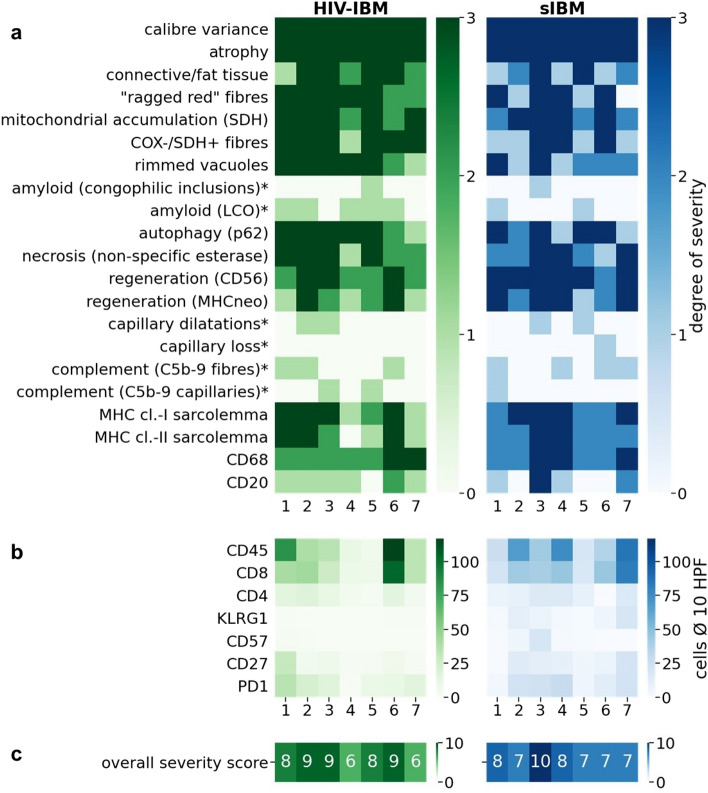
The molecular characteristics of sporadic inclusion body myositis (sIBM) have been intensively studied, and specific patterns on the cellular, protein and RNA level have emerged. However, these characteristics have not been studied in the context of HIV-associated IBM (HIV-IBM). In this study, we compared clinical, histopathological, and transcriptomic patterns of sIBM and HIV-IBM.
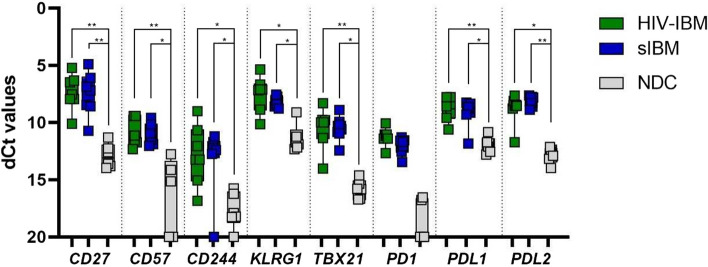
In this cross-sectional study, we compared patients with HIV-IBM and sIBM based on clinical and morphological features as well as gene expression levels of specific T-cell markers in skeletal muscle biopsy samples. Non-disease individuals served as controls (NDC). Cell counts for immunohistochemistry and gene expression profiles for quantitative PCR were used as primary outcomes.
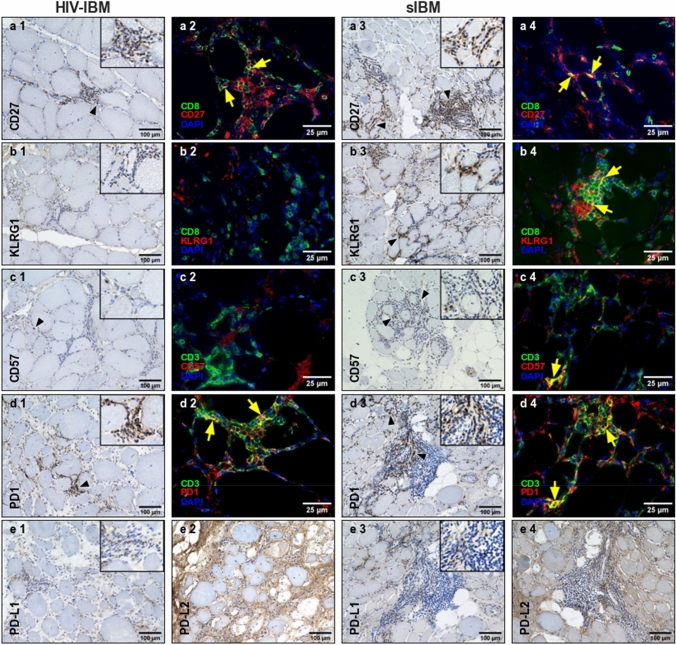
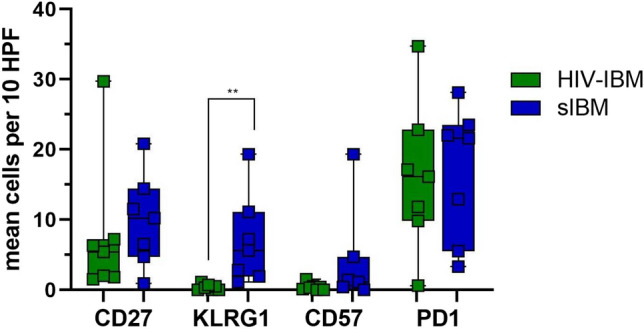
14 muscle biopsy samples (7 HIV-IBM, 7 sIBM) of patients and 6 biopsy samples from NDC were included. Clinically, HIV-IBM patients showed a significantly lower age of onset and a shorter period between symptom onset and muscle biopsy. Histomorphologically, HIV-IBM patients showed no KLRG1 or CD57 cells, while the number of PD1 cells did not differ significantly between the two groups. All markers were shown to be significantly upregulated at gene expression level with no significant difference between the IBM subgroups.
Despite HIV-IBM and sIBM sharing important clinical, histopathological, and transcriptomic signatures, the presence of KLRG1 cells discriminated sIBM from HIV-IBM. This may be explained by longer disease duration and subsequent T-cell stimulation in sIBM. Thus, the presence of TEMRA cells is characteristic for sIBM, but not a prerequisite for the development of IBM in HIV patients.
散发性包涵体肌炎(sIBM)的分子特征已得到深入研究,在细胞、蛋白质和 RNA 水平上出现了特定模式。然而,这些特征尚未在 HIV 相关 IBM(HIV-IBM)的背景下进行研究。在本研究中,我们比较了 sIBM 和 HIV-IBM 的临床、组织病理学和转录组学特征。
在这项横断面研究中,我们根据临床和形态特征以及骨骼肌活检样本中特定 T 细胞标志物的基因表达水平,比较了 HIV-IBM 和 sIBM 患者。非疾病个体作为对照(NDC)。免疫组织化学的细胞计数和定量 PCR 的基因表达谱用作主要结果。
纳入了 14 例肌肉活检样本(7 例 HIV-IBM,7 例 sIBM)的患者和 6 例来自 NDC 的活检样本。临床方面,HIV-IBM 患者的发病年龄明显较低,症状出现与肌肉活检之间的时间间隔也较短。组织形态学上,HIV-IBM 患者没有 KLRG1 或 CD57 细胞,而 PD1 细胞数量在两组之间无显著差异。所有标志物在基因表达水平上均显示出显著上调,而 IBM 亚组之间无显著差异。
尽管 HIV-IBM 和 sIBM 具有重要的临床、组织病理学和转录组学特征,但 KLRG1 细胞的存在可将 sIBM 与 HIV-IBM 区分开来。这可能是由于 sIBM 中疾病持续时间更长和随后的 T 细胞刺激所致。因此,TEMRA 细胞的存在是 sIBM 的特征,但不是 HIV 患者发生 IBM 的必要条件。