Department of Sociology, The Ohio State University, 238 Townshend Hall, 1885 Neil Avenue Mall, Columbus, OH, 43210, USA.
Institute for Population Research, The Ohio State University, 060 Townshend Hall, 1885 Neil Avenue Mall, Columbus, OH, 43210, USA.
Reprod Health. 2023 Jun 6;20(1):86. doi: 10.1186/s12978-023-01627-7.
The desired number of children is markedly higher in Sub-Saharan Africa (SSA) than in other major regions. Efforts to understand how and why these desires are generated and maintained have yielded a broad research literature. Yet there is no full picture of the range of contextual, cultural, and economic factors that support and disrupt high fertility desires.
This scoping review synthesizes thirty years of research on the determinants of fertility desires in SSA to better understand what factors underlie men and women's stated fertility desires and how they weigh the costs and benefits of having (more) children.
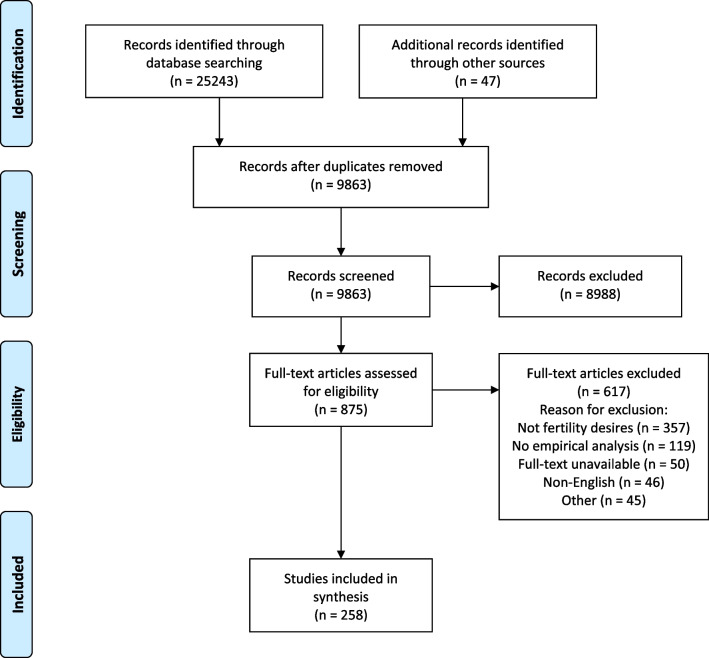
We identified and screened 9863 studies published from 1990 to 2021 from 18 social science, demographic, and health databases. We appraised determinants of fertility desires from 258 studies that met inclusion criteria according to their roles as traditional supports or contemporary disrupters of high fertility desires.
We identified 31 determinants of high fertility desires, which we organized into six overarching themes: economy and costs; marriage; the influence of others; education and status; health and mortality; and demographic predictors. For each theme, we summarize ways in which the determinants both support and disrupt high fertility desires. We find that high fertility remains desirable in many regions of sub-Saharan Africa but contemporary disrupters, such as the economic situations and increases to family planning and education, cause individuals to decrease their desired fertility with such decreases often viewed as a temporary adjustment to temporary conditions. Most included studies were quantitative, cross-sectional, and based on survey data.
This review demonstrates how traditionally supportive and contemporary disruptive forces simultaneously influence fertility desires in sub-Saharan Africa. Future studies analyzing fertility desires in sub-Saharan Africa should be informed by the lived experiences of men and women in this region, with qualitative and longitudinal studies prioritized.
撒哈拉以南非洲(SSA)的理想子女数明显高于其他主要地区。为了了解这些愿望是如何产生和维持的,人们进行了广泛的研究。然而,对于支持和破坏高生育率愿望的各种背景、文化和经济因素,我们还没有一个全面的了解。
本范围综述综合了 30 年来关于 SSA 生育意愿决定因素的研究,以更好地了解哪些因素是男性和女性生育意愿的基础,以及他们如何权衡生育(更多)孩子的成本和收益。
我们从 18 个社会科学、人口学和健康数据库中确定并筛选了 1990 年至 2021 年发表的 9863 项研究。我们根据其作为高生育率愿望的传统支持或当代破坏因素的作用,从符合纳入标准的 258 项研究中评估了生育意愿的决定因素。
我们确定了 31 个高生育率愿望的决定因素,我们将其组织成六个总体主题:经济和成本;婚姻;他人的影响;教育和地位;健康和死亡率;人口预测因素。对于每个主题,我们总结了决定因素如何既支持又破坏高生育率愿望的方式。我们发现,在撒哈拉以南非洲的许多地区,高生育率仍然是可取的,但当代的破坏因素,如经济状况以及计划生育和教育的增加,导致个人降低他们的期望生育率,这种下降通常被视为对临时情况的临时调整。大多数纳入的研究是定量的、横断面的,并基于调查数据。
本综述表明,传统的支持性和当代的破坏性力量如何同时影响撒哈拉以南非洲的生育意愿。未来分析撒哈拉以南非洲生育意愿的研究应该以该地区男性和女性的生活经历为依据,优先考虑定性和纵向研究。