Wu Qiaowei, Wang Chunlei, Xu Shancai, Ji Zhiyong, Qi Jingtao, Li Yuchen, Yao Jinbiao, Shi Huaizhang, Wu Pei
Department of Neurosurgery, The First Affiliated Hospital of Harbin Medical University, Harbin, China.
Quant Imaging Med Surg. 2023 Jun 1;13(6):3536-3546. doi: 10.21037/qims-22-970. Epub 2023 Apr 14.
It is necessary to explore the safety and efficacy of various endovascular treatment techniques in the treatment of patients with intracranial vertebrobasilar trunk dissecting aneurysms (VBTDAs). This study sought to compare the clinical and angiographic outcomes of patients with intracranial VBTDAs following low-profile visualized intraluminal support (LVIS)-within-Enterprise overlapping-stent technique with those of flow diversion (FD).
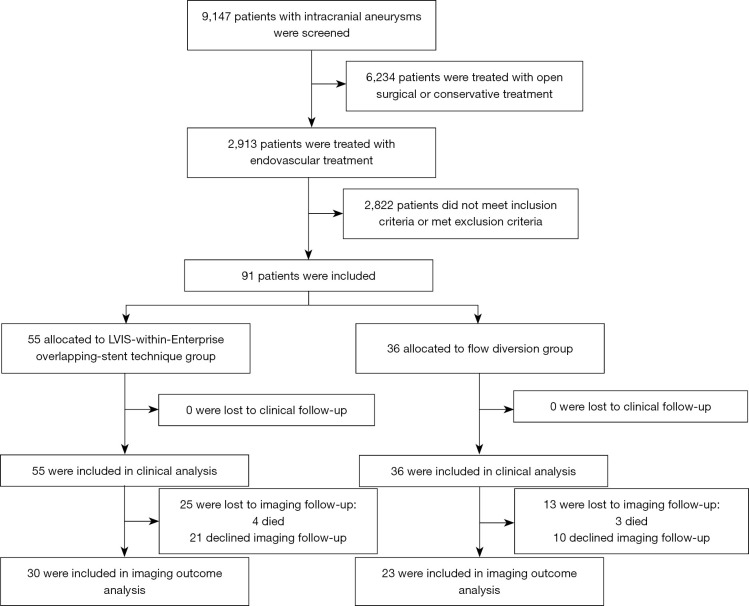
This was a retrospective, observational, cohort study. Between January 2014 and March 2022, 9,147 patients with intracranial aneurysms were screened, and 91 patients with 95 VBTDAs who underwent LVIS-within-Enterprise overlapping-stent assisted-coiling technique or FD were included in the analysis. The primary outcome was the complete occlusion rate at the last angiographic follow-up. The secondary outcomes included adequate aneurysm occlusion, in-stent stenosis/thrombosis, general neurological complications, neurological complications within 30 days after the procedure, the mortality rate, and unfavorable outcomes.
Among the 91 included patients, 55 were treated with LVIS-within-Enterprise overlapping-stent technique (the LE group) and 36 were treated with FD (the FD group). The angiography results at the median follow-up time of 8 months showed complete occlusion rates of 90.0% and 60.9% for the LE and FD groups, respectively, with an adjusted odds ratio of 5.79 (95% CI: 1.35-24.85; P=0.01). Adequate aneurysm occlusion (P=0.98), in-stent stenosis/thrombosis (P=0.46), general neurological complications (P=0.22), neurological complications within 30 days after the procedure (P=0.63), mortality rate (P=0.31), and unfavorable outcomes (P=0.07) at the last clinical follow-up did not differ significantly between the 2 groups.
A significantly higher complete occlusion rate for VBTDAs was found following LVIS-within-Enterprise overlapping-stent technique as compared with FD. The 2 treatment modalities have comparable adequate occlusion rates and safety profiles.
有必要探讨各种血管内治疗技术在颅内椎基底动脉干夹层动脉瘤(VBTDA)患者治疗中的安全性和有效性。本研究旨在比较采用低轮廓可视化腔内支撑(LVIS)-Enterprise重叠支架技术与血流导向(FD)治疗颅内VBTDA患者的临床和血管造影结果。
这是一项回顾性观察队列研究。2014年1月至2022年3月期间,对9147例颅内动脉瘤患者进行了筛查,91例患有95个VBTDA且接受了LVIS-Enterprise重叠支架辅助弹簧圈栓塞技术或FD治疗的患者纳入分析。主要结局是最后一次血管造影随访时的完全闭塞率。次要结局包括动脉瘤充分闭塞、支架内狭窄/血栓形成、一般神经并发症、术后30天内的神经并发症、死亡率和不良结局。
在纳入的91例患者中,55例采用LVIS-Enterprise重叠支架技术治疗(LE组),36例采用FD治疗(FD组)。中位随访时间8个月时的血管造影结果显示,LE组和FD组的完全闭塞率分别为90.0%和60.9%,调整后的优势比为5.79(95%CI:1.35-24.85;P=0.01)。最后一次临床随访时,两组在动脉瘤充分闭塞(P=0.98)、支架内狭窄/血栓形成(P=0.46)、一般神经并发症(P=0.22)、术后30天内的神经并发症(P=0.63)、死亡率(P=0.31)和不良结局(P=0.07)方面无显著差异。
与FD相比,采用LVIS-Enterprise重叠支架技术治疗VBTDA的完全闭塞率显著更高。两种治疗方式的充分闭塞率和安全性相当。