Khan Zahid
Acute Medicine, Mid and South Essex NHS Foundation Trust, Southend-on-Sea, GBR.
Cardiology, Barts Heart Centre, London, GBR.
Cureus. 2023 May 5;15(5):e38617. doi: 10.7759/cureus.38617. eCollection 2023 May.
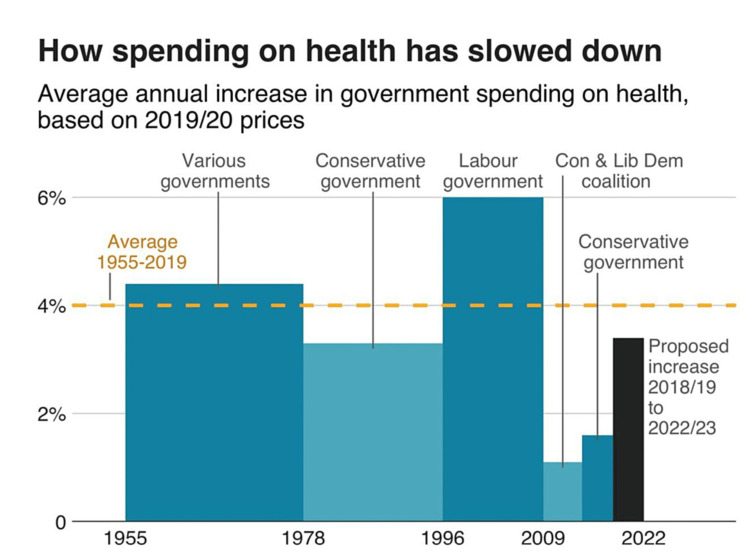
The National Health Services (NHS) is a British national treasure and has been highly valued by the British public since its establishment in 1948. Like other healthcare organizations worldwide, the NHS has faced challenges over the last few decades and has survived most of these challenges. The main challenges faced by NHS historically have been staffing retention, bureaucracy, lack of digital technology, and obstacles to sharing data for patient healthcare. These have changed significantly as the major challenges faced by NHS currently are the aging population, the need for digitalization of services, lack of resources or funding, increasing number of patients with complicated health needs, staff retention, and primary healthcare issues, issues with staff morale, communication break down, backlog in-clinic appointments and procedures worsened by COVID 19 pandemic. A key concept of NHS is equal and free healthcare at the point of need to everyone and anyone who needs it during an emergency. The NHS has looked after its patients with long-term illnesses better than most other healthcare organizations worldwide and has a very diversified workforce. COVID-19 also allowed NHS to adopt newer technology, resulting in adapting telecommunication and remote clinic. On the other hand, COVID-19 has pushed the NHS into a serious staffing crisis, backlog, and delay in patient care. This has been made worse by serious underfunding the coronavirus disease-19coronavirus disease-19 over the past decade or more. This is made worse by the current inflation and stagnation of salaries resulting in the migration of a lot of junior and senior staff overseas, and all this has badly hammered staff morale. The NHS has survived various challenges in the past; however, it remains to be seen if it can overcome the current challenges.
国民医疗服务体系(NHS)是英国的一项国宝,自1948年成立以来一直深受英国民众的高度重视。与全球其他医疗保健组织一样,NHS在过去几十年中面临着诸多挑战,并且挺过了其中的大部分挑战。NHS历史上面临的主要挑战包括人员留用、官僚作风、缺乏数字技术以及在患者医疗保健方面的数据共享障碍。这些情况已经发生了显著变化,因为NHS目前面临的主要挑战是人口老龄化、服务数字化的需求、资源或资金短缺、有复杂健康需求的患者数量增加、人员留用、初级医疗保健问题、员工士气问题、沟通中断、门诊预约和手术积压因新冠疫情而恶化。NHS的一个关键理念是在紧急情况下为每个有需要的人提供平等且免费的医疗服务。NHS在照顾患有长期疾病的患者方面比全球大多数其他医疗保健组织做得更好,并且拥有非常多样化的员工队伍。新冠疫情也促使NHS采用更新的技术,从而实现了电信和远程诊所的应用。另一方面,新冠疫情使NHS陷入了严重的人员配备危机、积压和患者护理延误。在过去十年或更长时间里,对新冠疫情的资金严重不足使情况变得更糟。当前的通货膨胀和工资停滞导致大量初级和高级员工移民到海外,这一切都严重打击了员工士气。NHS过去曾挺过各种挑战;然而,它能否克服当前的挑战仍有待观察。