Kilpatrick Lisa A, Alger Jeffry R, O'Neill Joseph, Joshi Shantanu H, Narr Katherine L, Levitt Jennifer G, O'Connor Mary J
G. Oppenheimer Family Center for Neurobiology of Stress and Resilience, Vatche and Tamar Manoukian Division of Digestive Diseases, David Geffen School of Medicine at University of California, Los Angeles, CA, USA.
Department of Neurology, University of California, Los Angeles, CA, USA.
Neuroimage Rep. 2022 Mar;2(1). doi: 10.1016/j.ynirp.2022.100082. Epub 2022 Jan 18.
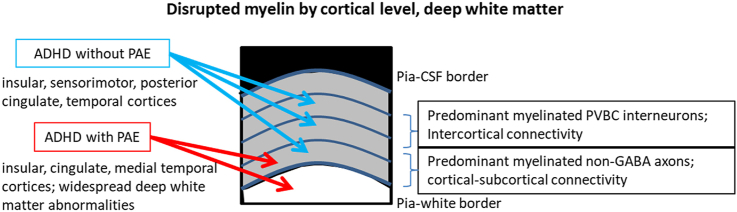
White matter alterations have been reported in children with prenatal alcohol exposure (PAE) and in children with attention deficit hyperactivity disorder (ADHD); however, as children with PAE often present with ADHD, covert PAE may have contributed to previous ADHD findings. Additionally, data regarding intracortical myelination in ADHD are lacking. Therefore, we evaluated intracortical myelination (assessed as the T1w/T2w ratio at 4 cortical ribbon levels) and myelin-related deep white matter features in children (aged 8-13 years) with ADHD with PAE (ADHD + PAE), children with familial ADHD without PAE (ADHD-PAE), and typically developing (TD) children. In widespread tracts, ADHD + PAE children showed higher mean and radial diffusivity than TD and ADHD-PAE children and lower fractional anisotropy than ADHD-PAE children; ADHD-PAE and TD children did not differ significantly. Compared to TD children, ADHD + PAE children had lower intracortical myelination only at the deepest cortical level (mainly in right insula and cingulate cortices), while ADHD-PAE children had lower intracortical myelination at multiple cortical levels (mainly in right insula, sensorimotor, and cingulate cortices); ADHD + PAE and ADHD-PAE children did not differ significantly in intracortical myelination. Considering the two ADHD groups jointly (via non-parametric combination) revealed common reductions in intracortical myelination, but no common deep white matter abnormalities. These results suggest the importance of considering PAE in ADHD studies of white matter pathology. ADHD + PAE may be associated with deeper, white matter abnormalities, while familial ADHD without PAE may be associated with more superficial, cortical abnormalities. This may be relevant to the different treatment response observed in these two ADHD etiologies.
已有报道称,产前酒精暴露(PAE)儿童和注意力缺陷多动障碍(ADHD)儿童存在白质改变;然而,由于PAE儿童常伴有ADHD,隐匿性PAE可能是先前ADHD研究结果的原因之一。此外,关于ADHD患者皮质内髓鞘形成的数据尚缺。因此,我们评估了患有PAE的ADHD儿童(ADHD + PAE)、无PAE的家族性ADHD儿童(ADHD - PAE)和正常发育(TD)儿童(8至13岁)的皮质内髓鞘形成(以4个皮质带水平的T1w/T2w比值评估)以及与髓鞘相关的深部白质特征。在广泛的脑区,ADHD + PAE儿童的平均扩散率和径向扩散率高于TD儿童和ADHD - PAE儿童,而分数各向异性低于ADHD - PAE儿童;ADHD - PAE儿童和TD儿童之间无显著差异。与TD儿童相比,ADHD + PAE儿童仅在最深的皮质水平(主要在右侧岛叶和扣带回皮质)皮质内髓鞘形成较低,而ADHD - PAE儿童在多个皮质水平(主要在右侧岛叶、感觉运动和扣带回皮质)皮质内髓鞘形成较低;ADHD + PAE儿童和ADHD - PAE儿童在皮质内髓鞘形成方面无显著差异。联合考虑两个ADHD组(通过非参数组合)显示皮质内髓鞘形成普遍减少,但深部白质无共同异常。这些结果表明在ADHD白质病理学研究中考虑PAE的重要性。ADHD + PAE可能与更深部的白质异常有关,而无PAE的家族性ADHD可能与更浅表的皮质异常有关。这可能与这两种ADHD病因中观察到的不同治疗反应相关。