Oregon Health and Science University, SW Sam Jackson Park Road, Portland, OR 97239, USA.
J Am Acad Child Adolesc Psychiatry. 2011 Mar;50(3):283-92. doi: 10.1016/j.jaac.2010.12.003. Epub 2011 Jan 20.
Identification of biomarkers is a priority for attention-deficit/hyperactivity disorder (ADHD). Studies have documented macrostructural brain alterations in ADHD, but few have examined white matter microstructure, particularly in preadolescent children. Given dramatic white matter maturation across childhood, microstructural differences seen in adolescents and adults with ADHD may reflect compensatory restructuring, rather than early neurophenotypic markers of the disorder.
Using tract-based spatial statistics, mean fractional anisotropy (FA) maps were created using diffusion tensor imaging. FA, mean diffusivity (MD), and associated axial and radial diffusivities were compared between 16 children with ADHD and 20 healthy children (age 7-9 years).
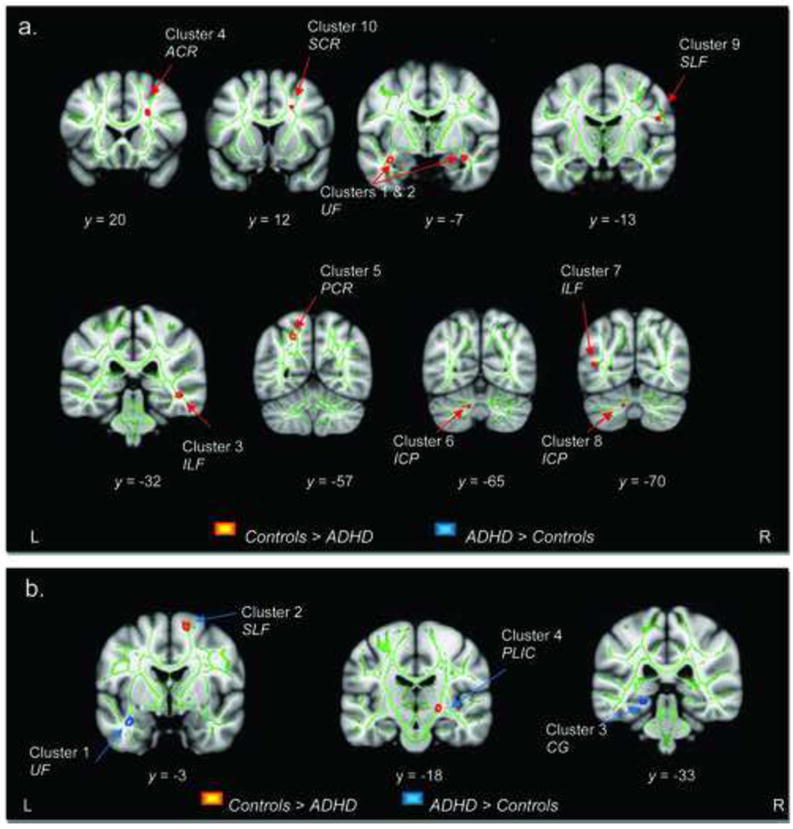
Youth with ADHD showed decreased FA in frontoparietal, frontolimbic, cerebellar, corona radiata, and temporo-occipital white matter compared with controls. In addition, ADHD was associated with lower MD in the posterior limb of the internal capsule and frontoparietal white matter and greater MD in frontolimbic white matter. Lower axial diffusion and/or higher radial diffusion were differentially observed for youth with ADHD in earlier versus later maturing areas of group FA/MD difference.
This study suggests that, even prior to adolescence, ADHD represents a disorder of altered structural connectivity of the brain, characterized by distributed atypical white matter microstructure. In addition, later maturing frontolimbic pathways were abnormal in children with ADHD, likely due to delayed or decreased myelination, a finding not previously demonstrated in the adolescent or adult stages of the disorder. These results suggest that disruptions in white matter microstructure may play a key role in the early pathophysiology of ADHD.
识别生物标志物是注意力缺陷/多动障碍(ADHD)的首要关注点。研究已经记录了 ADHD 患者大脑的宏观结构改变,但很少有研究检查白质微观结构,尤其是在青春期前的儿童中。鉴于儿童期大脑的白质成熟程度显著,ADHD 青少年和成年人中看到的微观结构差异可能反映了代偿性重构,而不是该疾病的早期神经表型标志物。
使用基于束的空间统计学,使用弥散张量成像创建平均分数各向异性(FA)图。比较了 16 名 ADHD 儿童和 20 名健康儿童(7-9 岁)之间的 FA、平均扩散系数(MD)以及相关的轴向和径向扩散系数。
与对照组相比,ADHD 患儿在前顶叶、额眶部、小脑、放射冠和颞枕叶白质中 FA 降低。此外,ADHD 与内囊后肢和额顶叶白质 MD 降低以及额眶部白质 MD 升高有关。与对照组相比,ADHD 患儿在更早成熟的 FA/MD 差异区域中,轴向扩散较低和/或径向扩散较高。
这项研究表明,即使在青春期之前,ADHD 也是一种大脑结构连接改变的疾病,其特征是分布广泛的白质微观结构异常。此外,ADHD 患儿的后额眶部通路异常,可能是由于髓鞘化延迟或减少所致,这一发现以前在该疾病的青少年或成年阶段没有得到证明。这些结果表明,白质微观结构的破坏可能在 ADHD 的早期病理生理学中起关键作用。