
奥罗米亚不同地区低地面包小麦品种灌溉的基因型×环境互作
Genotype × environment interaction of lowland bread wheat varieties for irrigation in different areas of Oromia.
作者信息
Bayissa Tilahun, Mengistu Girma, Gerema Geleta, Balcha Urgaya, Feyisa Hailu, Kedir Aliyi, Legese Zeleke, Asegid Desu, Leta Tesfaye, Jobe Tafa
机构信息
Sinana Agricultural Research Center Bale Robe Ethiopia.
Oromia Agricultural Research Institute Addis Ababa Ethiopia.
出版信息
Plant Environ Interact. 2023 Jan 2;4(1):2-10. doi: 10.1002/pei3.10097. eCollection 2023 Feb.
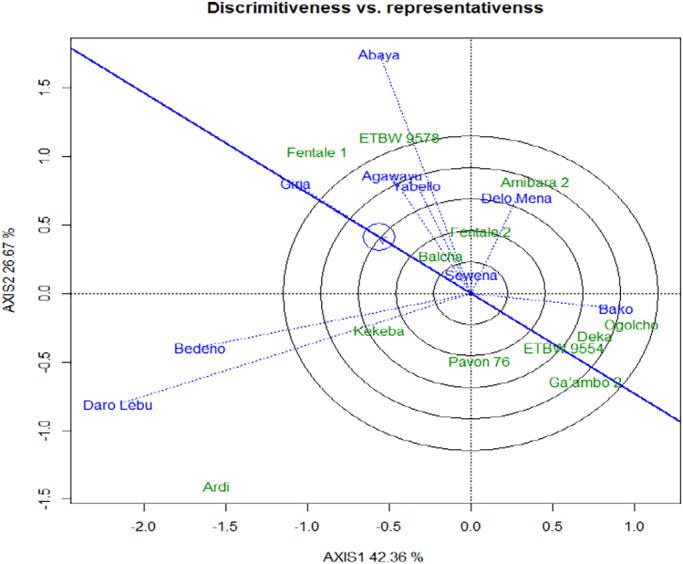
Ethiopia is the leading wheat producer in Sub-Saharan Africa, and the productivity has increased in the last few years. There is also a potential for irrigated wheat production in the lowlands, even though its cultivation is at infant stage. The experiment was conducted in the Oromia region at nine locations in 2021 with irrigation. The study aimed to select high yielding and stable bread wheat variety/ies for lowland areas. Twelve released bread wheat varieties were tested using randomized complete block design with two replications. Environment had the largest effect, 76.5% of total variability, while genotypes 5.0% and GE interaction 18.5% explained total sum of squares. The average grain yield of varieties across locations ranged from the lowest 1.40 t ha at Girja to the highest 6.55 t ha at Daro Labu, with a grand mean of 3.14 t ha. The result showed that varieties released for irrigated areas, Fentale 1, Ardi, and Fentale 2, were ranked the top three based on overall environment mean grain yield. The first and second principal component account 45.5% and 24.7% of the genotype by environment interaction (G × E), respectively, explained 70.2% of the total variation. Daro Lebu and Bedeno were the most productive environment, while Girja was the least productive of irrigated bread wheat for lowlands of the Oromia region. Genotype Selection Index (GSI) showed that varieties Fentale 2, Fentale 1, Pavon 76, and ETBW9578 are stable and high yielding. Based on AMMI and GGE biplot analysis, Girja indicated the most discriminating area and Sewena as representative environment for selecting wide adaptable irrigated lowland varieties. The results of the present study indicated that Fentale 2 and Fentale 1 showed better yield stability across all test environments, therefore, these bread wheat varieties are recommended for wide cultivation in irrigated areas of the Oromia region.
埃塞俄比亚是撒哈拉以南非洲地区主要的小麦生产国,且在过去几年中产量有所增加。尽管低地地区的灌溉小麦种植尚处于起步阶段,但仍具有生产潜力。该试验于2021年在奥罗米亚地区的9个地点进行,采用了灌溉措施。该研究旨在为低地地区选育高产且稳定的面包小麦品种。使用随机完全区组设计对12个已发布的面包小麦品种进行了测试,重复两次。环境的影响最大,占总变异的76.5%,而基因型占5.0%,基因型与环境的互作占18.5%,解释了总平方和。各地点品种的平均籽粒产量范围从吉尔贾的最低1.40吨/公顷到达罗拉布的最高6.55吨/公顷,总体均值为3.14吨/公顷。结果表明,针对灌溉地区发布的品种芬塔莱1号、阿尔迪和芬塔莱2号,基于总体环境平均籽粒产量位列前三。第一和第二主成分分别占基因型与环境互作(G×E)的45.5%和24.7%,解释了总变异的70.2%。达罗勒布和贝德诺是最具生产力的环境,而吉尔贾是奥罗米亚地区低地灌溉面包小麦生产力最低的环境。基因型选择指数(GSI)表明,芬塔莱2号、芬塔莱1号、帕冯76和ETBW9578品种高产且稳定。基于AMMI和GGE双标图分析,吉尔贾是最具区分性的区域,塞韦纳是选择广泛适应的灌溉低地品种的代表性环境。本研究结果表明,芬塔莱2号和芬塔莱1号在所有测试环境中均表现出更好的产量稳定性,因此,推荐这些面包小麦品种在奥罗米亚地区的灌溉区域广泛种植。


 Zotero 插件